
One of the first questions almost every Australian homeowner asks before committing to a solar installation is a straightforward one: how long will it take to get my money back? It is a completely reasonable question. Solar panels are a significant upfront investment, and understanding exactly when that investment transitions from a cost to a source of pure savings is fundamental to making a confident, informed decision.
The good news for Australians in 2026 is that solar panel payback periods have never been shorter. A combination of falling system prices, rising electricity tariffs, generous government rebates, and improving panel efficiency has compressed what used to be a 7 to 10 year break-even point into something far more attractive. For many Sydney and NSW households, a well-designed solar system now pays for itself within three to five years and then continues generating free electricity for another twenty years beyond that point.
At Isolux Solar, we have been helping homeowners across Sydney and NSW understand the real financial case for solar since 2013. In this comprehensive guide, we walk through everything you need to know about the solar panel payback period in Australia in 2026, including how to calculate it accurately for your own home, what factors speed it up or slow it down, and real worked examples using current installed prices and electricity rates.
What Is a Solar Panel Payback Period?
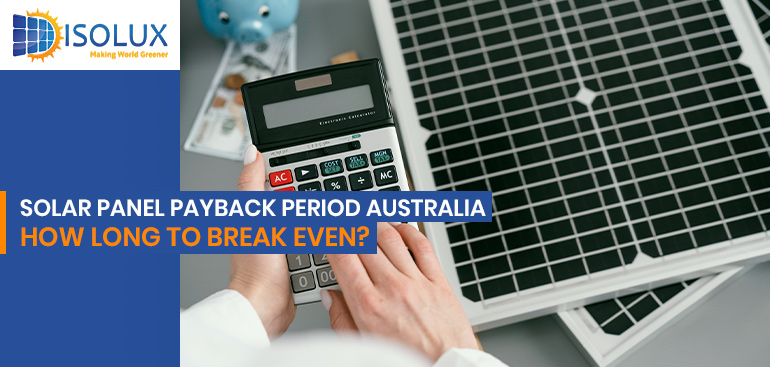
The solar panel payback period is the length of time it takes for the total financial savings generated by your solar system to equal the upfront cost you paid to have it installed. Once the payback period is reached, every dollar of savings your system generates from that point forward is pure financial gain – essentially free electricity for the remaining life of the system.
To put it in everyday terms, imagine you install a 6.6 kW solar system for a net cost of $5,500 after the federal STC rebate. If that system saves you $1,800 per year on your electricity bill, you will reach your payback point in approximately three years and one month. For the remaining twenty-two or more years of the system’s operational life, you continue saving $1,800 or more per year – effectively earning back your investment many times over.
The payback period is distinct from the return on investment (ROI), though the two concepts are closely related. ROI expresses the total financial gain from the investment as a percentage of the original cost over a defined time period. Payback period simply identifies the break-even point. Both metrics matter, but for most Australian households weighing the decision to go solar, the payback period is the more intuitive and immediately useful number.
It is also important to understand that the payback period calculation does not include the ongoing maintenance costs of your system, which are minimal for a well-installed solar PV system but are not zero. A biennial system service costs approximately $150 to $300, and occasional cleaning costs a similar amount annually if you use a professional service. These costs are small relative to your annual savings but should be factored into a thorough financial analysis.
What Is the Average Solar Panel Payback Period in Australia in 2026?
Based on current installed system prices, electricity tariff rates, and available government rebates, the average solar panel payback period for Australian households in 2026 sits between three and six years for most residential installations. This range reflects the variation across system sizes, states, household energy usage profiles, and self-consumption rates.
To provide a clear benchmark: a standard 6.6 kW solar system in Sydney installed at a price of $5,500 to $8,000 after the federal STC rebate, generating annual savings of $1,500 to $2,000 for a household with moderate daytime consumption, achieves payback in approximately three to five years. A larger 10 kW system, with a higher upfront cost but proportionally greater savings for a high-consumption household, often achieves a similar or even shorter payback period because the savings scale efficiently with usage.
Commercial solar systems in Australia typically achieve payback even faster, with most well-designed commercial installations breaking even within two to four years. This is because businesses generally consume large volumes of electricity during daytime hours when solar is generating, making self-consumption rates significantly higher than residential systems.
In all scenarios, the payback period needs to be understood in the context of what comes after it. Australian solar panels are typically warrantied for 25 years of performance output. Systems installed today will still be generating electricity in 2051. Even a system with a six-year payback period will deliver approximately nineteen years of ongoing savings after the break-even point, making it one of the most compelling financial investments available to Australian homeowners regardless of the specific payback timeline.
How to Calculate Your Solar Panel Payback Period: Step-by-Step
Calculating your solar panel payback period accurately requires three pieces of information: what you paid for the system, how much it saves you each year, and simple arithmetic to divide the two. The challenge lies in calculating the annual savings figure accurately, which involves understanding how your solar system interacts with your electricity bill.
Step 1 – Find Your System Cost After Rebates
Your payback period calculation should always use the net system cost after all applicable rebates have been deducted, since these rebates reduce the actual money you need to recover through savings.
For a residential solar installation in 2026, the primary rebate is the federal Small-scale Technology Certificate (STC) scheme, which is applied as an upfront discount on your installation quote. Isolux Solar processes your STC paperwork as part of every installation – the rebate appears as a line-item reduction on your invoice rather than a separate claim you need to make after installation.
As a guide, the STC rebate in 2026 is worth approximately $3,000 to $4,000 on a 6.6 kW system, depending on your location and current STC market prices. This means a system quoted at $8,500 to $9,000 before rebates may cost you $5,500 to $6,000 after the STC discount is applied.
If you are in a state with additional rebates – such as Victoria’s Solar Panel Rebate of up to $1,400 for eligible households, or state-based battery incentives in NSW – these should also be deducted from your upfront cost before calculating the payback period.
Step 2 – Calculate Your Annual Solar Savings
Annual solar savings come from two sources. The first and more valuable source is self-consumed solar energy, which is the solar electricity you use directly in your home instead of buying from the grid. Every kilowatt-hour of self-consumed solar electricity saves you the full grid electricity rate – currently averaging 35 to 40 cents per kWh in NSW. The second source is the feed-in tariff credit you receive for any excess solar energy your system generates and exports to the grid. Feed-in tariff rates in NSW currently range from 5 to 9 cents per kWh depending on your electricity retailer.
The proportion of your solar generation that you self-consume versus export is called your self-consumption rate, and it is the single most important variable in determining how valuable your solar system is to you. A household that is home during the day and runs appliances such as washing machines, dishwashers, and pool pumps during solar generation hours might self-consume 60% to 70% of their solar output. A household where all occupants are away at work during the day might only self-consume 30% to 40% of their generation, with the remainder exported at the much lower feed-in rate.
To calculate your annual savings:
First, estimate your system’s annual energy generation. A 6.6 kW system in Sydney produces approximately 9,500 to 10,500 kWh per year based on Sydney’s average solar irradiance of 3.9 kWh per day per kW of installed capacity (Clean Energy Council data).
Second, apply your self-consumption rate. If you self-consume 40% of 10,000 kWh, you self-consume 4,000 kWh. At 38 cents per kWh saved, this represents $1,520 in avoided grid electricity costs.
Third, calculate your feed-in tariff earnings. The remaining 60% (6,000 kWh) is exported at, say, 7 cents per kWh, earning you $420 in feed-in credits.
Your total annual savings are therefore $1,520 plus $420, giving $1,940 per year.
Step 3 – Divide Cost by Annual Savings
The payback period formula is straightforward:
Payback Period (years) = Net System Cost divided by Annual Savings
Using the figures from Step 1 and Step 2: $6,000 divided by $1,940 gives a payback period of approximately 3.1 years. This is the break-even point at which your cumulative savings have recovered your full investment.
Worked Example: 6.6kW System in Sydney
To make this entirely concrete, here is a complete worked example using a real Isolux Solar customer scenario from western Sydney in 2026.
The household is a four-bedroom family home in Parramatta with a quarterly electricity bill of $550. They work from home two days per week and the remaining household members are home after school hours. Their self-consumption rate is estimated at 45%.
A 6.6 kW solar system using Tier 1 Jinko panels and a Sungrow inverter is installed for a quoted price of $8,200. After the federal STC rebate of $3,400, the net cost to the household is $4,800.
The system generates approximately 10,200 kWh per year in Parramatta. At 45% self-consumption, the household uses 4,590 kWh of free solar energy instead of buying it from the grid at 38 cents per kWh, saving $1,744. The remaining 5,610 kWh is exported at 7 cents per kWh, earning $393 in feed-in credits. Total annual saving is $2,137.
Payback period: $4,800 divided by $2,137 equals 2.25 years – approximately 27 months.
This household will have fully recovered their investment in just over two years, after which they continue saving over $2,100 per year for the remaining twenty-three-plus years of the system’s operational life.
Solar Panel Payback Period by System Size in Australia
System size has a direct relationship with both the upfront cost and the annual savings of your solar installation. Understanding how payback periods compare across different system sizes helps you identify which system is the right match for your household’s energy consumption and financial goals.
5kW Solar System Payback Period
A 5 kW solar system is well-suited to smaller households with quarterly electricity bills of $150 to $250. In Sydney, a fully installed 5 kW system costs approximately $4,500 to $6,500 after the STC rebate. It generates approximately 7,000 kWh per year and delivers estimated annual savings of $1,000 to $1,400 depending on the self-consumption rate.
Payback period: approximately 3.5 to 5 years for most Sydney households. This system size suits two-person households, retirees at home during the day with a moderate appliance load, and rental properties where the landlord installs solar to improve property attractiveness.
6.6kW Solar System Payback Period
The 6.6 kW system is the most popular residential solar system size in Australia, and for good reason. It represents the optimal balance between system capacity, available roof space, and inverter sizing rules that allow a 5 kW inverter to be paired with up to 6.6 kW of panels under the Clean Energy Council’s oversizing guidelines.
In Sydney, a fully installed 6.6 kW system costs approximately $5,500 to $8,000 after the STC rebate. It generates approximately 9,500 to 10,500 kWh per year and delivers annual savings of $1,200 to $2,000 depending on self-consumption rate and electricity usage patterns.
Payback period: approximately 3 to 5 years for the average Sydney household with moderate daytime usage. For households with a higher self-consumption rate – those at home during the day, running a pool, or using air conditioning heavily – the payback can compress to as little as 2.5 years.
For a detailed breakdown of everything included in a 6.6 kW system, read our How Much Money Do You Save with Solar Panels in NSW? guide.
10kW Solar System Payback Period
The 10 kW solar system is the right choice for larger families, households with an electric vehicle, or homes running ducted air conditioning heavily throughout summer and winter. In Sydney, a fully installed 10 kW system costs approximately $8,500 to $12,000 after the STC rebate. It generates approximately 14,900 to 15,300 kWh per year and delivers annual savings of $2,000 to $3,000 for a household that consumes proportionally more energy during daylight hours.
Payback period: approximately 3 to 5 years for high-consumption households. The larger system size means the upfront cost is higher, but the savings scale up efficiently because there is more solar generation available to displace expensive grid electricity. For households whose quarterly bills exceed $450, a 10 kW system often delivers a faster payback than a smaller system would, precisely because the additional generation capacity is matched to their above-average daytime consumption.
For more details on the 10 kW system, read our comprehensive 10kW Solar System Guide.
13.2kW Solar System Payback Period
The 13.2 kW system is designed for large homes with quarterly electricity bills above $600, EV owners who charge at home, or properties with above-average energy demands. The installed cost in Sydney ranges from approximately $11,000 to $16,000 after the STC rebate. Annual generation of 18,900 to 19,300 kWh delivers estimated annual savings of $3,000 or more for households that consume heavily during daylight hours.
Payback period: approximately 3.5 to 5 years for households with consumption patterns that can make effective use of the larger generation capacity. The payback calculation for a large system is most sensitive to the self-consumption rate. A household that exports the majority of a 13.2 kW system’s generation at low feed-in tariff rates will have a meaningfully longer payback period than one that self-consumes 60% or more.
For a detailed 15 kW system analysis relevant to this discussion, see our 15kW Solar System Sydney Guide.
Solar Panel Payback Period by State in Australia
Australia’s solar payback period varies meaningfully by state due to differences in electricity tariff rates, solar irradiance, available rebates, and local installation costs. Understanding the payback landscape in your specific state provides a more accurate picture than national averages alone.
Solar Payback Period in NSW and Sydney
NSW households benefit from some of Australia’s highest electricity tariffs, which directly accelerate solar payback. With grid electricity averaging 35 to 40 cents per kWh in 2026, every kilowatt-hour of solar energy self-consumed delivers substantial savings. Sydney’s solar irradiance of 3.9 peak sun hours per day per kW installed is strong, though slightly below Queensland’s figures.
The average payback period for a 6.6 kW system in Sydney is 3 to 5 years, with households in western Sydney – where electricity consumption is typically higher due to larger homes and more air conditioning usage – often achieving payback at the shorter end of that range.
Solar Payback Period in Victoria and Melbourne
Victoria presents a mixed payback picture. Melbourne receives slightly less solar irradiance than Sydney or Brisbane, averaging approximately 3.6 peak sun hours per day. However, Victorian electricity tariffs are similarly high, and Victoria’s Solar Panel Rebate of up to $1,400 for eligible households significantly reduces the effective upfront cost.
The average payback period for a 6.6 kW system in Melbourne is 3.5 to 5.5 years, with households in regional Victoria and country areas often achieving faster payback due to more consistent sunshine and higher consumption from larger properties.
Solar Payback Period in Queensland and Brisbane
Queensland is arguably Australia’s most solar-friendly state from a payback perspective. Brisbane averages approximately 4.2 to 4.5 peak sun hours per day, generating more electricity per kilowatt of installed capacity than any other capital city. Additionally, electricity prices in Southeast Queensland have risen substantially in recent years.
The average payback period for a 6.6 kW system in Brisbane is 2.5 to 4 years, with north Queensland households in Cairns, Townsville, and Mackay often achieving payback in as little as two to three years due to exceptional solar irradiance and high air conditioning loads that create strong daytime self-consumption.
Solar Payback Period in Western Australia and Perth
Western Australia presents a unique payback environment. Perth receives excellent solar irradiance of approximately 4.4 to 4.8 peak sun hours per day, among the highest of any capital city. However, Synergy’s electricity tariffs are lower than those in eastern states, which slightly offsets the advantage of high solar generation.
The average payback period for a 6.6 kW system in Perth is 3 to 5 years. The WA government has historically offered interest-free loans for solar installations, and the federal STC rebate applies equally in WA, both reducing the effective upfront cost.
Solar Payback Period in South Australia and Adelaide
South Australia has had Australia’s highest electricity tariffs for many years, and Adelaide receives strong solar irradiance of approximately 4.2 to 4.5 peak sun hours per day. This combination of high tariffs and good sunshine creates one of Australia’s most compelling solar payback environments.
The average payback period for a 6.6 kW system in Adelaide is 2.5 to 4 years, and South Australia’s high solar self-sufficiency ambitions have been supported by generous battery incentives that, when combined with a solar system, can further improve the overall return on investment.
Key Factors That Affect How Quickly Solar Pays for Itself
The payback period calculations above use average assumptions, but your actual payback period will be shaped by a set of specific factors unique to your household and property. Understanding these factors allows you to make decisions that actively shorten your payback period rather than simply accepting the average outcome.
Electricity Tariff Rate
Your electricity tariff is the most powerful lever in the payback calculation. Every cent per kilowatt-hour increase in grid electricity prices makes your self-consumed solar electricity proportionally more valuable. A household paying 40 cents per kWh saves significantly more from the same amount of self-consumed solar than a household paying 30 cents per kWh.
This is why it pays to review your electricity plan before and after going solar. Many electricity retailers offer solar-optimised plans that provide a reasonable feed-in tariff in exchange for a flat or slightly higher usage rate, which can work well for high self-consumption households. Others offer time-of-use tariffs with very high peak rates, which solar paired with battery storage can be particularly effective at avoiding.
Solar Self-Consumption Rate
As established in the calculation section, your self-consumption rate is the proportion of your solar generation that you use directly in your home rather than exporting. Since self-consumed solar is worth the full grid tariff (38 cents per kWh) while exported solar earns only the feed-in tariff (5 to 9 cents per kWh), maximising self-consumption is the single most effective strategy for shortening your payback period.
Households that shift high-consumption activities – washing machines, dishwashers, pool pumps, EV charging – to solar generation hours typically achieve self-consumption rates of 50% to 70% compared to 30% to 40% for households that run all appliances in the evening. This difference alone can shorten the payback period by one to two years on the same system.
Feed-in Tariff Rate
While feed-in tariffs are considerably lower than grid tariffs in 2026, they still contribute meaningfully to your annual savings, particularly for larger systems that export significant volumes of electricity. Feed-in tariff rates in NSW currently range from 5 to 9 cents per kWh, depending on your retailer, and choosing the right retailer can make a noticeable difference to your annual earnings.
It is worth shopping around for feed-in tariff rates at the time of installation and reviewing them annually, as retailers regularly adjust their offers. The Isolux Solar team can advise on which retailers are offering the strongest solar feed-in arrangements in NSW at the time of your installation.
System Quality and Panel Efficiency
Not all solar systems perform equally over their lifetime. A system installed with Tier 1 panels from manufacturers with proven degradation rates will generate more electricity meaningfully over 25 years than a system installed with lower-quality panels that degrade faster. Panel degradation refers to the gradual reduction in electricity output that occurs in all solar panels over time. Premium Tier 1 manufacturers typically guarantee no more than 0.5% per year degradation, meaning their panels generate at least 87.5% of their original output after 25 years. Lower-quality panels may degrade at 0.7% to 1% per year, producing only 75% to 80% of their original output after 25 years.
This difference in long-term output directly affects the payback period calculation. A system that degrades slowly maintains higher annual savings throughout its life, effectively shortening the payback period and extending the period of full savings production after break-even.
Isolux Solar installs only Tier 1 certified solar panels from brands including Jinko, Trina, REC, Tindo, and SunPower, all of which carry strong degradation warranties that protect your long-term generation and savings assumptions.
Roof Orientation and Shading
A north-facing roof in Australia receives the most solar radiation throughout the year and produces the highest annual generation from a given system size. East and west-facing roofs produce approximately 15% to 20% less annual generation than a north-facing equivalent, which extends the payback period modestly. South-facing roofs produce significantly less and are generally not recommended for the primary array unless no other orientation is available.
Shading is an equally significant factor. Even partial shading from a nearby tree, chimney, or neighbouring structure can cause disproportionate output losses due to the series-wiring characteristics of standard string inverter setups. If your roof has shading challenges, power optimisers or microinverters can mitigate these losses and prevent shading from extending your payback period unnecessarily.
Household Energy Usage Patterns
The timing of your household’s electricity consumption relative to solar generation hours is arguably the most controllable factor affecting your payback period. Two households with identical systems, identical total daily energy consumption, and identical electricity tariffs can have very different payback periods if one household consumes primarily during daylight hours and the other consumes primarily in the evenings.
Consider a household that uses 20 kWh of electricity per day. If 12 kWh of that consumption occurs between 9 am and 4 pm when solar is generating strongly, the self-consumption rate is high and the payback period is short. If the same household runs most appliances after 6 pm, only 4 to 6 kWh might be self-consumed from solar during the day, and the payback period stretches significantly.
How Government Rebates Shorten Your Solar Payback Period
Government rebates are a direct reduction in the upfront cost of your solar system, which mechanically shortens the payback period by reducing the numerator in the payback calculation. In 2026, Australian homeowners have access to both federal and state-level incentives that can collectively reduce system cost by 30% to 50% compared to the unsubsidised price.
Federal STC Rebate
The federal government’s Small-scale Technology Certificate scheme is the primary solar rebate available to all Australian households and businesses. In 2026, the STC deeming period is five years, and the rebate is worth approximately $3,000 to $4,500 on a 6.6 kW system depending on your location and current STC spot prices. The rebate is applied as an instant upfront discount on your installation invoice – there is no paperwork to complete after installation and no delay in receiving the benefit.
Isolux Solar processes all STC paperwork on behalf of every customer as part of our standard installation service. The rebate value is clearly shown on your quote as a deduction from the gross system price.
One important timing consideration: the STC deeming period reduces by one year every 1 January, which means the rebate value decreases slightly each year. Installing earlier in the year, before the January reduction, locks in a slightly higher rebate value. This is a genuine but modest consideration – the difference is not enormous, but it is real and worth being aware of.
State-Based Rebates and VPP Incentives
Beyond the federal STC rebate, several Australian states offer supplementary incentives that further reduce the effective upfront cost of a solar installation.
In NSW, the primary additional incentive is the Virtual Power Plant participation scheme under the Peak Demand Reduction Scheme, which provides up to $1,500 for households that connect a battery to a VPP network. While this is primarily a battery incentive, it contributes to the overall payback calculation for a solar-plus-battery system.
Victoria’s Solar Homes Program offers a rebate of up to $1,400 on solar panel installations for eligible households, plus an interest-free loan of up to $1,400. This effectively provides up to $2,800 in financial assistance on top of the federal STC rebate for eligible Victorian homeowners, compressing the payback period significantly.
South Australia’s historical battery incentives, Queensland’s emerging battery programs, and WA’s interest-free loan scheme all contribute to state-specific payback improvements that can push payback periods well below the national average in the right circumstances.
Does Adding a Battery Affect the Solar Payback Period?
This is one of the most important questions for anyone considering a solar-plus-battery system rather than solar panels alone, and it deserves an honest, nuanced answer.
Adding a home battery to your solar installation increases the upfront system cost, which by itself lengthens the payback period. However, a battery also increases your self-consumption rate by allowing you to store excess solar energy generated during the day and use it in the evening rather than exporting it at the low feed-in tariff rate. This increased self-consumption improves the value of every unit of solar energy your system generates.
For a household that currently exports 60% of its solar generation at 7 cents per kWh, adding a battery that captures 40% of that export and redirects it to evening consumption at 38 cents per kWh creates a per-kWh value improvement of 31 cents. Across thousands of kilowatt-hours per year, this is meaningful.
The net effect on the payback period depends on the battery cost and the additional savings it generates. In 2026, with the federal Cheaper Home Batteries Program providing a 30% rebate on eligible battery installations, the payback period for a solar-plus-battery system is typically five to eight years – longer than solar alone, but still well within the system’s operational lifetime and improving as battery prices continue to fall.
The most financially compelling scenario for battery storage in 2026 is households on time-of-use electricity tariffs with high peak rates, where a battery charged from cheap off-peak grid power or solar can avoid very expensive peak consumption periods. For these households, the additional battery payback period can be as short as four to six years.
Residential vs Commercial Solar Payback Period in Australia
Commercial solar installations in Australia consistently achieve faster payback periods than residential systems, typically breaking even in two to four years. Understanding why this is the case helps residential homeowners appreciate the opportunity they have – and the strategies they can borrow from the commercial sector to shorten their own payback period.
The primary reason commercial solar pays back faster is daytime energy consumption. A typical business operates Monday to Friday between approximately 8 am and 6 pm – precisely the hours when solar panels are generating. A retail shop, office building, warehouse, or childcare centre running air conditioning, lighting, refrigeration, and equipment during business hours naturally self-consumes a very high proportion of the solar energy generated by its rooftop system. Self-consumption rates of 70% to 90% are not unusual for commercial installations, compared to 30% to 50% for a typical household where occupants are at work during solar generation hours.
Additionally, commercial electricity tariffs in Australia are often higher than residential tariffs on a per-unit basis, meaning each kilowatt-hour of self-consumed solar is worth more in dollar terms. A business paying 28 to 38 cents per kWh for grid electricity during business hours saves that full amount for every kilowatt-hour its solar system generates and displaces.
A typical 30 kW commercial solar system in Sydney, generating approximately 43,000 kWh per year, installed for approximately $25,000 after rebates, with a self-consumption rate of 80% and a grid tariff of 32 cents per kWh, would save approximately $11,000 per year in electricity costs. Payback period: approximately 2.3 years.
How to Shorten Your Solar Payback Period: Practical Tips
While some factors affecting your payback period – such as roof orientation and local electricity tariffs – are outside your direct control, several practical steps can meaningfully reduce your break-even timeline.
Shifting high-consumption appliances to solar hours is the most impactful action available to residential households. Set your washing machine, dishwasher, and pool pump to run between 9 am and 3 pm using their built-in timers or smart home integration. If you have an EV, set it to charge during daylight hours rather than overnight. Each appliance shifted to solar hours increases your self-consumption rate and reduces the grid electricity you purchase, directly improving annual savings without any additional system cost.
Choosing the right electricity retailer matters more than many homeowners realise. Feed-in tariff rates vary from 2 cents to 12 cents per kWh, depending on the retailer, and making the right choice at installation can add hundreds of dollars to your annual savings. Equally, some retailers offer time-of-use tariffs with very attractive off-peak rates (sometimes as low as 8 to 12 cents per kWh overnight) while charging peak rates above 50 cents per kWh. For households with battery storage, this tariff structure creates significant arbitrage opportunities.
Sizing your system appropriately to your consumption is critical. Oversizing a system beyond your ability to self-consume its output means you are exporting large quantities of electricity at low feed-in rates rather than displacing expensive grid electricity. The right system size for payback optimisation is one where your annual generation broadly matches your annual consumption, ensuring high self-consumption rates throughout the year.
Regular maintenance, including panel cleaning, also contributes to payback period performance. As discussed in our How to Clean Solar Panels Guide, even moderate soiling can reduce panel output by 5% to 15%, effectively extending your payback period by months simply through reduced generation.
What Happens After the Payback Period Is Reached?
Reaching your solar payback period is not the end of the story – it is the beginning of the most financially rewarding phase of your solar ownership. Once your cumulative savings have equalled your upfront investment, your solar system transitions from a cost you are recovering to a source of purely free electricity.
For a household that achieves payback in four years on a 25-year system, there are 21 years of ongoing savings remaining. If annual savings average $1,800 over that period, the total post-payback savings are $37,800. Even accounting for modest system degradation and potential inverter replacement at year 10 to 15, the net financial benefit over the system’s lifetime is extraordinary compared to almost any other household investment.
It is also worth considering the effect of electricity price rises on post-payback savings. If grid electricity prices continue to rise at even 3% to 5% per year – which is consistent with recent historical trends in Australia – the dollar value of your annual savings grows each year even if your system’s output remains constant. A system saving $1,800 per year today will save proportionally more in 2030, 2035, and beyond as the electricity it displaces becomes increasingly expensive.
At Isolux Solar, we consistently tell our customers that the day their system reaches payback is worth celebrating – but the twenty years of savings that follow are the real financial prize.
Is Solar Worth It Even With a Longer Payback Period?
Some Australian homeowners, particularly those with north-facing roofs in areas with moderate sunshine or lower self-consumption potential, may find their calculated payback period sits at the longer end of the range – five, six, or even seven years. The natural question is whether solar is still worth installing at these payback periods.
The honest answer is yes, in virtually all cases. Here is why.
Even a six-year payback on a 25-year system leaves 19 years of pure savings production. At $1,500 per year in savings, that is $28,500 in post-payback financial benefit. Even after deducting an estimated $3,000 in maintenance costs over the system’s lifetime, the net benefit is approximately $25,500 – on an original investment of, say, $9,000. That represents a return on investment of approximately 280% over the system’s lifetime, or roughly 11% annualised. Very few financial products available to retail investors deliver comparable returns with comparable reliability.
Furthermore, the payback period assumptions in the calculation are typically conservative. They use current electricity prices, current feed-in tariff rates, and current self-consumption patterns. In reality, electricity prices have consistently risen over time, feed-in tariff strategies evolve, and many homeowners add battery storage later, which retroactively improves the economics of the original solar investment.
There is also the non-financial dimension. Carbon reduction, energy independence, protection from grid outages, and the satisfaction of generating your own clean electricity are genuine benefits that many Australian homeowners value independently of the financial case.
Frequently Asked Questions About Solar Payback Period Australia
What is the average solar payback period in Australia in 2026?
The average solar panel payback period for Australian households in 2026 is three to six years for most residential installations. The exact period depends on system size, location, electricity tariff, self-consumption rate, and available rebates.
Does the government rebate reduce the payback period?
Yes, significantly. The federal STC rebate reduces the upfront system cost by $3,000 to $4,500 on a typical 6.6 kW system, directly compressing the payback period. State-based rebates in Victoria, NSW, SA, and WA provide additional cost reductions.
What is the payback period for a 6.6kW solar system in Sydney?
For a typical Sydney household, the payback period for a 6.6 kW solar system is approximately three to five years. Households with higher daytime consumption – those at home during the day or running a pool – can achieve payback in as little as 2.5 years.
Does adding a battery storage system extend the payback period?
Yes, adding a battery increases the upfront cost and therefore extends the payback period compared to solar panels alone. However, the federal 30% battery rebate available in 2026 significantly reduces this extension, and a battery’s ability to increase self-consumption and avoid peak tariffs improves annual savings. A solar-plus-battery system typically achieves payback in five to eight years.
How can I shorten my solar payback period?
The most effective strategies are shifting high-consumption appliances to daylight hours to increase self-consumption, choosing the right electricity retailer for the best feed-in tariff, sizing your system appropriately to your consumption profile, and maintaining your panels with regular cleaning to protect output.
Is solar worth it if my payback period is six or seven years?
Absolutely. Even with a six-year payback on a 25-year system, you receive approximately 19 years of pure ongoing savings after the break-even point. The long-term return on investment is typically well above 200% of the original system cost.
How does roof orientation affect my payback period?
North-facing roofs produce the most annual generation in Australia and deliver the fastest payback. East or west-facing roofs produce approximately 15% to 20% less annual energy, modestly extending the payback period. A quality solar installer like Isolux Solar will design your system layout to maximise output from your available roof space, regardless of orientation.
What is the payback period for commercial solar in Australia?
Commercial solar installations typically achieve payback in two to four years due to high daytime self-consumption rates and larger system sizes. A 30 kW commercial system in Sydney can pay itself back in approximately two to three years.
How long do solar panels last after the payback period?
Most Tier 1 solar panels are warranted for 25 years of performance output, meaning they continue generating electricity for at least 19 to 22 years after the typical payback period is reached. Many systems continue operating effectively well beyond their 25-year warranty period.
Does rising electricity prices affect the payback period?
Rising electricity prices improve your payback period by increasing the value of each unit of self-consumed solar energy. If tariffs rise from 38 cents to 42 cents per kWh over a few years, your annual savings increase proportionally without any change to your system.
Conclusion
The solar panel payback period in Australia in 2026 has never been shorter, and the financial case for installing solar has never been clearer. A combination of falling system prices, rising electricity tariffs, strong government rebates, and improving panel technology has brought the average payback period for Sydney and NSW households to approximately three to five years – a fraction of the system’s 25-year operational lifetime.
Understanding your specific payback period before installation is not just an academic exercise. It is the foundation of a genuinely informed investment decision. When you know that your net system cost of $5,500 will be recovered in 3.2 years, and that you will then save $1,900 per year for the following 21 years, the decision to go solar becomes one of the most straightforward financial choices available to an Australian homeowner.
At Isolux Solar, every free quote we provide includes a personalised payback period and savings estimate based on your actual energy bill, your specific roof configuration, and the rebates available in your state at the time of installation. We do not use generic assumptions or best-case numbers – we use your real data to give you a payback projection you can rely on.
If you are ready to find out exactly how long it will take for solar panels to pay for themselves at your home, the Isolux Solar team is ready to help with a free, no-obligation assessment.
Get Your Free Solar Payback Estimate from Isolux Solar
Isolux Solar is a CEC-accredited solar installation company operating across Sydney and NSW since 2013. All savings estimates and payback period calculations in this guide use indicative figures based on current installed prices, electricity tariff data, and Clean Energy Council generation benchmarks as of March 2026. Individual results will vary based on specific household circumstances.