The Solar Sharer Offer gives eligible Australian households up to 24 kWh of completely free electricity during a three-hour window in the middle of every day – and you do not need solar panels to access it. Available from 1 July 2026 in New South Wales, South Australia, and South East Queensland, this new regulated electricity plan is one of the most significant changes to how Australians pay for power in years. In this guide, ISOLUX Solar explains exactly how the Solar Sharer Offer works, who qualifies, what the catches are, and – crucially – how combining it with rooftop solar or battery storage can turn three free hours into year-round savings on your electricity bill.
Solar Sharer Offer: Quick Answer Every Aussie Homeowner Needs
The Solar Sharer Offer (SSO) is a new Australian Government electricity plan that provides eligible households with a three-hour window of free electricity in the middle of each day, every day of the year.
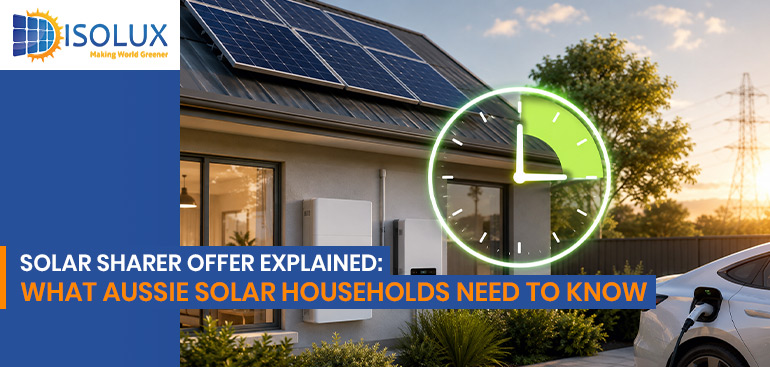
The free-power period is timed to coincide with peak solar generation. It runs during the following three-hour windows: New South Wales and South East Queensland from 11am to 2pm, and South Australia from 12pm to 3pm.
The SSO not only provides an opportunity to cut household bills. It can also help to minimise peak electricity prices by reducing peak demand in the evening, while improving grid stability overall.
The key things to know upfront are straightforward. The offer is opt-in only – your retailer will not switch you automatically. You need a smart meter. And while three hours of free power sounds simple, the rates outside that window matter just as much as the free period itself.
Why Did the Australian Government Create the Solar Sharer Offer?
To understand the Solar Sharer Offer, it helps to understand what drove the Australian Government to create it in the first place.
Australia has more than 4.3 million rooftop solar installations. On a clear midday, those systems push so much electricity into the grid that the market cannot absorb it at normal prices. The result is that midday electricity becomes extremely cheap on the wholesale market – sometimes even negative in price – while households are still paying full rates on their bills.
Instead of running the majority of appliances during peak periods (5pm to 9pm), which puts more demand stress on the grid, a cost-free period throughout the day enables Australian households to use appliances like dishwashers and EV chargers when solar is at its peak generation and reduce peak demand.
The Solar Sharer Offer is therefore designed to pass the benefit of Australia’s solar boom directly to households, whether or not they have panels on their own roof. It is part of broader reforms to the Default Market Offer (DMO) framework – the regulated price cap that protects households who do not or cannot shop around for energy deals.
Who Is Eligible for Solar Sharer Offer?
Eligibility for the Solar Sharer Offer is straightforward, but there are specific requirements you need to meet. You can get the SSO if all of the following are true: you are a residential customer, you have a smart meter (also called an interval meter), you live in a region where the Default Market Offer applies (New South Wales, South Australia and South East Queensland), and you are not supplied through an embedded network.
An embedded network refers to places like caravan parks, retirement villages, or apartment blocks where the site owner sells electricity to residents directly. If you live in one of these arrangements, you are not eligible for the Solar Sharer Offer under the current rules.
Retailers with more than 1,000 customers across all the regions where the DMO applies are required to offer the SSO. This means the major retailers across NSW, South East Queensland, and South Australia must make the plan available. Smaller retailers may not be required to offer it; however, many are choosing to do so voluntarily.
Also importantly, the Solar Sharer Offer is available to both homeowners and renters. You do not need to own your property to be eligible.
Do You Need a Smart Meter?
Yes, a smart meter is a non-negotiable requirement. A smart meter – read remotely in short intervals – is required, and a basic digital meter is not enough. The easiest way to confirm is to ask your retailer. If you do not have a smart meter, ask whether one can be installed and whether any fees apply, as costs vary between retailers.
A smart meter records your electricity usage in short intervals – typically every 30 minutes – and sends that data to your retailer remotely. This precision is what allows the retailer to distinguish between electricity used during the free window and electricity used at paid rates.
When Is the Free Electricity Period? (State-by-State Breakdown)
The free electricity window is fixed and consistent throughout the year, regardless of daylight saving time. This predictability is deliberate – the government designed it to stay the same so households can build reliable routines around it.
Here is the exact breakdown by state:
| State / Region | Free Electricity Window | Network Areas |
| New South Wales | 11am to 2pm (AEST/AEDT) | Ausgrid, Endeavour, Essential Energy |
| South East Queensland | 11am to 2pm (AEST/AEDT) | Energex network |
| South Australia | 12pm to 3pm (ACST/ACDT) | SA Power Networks |
The times do not change for daylight saving, to keep things simple and predictable. This is a practical advantage – you set your appliances once, and the schedule holds all year.
The timing is not arbitrary. These windows align with when rooftop solar systems across Australia generate the most electricity, flooding the grid with cheap renewable energy that, until now, most households could not directly benefit from.
Is There a Limit on How Much Free Electricity You Can Use?
Yes – there is a daily cap on how much free electricity you can access. However, for most Australian households, this cap is generous enough that it will never be an issue.
Households can access up to 24 kilowatt-hours of free electricity during the three-hour window each day. This is around what a five-person household uses in an entire day on average.
To put 24 kWh in practical context, running a washing machine uses approximately 1 to 2 kWh. A dishwasher uses around 1 to 1.5 kWh. An electric vehicle charger on a Level 2 connection draws between 7 and 11 kWh per hour. Running air conditioning at a moderate setting for three hours uses around 3 to 5 kWh. Even combining several of these simultaneously during the free window, most households will stay comfortably under 24 kWh.
Any additional electricity used beyond the cap is charged at a ‘reasonable use’ rate – this rate is equal to the off-peak or solar soak rate charged for electricity used outside the free period. So even if you do exceed the cap, you will not be hit with expensive peak rates. You will simply pay the cheapest applicable rate – the same one used for off-peak consumption at other times of the day.
Solar Sharer Offer: How Time-of-Use Pricing Works Outside the Free Window
This is the section that most households overlook – and it is where the Solar Sharer Offer becomes more nuanced than the free electricity headline suggests.
Outside the free period, electricity is charged at elevated time-of-use rates – for example, peak, shoulder, or off-peak rates. These rates can be higher than what you currently pay on a standard flat-rate electricity plan.
Therefore, the Solar Sharer Offer genuinely saves you money only if you can shift a meaningful portion of your energy use into the free three-hour window. If you use most of your electricity in the morning before the free window starts, or in the evening after it ends, the higher peak rates outside the window can actually increase your total bill compared to your current plan.
The SSO may not suit you if most of your electricity use is in the morning or evening when prices are higher, or if you cannot change when you use electricity to the middle of the day.
Also, the daily supply charge – the fixed fee your retailer charges just for being connected to the grid – still applies even on the Solar Sharer Offer. The free window covers usage charges only, not your supply charge.
The practical lesson here is simple: do not sign up based on the free electricity headline alone. Review your usage patterns first, then decide whether the Solar Sharer Offer works for your household’s actual routine.
Does the Solar Sharer Offer Work If You Already Have Solar Panels?
Yes – and in fact, existing solar households are among those best positioned to benefit from the Solar Sharer Offer.
If you already have rooftop solar, your panels are generating electricity during the same midday window covered by the Solar Sharer Offer. Therefore, your panels are already reducing or eliminating your need to draw from the grid during that window. The Solar Sharer Offer becomes most valuable in your case for electricity that exceeds what your panels can produce – for example, on overcast days, during extended appliance use, or when running energy-intensive loads like EV charging.
For households without solar panels, the Solar Sharer Offer represents a direct path to accessing the benefit of Australia’s midday solar surplus. It is, in effect, a way to share in the grid’s solar generation without installing panels yourself.
However, if you are considering going solar, adding panels alongside the Solar Sharer Offer creates a powerful combination. Your solar panels generate electricity during the free window, which means your household effectively consumes electricity from two zero-cost sources simultaneously during those three hours – your own panels and the grid’s free midday supply.
At ISOLUX Solar, we can help you design a solar system that maximises self-consumption during the Solar Sharer Offer window and also positions you to benefit from battery storage after the free period ends.
How to Get the Most From Your 3 Hours of Free Electricity
The Solar Sharer Offer rewards households who can shift their energy-intensive tasks to the midday window. Here is how to make those three hours work hardest for you.
Run High-Energy Appliances During the Free Window
The single most effective strategy is simple: reschedule any appliance that has a delay or timer function to operate between 11am and 2pm (NSW and SE QLD) or 12pm and 3pm (SA).
Washing machines, dishwashers, dryers, and robotic vacuum cleaners all have timer settings built in. Most modern appliances can be programmed the night before to start during the free window. This one habit change costs nothing and begins saving money from day one.
EV owners have a particularly strong incentive. Charging an electric vehicle during the free window can save several dollars per charge session – and over hundreds of charges per year, the cumulative saving is significant.
Pre-Heat or Pre-Cool Your Home
Running reverse-cycle air conditioning during the free window to pre-heat or pre-cool your home before the paid evening period is another effective strategy. A well-insulated home can hold temperature for several hours. Therefore, if you cool the home to 23°C during the free window on a hot afternoon, the house may not need air conditioning again until well into the evening – by which time you have shifted that large energy load away from expensive peak rates.
Schedule Your Hot Water Heating
Many households have electric hot water systems on a controlled load circuit, which means they are billed separately and may not benefit from the Solar Sharer Offer’s free window. Check with your retailer whether your hot water system is on controlled load. If it is not, scheduling water heating during the free window is one of the highest-value shifts available, since hot water systems typically consume 3 to 5 kWh per heating cycle.
Real-Life Example: How Much Could a NSW Family Actually Save?
Let us work through a practical example to illustrate what the Solar Sharer Offer can mean in dollar terms for a typical Sydney household.
Consider a family of four in Western Sydney on a current flat-rate electricity plan paying 35 cents per kWh. They currently use approximately 22 kWh per day, with about 8 kWh used between 10am and 3pm (working from home, running appliances, charging devices).
After switching to the Solar Sharer Offer and shifting a further 4 kWh of usage into the free window – by running the dishwasher, washing machine, and pre-cooling the lounge room – they now have 12 kWh of usage falling within the free period daily.
Saving per day: 12 kWh × 35¢ = $4.20 per day
Annual saving: $4.20 × 365 = $1,533 per year
This calculation assumes the peak rates outside the free window are broadly comparable to the current flat rate. In practice, the actual saving depends on your retailer’s specific SSO plan rates, your usage patterns, and how much of your consumption you can realistically shift. Some households will save more; some will save less.
The key takeaway is that even modest load-shifting – just one or two extra loads of washing and an hour of pre-cooling per day – can add up to real and meaningful savings across a full year.
Solar Sharer Offer vs Your Current Electricity Plan: What to Compare
Switching to the Solar Sharer Offer is not automatically the right move for every household. Here is what to examine before you decide.
The free window rates are the headline, but they are only part of the picture. Look carefully at peak, shoulder, and off-peak rates charged outside the free window on the specific SSO plan your retailer offers. Compare these to the rates on your current plan.
Your usage pattern is the most important variable. Use your smart meter data or recent electricity bills to estimate how much energy you currently use between 11am and 2pm (or 12pm and 3pm in SA). The more of your daily usage that falls in the free window, the stronger the case for switching.
The daily supply charge still applies on the Solar Sharer Offer. Check whether your retailer’s SSO plan changes the daily supply charge compared to your current plan.
Multiple SSO plans exist from different retailers. Even though they are regulated, not all SSOs are the same. You should compare SSOs on Energy Made Easy and look closely at the rates outside the free period, which matter a lot if you do not change when you use electricity.
The Australian Government’s Energy Made Easy website (energymadeeasy.gov.au) is the official comparison tool for SSO plans. Entering your NMI (National Metering Identifier, found on your electricity bill) gives you a personalised comparison based on your actual usage history, which is the most accurate way to assess your potential savings.
Does the Solar Sharer Offer Work Even Better With a Battery?
For households that cannot be at home during the 11am to 2pm free window, a home battery changes the entire equation.
A battery allows you to store free midday electricity and use it later – specifically during the expensive peak period in the evening. Instead of drawing from the grid at peak rates between 5pm and 9pm, you draw from stored battery power that cost you nothing to collect.
The most effective approach for those not home during the free window is to store the midday energy in a home battery and use it in the evening peak, when power costs the most.
This combination – Solar Sharer Offer plus battery storage – is arguably the most powerful way to benefit from Australia’s solar surplus regardless of your daily routine. Your battery charges for free during the day. You use that stored power in the evening. The expensive peak period effectively disappears from your bill.
The federal government’s Cheaper Home Batteries Program, launched on 1 July 2025, provides approximately a 30% discount on the upfront cost of eligible home batteries. This rebate stacks with the Solar Sharer Offer, making 2026 one of the most financially compelling times to add battery storage to your home.
At ISOLUX Solar, we design and install battery systems specifically matched to your household’s energy profile and the Solar Sharer Offer window times in your state. Contact us for a free assessment.
What About Renters? Can You Access the Solar Sharer Offer?
Yes – renters are eligible for the Solar Sharer Offer, and this is one of its most important features. For the first time, renters can directly access the financial benefit of Australia’s solar boom without relying on their landlord to install panels.
To access the Solar Sharer Offer as a renter, you need to be the account holder for your electricity connection – that is, your name must be on the electricity account. You also need a smart meter at your property. If you rent in a unit or apartment, check whether your building is connected through an embedded network, as embedded network customers are not eligible under the current rules.
Renters in strata properties should check with their strata manager or building owner about the metering setup before contacting a retailer. In many modern apartment buildings, smart meters are already installed and renters can opt into the Solar Sharer Offer directly.
Solar Sharer Offer: States Not Yet Covered (Victoria, ACT, Tasmania)
The Solar Sharer Offer launched on 1 July 2026 in NSW, South Australia, and South East Queensland only. These are the three regions covered by the federal Default Market Offer framework.
The Solar Sharer Offer is not available in Victoria, but a similar scheme is coming. The Victorian Midday Power Saver will give eligible households three hours of free electricity in the middle of the day from 1 October 2026. Like the SSO, it is opt-in and requires a smart meter. You do not need solar to access it.
The ACT and Tasmania do not currently have an equivalent scheme, though federal and state governments have signalled that expansion beyond the initial three states is expected as the program matures. If you are in Victoria, keep an eye on the Victorian Government’s energy website for Midday Power Saver updates from October 2026.
Several energy retailers were already offering similar voluntary free midday electricity plans before the Solar Sharer Offer was formalised – so if you are in a state not yet covered by the SSO, it is worth asking your retailer whether they have an equivalent product available now.
How to Opt In to the Solar Sharer Offer
The process for joining the Solar Sharer Offer is straightforward, and you can complete it in a few steps.
Step 1: Confirm your eligibility.
Check that you live in NSW, South Australia, or South East Queensland. Confirm with your retailer that your property has a smart meter installed. If not, ask whether one can be installed and what, if any, costs apply.
Step 2: Review your usage patterns.
Look at your smart meter data or recent electricity bills to understand when you use the most electricity throughout the day. The Australian Government’s Energy Savings Calculator, available through energy.nsw.gov.au, can help NSW households assess their potential saving.
Step 3: Compare available SSO plans.
Visit energymadeeasy.gov.au and enter your NMI to compare Solar Sharer Offer plans from different retailers side by side. Pay close attention to peak and shoulder rates outside the free window, not just the free period itself.
Step 4: Contact your retailer.
Once you have identified the plan that suits your usage, contact your retailer directly to opt in. You can also switch to a different retailer offering a better SSO plan – you are not locked into your current provider.
Step 5: Adjust your daily routines.
Once you are on the Solar Sharer Offer, set your time-based appliances to run during the free window. The more of your usage you shift, the more you save.
Frequently Asked Questions About Solar Sharer Offer
Do I need solar panels to get the Solar Sharer Offer?
No. The Solar Sharer Offer is available to any eligible household with a smart meter in NSW, South Australia, or South East Queensland – with or without rooftop solar panels.
Will my retailer automatically put me on the Solar Sharer Offer?
No. The Solar Sharer Offer is opt-in only. You must contact your retailer and ask to be placed on an SSO plan. Your retailer cannot switch you without your consent.
What happens if I use more than 24 kWh during the free window?
Any electricity used beyond the 24 kWh daily cap during the free window is charged at the reasonable use rate – the cheapest rate on the plan, equivalent to the off-peak or solar soak rate. You will not be charged at peak rates for excess usage during the free window.
Are there any other charges during the free period?
Yes. Your daily supply charge still applies, even during the free window. If you have appliances on a controlled load circuit (common for older hot water systems), those are billed separately and do not benefit from the free usage period.
Can I get the Solar Sharer Offer and the NSW Home Energy Saver Program loan?
Yes. These are separate programs. The NSW Home Energy Saver Program provides zero-interest loans of up to $15,000 for energy upgrades including solar panels, batteries, and other efficiency improvements. The Solar Sharer Offer is an electricity pricing plan. The two programs are fully compatible and can be used together to maximise your energy savings.
Is the Solar Sharer Offer available in strata or apartment buildings?
Potentially yes, provided your apartment is metered individually (not through an embedded network) and has a smart meter. Check with your strata manager and retailer to confirm your setup.
What if I am in Victoria?
Victoria is introducing the Midday Power Saver scheme from 1 October 2026, which operates on similar principles to the Solar Sharer Offer. Contact your retailer or visit the Victorian Government’s energy website for details.