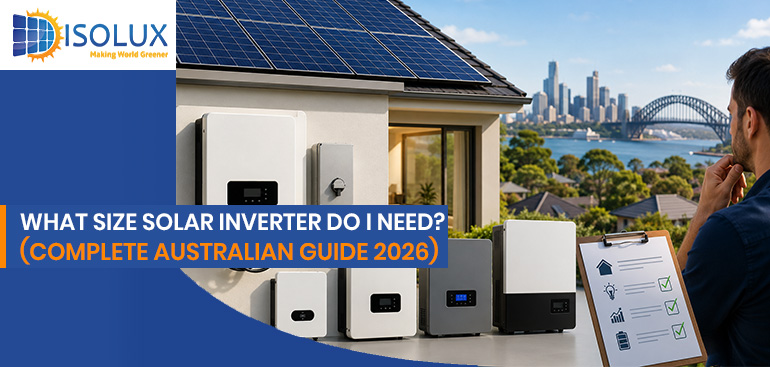

For most Australian homes, the right solar inverter size is between 5 kW and 10 kW. A 5 kW inverter paired with a 6.6 kW panel array suits the majority of single-phase households with average daily energy use. Larger homes with higher consumption, three-phase power, or plans to add an EV or battery should consider a 8 kW to 10 kW inverter or larger.
Getting your solar inverter size right is one of the most important decisions in the entire solar system design. An inverter that is too small clips your solar production and wastes energy. One that is too large runs inefficiently and may not meet grid compliance rules. This complete guide walks you through every factor you need to consider before making a decision.
What Does a Solar Inverter Do?
Your solar panels generate DC (direct current) electricity. However, everything in your home runs on AC (alternating current) electricity – the same type that comes from the grid. The solar inverter sits between your panels and your home’s switchboard, converting DC electricity into AC electricity that your appliances can actually use.
Without a properly functioning inverter, your solar panels produce power that cannot be used by your home. Therefore, the inverter is not just a supporting component – it is the operational heart of your entire solar system.
Modern inverters also communicate with the grid, manage export limits, track system performance, and protect your home from electrical faults. Advanced hybrid inverters go further still, managing the flow of energy between solar panels, battery storage, your home, and the grid simultaneously.
Types of Solar Inverter Available in Australia
Understanding the different inverter types helps you choose the right one for your roof layout, energy goals, and budget.
String Solar Inverter
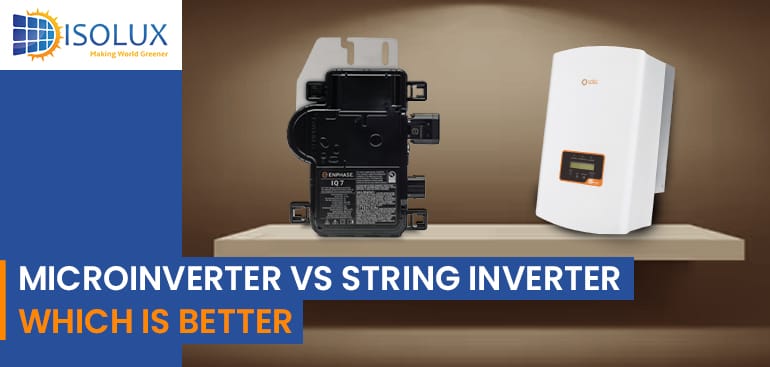
A string inverter is the most common and costeffective type used in Australian homes. It connects multiple solar panels in a series circuit (called a “string”) and converts the combined DC output into AC power.
String inverters suit rooftops with minimal shading, consistent panel orientation, and straightforward layouts. They are reliable, wellunderstood by installers, and relatively simple to maintain. The main limitation is that if one panel in the string underperforms due to shading or soiling, it can reduce the output of the entire string.
For a standard northfacing roof in Sydney or Brisbane with no significant shading, a string inverter is typically the best combination of performance and value.
Microinverters
Microinverters are small individual inverters that attach to each solar panel separately. Each panel has its own inverter, which means panels operate independently. If one panel underperforms due to shading, bird droppings, or a fault, the others are not affected.
This independent operation makes microinverters the best choice for complex rooftops with multiple orientations, significant shading, or split roof sections. The tradeoff is a higher upfront cost – microinverters typically cost 20 to 30% more than a comparable string inverter system.
Microinverters also commonly carry 25year warranties, matching the expected lifespan of the solar panels themselves. This is a meaningful advantage for homeowners who plan to own the property longterm.
Power Optimisers with String Inverter
Power optimisers are panellevel devices that attach to each panel and optimise its individual DC output before sending power to a central string inverter. This hybrid approach delivers much of the shading tolerance of microinverters while maintaining a single central inverter for AC conversion.
SolarEdge is the most widely known system of this type in Australia. It suits rooftops with partial shading or mixed orientations where a standard string inverter would underperform, without going to the full cost of microinverters.
Hybrid Solar Inverter
A hybrid solar inverter combines a solar inverter and a battery inverter into a single unit. It manages the flow of energy between your solar panels, battery storage, home, and grid from one central device.
Hybrid inverters are essential if you want to add a battery to your system now or in the future. Also, they are the standard choice for homeowners who want wholehome backup during a grid outage, smart energy management, EV charging capability, or timeofuse tariff optimisation.
The cost premium over a standard string inverter is typically $800 to $1,500. However, for any homeowner who might add a battery within the next five years, installing a hybrid inverter from the start avoids a costly inverter replacement later.
The Golden Rule: How to Size a Solar Inverter in Australia
The standard rule for sizing a solar inverter in Australia is that the inverter capacity should be between 75% and 100% of your solar panel array’s total rated output in kilowatts.
What Is the DC to AC Ratio?
The DC to AC ratio compares the total DC output of your panels to the AC output rating of your inverter. A ratio of 1.0 means they are equal. A ratio above 1.0 means your panels are oversized relative to your inverter.
For example, a 6 kW solar array paired with a 5 kW inverter has a DC/AC ratio of 1.2, which is standard practice in Australia. This ratio is also commonly expressed as the panels being “oversized” relative to the inverter.
The 133% Oversizing Rule Explained
Under Australian Standard AS/NZS 5033 and Clean Energy Council guidelines, solar panels can be installed at up to 133% of the inverter’s rated capacity. This is the widely applied oversizing rule, and it is the reason why 6.6 kW systems paired with 5 kW inverters dominate the Australian market.
The logic is straightforward. Solar panels only reach their rated output briefly at peak midday sun. In the morning and afternoon, output is lower. By pairing more panel capacity with a slightly smaller inverter, the system captures more energy across the full day without needing a larger inverter for the brief midday peak.
A singlephase house in NSW can install up to 10 kW of solar, and a threephase home can install up to 30 kW as it has three phases. The 10 kW perphase capacity refers to the inverter rather than the amount of panels on the roof. For example, a 10 kW inverter can be paired with 13.3 kW of solar capacity.
If the system size exceeds the inverter manufacturer’s specifications, you will not be able to access the Australian Government’s Smallscale Renewable Energy Scheme rebate. Therefore, always confirm oversizing compliance with your installer before proceeding.
Solar Inverter Size Guide by Household Type
The following guide matches common Australian household types to recommended inverter sizes. These are starting points. Your installer will refine the recommendation based on your specific roof, grid connection, and energy data.
3 kW to 4 kW inverter suits small households of one to two people with low daily consumption of around 8 to 12 kWh. It suits apartments or small homes with limited roof space and modest energy needs. A 4 kW inverter can pair with a 5.3 kW panel array under the 133% rule.
5 kW inverter is the most popular singlephase inverter size in Australia. It suits the majority of threetofour person households with daily consumption of 15 to 22 kWh. Paired with 6.6 kW of panels, it is Australia’s dominant residential solar combination and the benchmark against which all other configurations are compared.
6 kW to 8 kW inverter suits larger families with daily consumption above 22 kWh, or any household planning to add an EV, pool pump, or battery storage in the near future. An 8 kW inverter can pair with up to 10.6 kW of panels. This size often requires a threephase connection, depending on your network’s singlephase limits.
10 kW inverter suits highconsumption homes with daily usage above 30 kWh, or any household with threephase power that wants maximum solar generation. It can pair with up to 13.3 kW of panels. Ausgrid states that households can get up to 10 kW per phase based on the inverter size, meaning a singlephase house can install up to 10 kW of solar inverter capacity.
15 kW and above suits small businesses, large properties, or threephase homes with very high consumption or significant EV fleet charging. These sizes require a threephase grid connection and a detailed load assessment before installation.
SinglePhase vs ThreePhase Solar Inverter: Which Do You Need?
Understanding your home’s electricity supply phase is critical for inverter sizing. Most Australian homes have singlephase connections, but larger and newer properties often have threephase supplies.
A singlephase supply provides 240V electricity through three wires. A threephase supply uses five wires and provides more power capacity, enabling more or larger appliances to run simultaneously.
In practical solar terms, a connection limit restricts the size of the inverter that can be connected to the grid. If the connection limit is 10 kW per phase, you could connect a 10 kW inverter if your grid connection is singlephase. If you have a threephase connection, you could install a threephase inverter up to 30 kW.
For most singlephase homes, a 5 kW inverter is the most practical and most commonly installed choice. The standard connection limit for singlephase residential properties in most Australian states is 5 kW to 10 kW, depending on your network.
For threephase homes, threephase inverters distribute generation evenly across all three phases. This is important for homes with large threephase appliances or those that want genuine wholehome backup during a grid outage.
Check your electricity meter or recent bill to confirm your connection type, or ask your installer to verify during the site assessment.
Grid Connection Limits: What Your Network Allows
Your solar inverter cannot be larger than what your local electricity distribution network allows. These limits are set by your Distribution Network Service Provider (DNSP) and vary by state and region.
NSW and Ausgrid Inverter Limits
In New South Wales, Ausgrid covers the majority of the Sydney metro area. Under current Ausgrid guidelines, singlephase homes can connect a solar inverter of up to 10 kW. However, Ausgrid may impose an export limit of 5 kW even when the inverter is rated at 10 kW. This means your system can use up to 10 kW of solar power internally but may only export a maximum of 5 kW to the grid at any one time.
Ausgrid also offers dynamic export limiting in some areas, which adjusts the export cap in real time based on local grid conditions rather than applying a fixed limit at all times. This can allow more flexibility for larger systems in areas where the grid can absorb more solar export at certain times.
For homes outside Ausgrid’s territory in NSW, other networks such as Endeavour Energy and Essential Energy have their own specific limits. Your installer will confirm these limits during the quoting process.
Western Australia’s New 2026 Inverter Rules
Western Australia has recently made significant changes to its solar connection framework. From May 2026, homes and small businesses on the South West Interconnected System (SWIS) can install up to 30 kVA of total inverter capacity under a standard connection. That 30 kVA refers to the combined rating of all inverters on the property – solar and battery added together.
This is a generous increase compared to the previous limits. Also, all inverters installed from May 2026 must comply with the grid connection standard AS/NZS 4777.2:2020 and be configured to the Australia Region B grid profile.The practical effect for Perth homeowners is significant access to larger solarplusbattery systems under a simpler standard connection. However, a low default export limit of 1.5 kW still applies in areas where the grid is under congestion pressure from high solar penetration.
Hybrid Solar Inverter vs Standard Inverter: What Is the Difference?
This is one of the most common questions from Australian homeowners researching solar in 2026. The choice between a hybrid and a standard inverter is increasingly important, and getting it right upfront saves significant money later.
A standard string inverter converts solar DC power to AC for your home and the grid. It has no battery management capability and no backup power function. If the grid goes down, a standard inverter shuts your system off entirely for safety reasons, even if the sun is shining.
A hybrid solar inverter does everything a standard string inverter does, plus it manages battery charge and discharge, can operate your home in an island mode during a grid outage, and typically includes advanced smart energy management features. It connects to both the solar panels and the battery in a single unit.
Hybrid inverters cost $800 to $1,500 more than standard string inverters but provide batteryready capability and advanced energy management.
For homeowners who are certain they will never add a battery, a standard string inverter from a quality brand delivers excellent value and reliability. However, for the significant and growing proportion of Australians who plan to add battery storage within the next few years, a hybrid inverter eliminates the need to replace the inverter later, which typically costs $1,500 to $3,000 in additional upgrade work.
Do You Need a Battery Ready Solar Inverter?
The short answer is: if there is any chance you will ever add a battery, choose a hybrid inverter from the start.
Retrofitting a battery to an incompatible inverter can involve additional cost and complexity – planning ahead avoids this entirely. When you install a standard string inverter today and then decide to add a battery in three years, you typically need to replace the entire inverter with a hybrid model. This doubles the cost and disruption compared to simply installing a hybrid inverter initially.
Battery ready inverters from brands such as Sungrow, GoodWe, Fox ESS, Fronius, and Sigenergy are all widely available in Australia in 2026 and are priced very competitively compared to previous years. In many cases, the total installed cost of a hybrid inverter and battery together is lower than you might expect, particularly after the federal Cheaper Home Batteries rebate reduces the battery cost.
Consider what your home will look like in five years. If there is a reasonable chance of adding an EV, increasing your electricity consumption, or wanting backup power protection, the hybrid inverter is the clearly correct choice.
Best Solar Inverter Brands in Australia 2026
Australia’s solar market is mature and competitive. Several brands have established strong track records with local installers and homeowners.
Fronius is consistently rated as the top inverter brand by Australian installers in independent surveys. Australian homeowners benefit from federal Smallscale Technology Certificates that reduce upfront solar system costs, and Fronius inverters are among the most reliable and bestsupported products in the market. Fronius inverters are premiumpriced but carry exceptional build quality and a 5year standard warranty extendable to 10 years.
Sungrow is the most widely installed inverter brand in Australia and the world’s largest inverter manufacturer. Sungrow offers hybrid and string options across a wide power range, excellent appbased monitoring through iSolarCloud, and competitive pricing. Their hybrid SH series is one of the most popular batteryready inverters installed in Australia in 2026.
GoodWe is a strong midrange choice with a robust range of hybrid inverters including the ET and EH series. GoodWe has a strong local presence in Australia, including a dedicated aftersales support team in Melbourne.
SolarEdge offers power optimiserbased systems that suit shaded or complex rooftops. SolarEdge’s HDWave and Home Hub inverters are highly regarded for their efficiency and smart monitoring capability.
Fox ESS is a newer entrant but has gained rapid traction in Australia. Their H3Smart and H3Pro hybrid inverters pair natively with the EQ4800 and CQ6 battery series and offer strong performance at competitive pricing.
Enphase offers microinverter systems that are the premium choice for shaded rooftops or complex multi orientation installations. Enphase carries a 25year product warranty, which is unmatched in the industry.
Read Also This: How to Choose the Best Solar Inverter (2026 Guide)
How Much Does a Solar Inverter Cost in Australia?
Inverter pricing in 2026 varies significantly by type, brand, and power rating. The following figures represent installed component costs, not total system prices.
A standard string inverter at 5 kW from a reputable brand such as Sungrow or GoodWe typically costs between $600 and $1,200 for the unit itself, with installation included in the total system quote.
A hybrid solar inverter at 5 kW from brands such as Sungrow SH5, GoodWe ET, or Fox ESS H3 typically costs $1,400 to $2,800 for the unit. Premium brands like Fronius and SolarEdge sit at the higher end of this range.
Microinverter systems from Enphase are priced per panel. Each Enphase IQ8 microinverter costs approximately $180 to $250 per unit. For a 6.6 kW system with 15 panels, this amounts to $2,700 to $3,750 in microinverter costs alone, significantly more than a single string inverter.
Inverter replacement (when an existing inverter fails outside warranty) typically costs $1,200 to $2,500 fully installed for a standard string inverter, and $2,000 to $4,000 for a hybrid inverter replacement.
When comparing solar quotes, always confirm the inverter brand, model, and warranty term. Some quotes use cheaper or lesserknown inverter brands to reduce headline pricing. The inverter is not the place to cut corners, as it is the component most likely to require replacement during the 25year life of your solar panels.
Solar Inverter Installation: What to Expect
Solar inverter installation in Australia must be carried out by a CEC accredited installer. The inverter is a live electrical component and installation involves work on your home’s switchboard, which requires a licensed electrician.
A standard residential solar system installation, including panels, inverter, mounting, and switchboard work, typically takes one full day for a straightforward single story home. More complex installations with multiple roof sections, three phase switchboards, or hybrid inverter configurations may take one to two days.
Your installer will mount the inverter in a wellventilated, shaded location, typically on an exterior or garage wall. Proper placement matters because inverters generate heat during operation and perform better when kept away from direct afternoon sun. Most quality inverters are IP65rated for outdoor installation, meaning they are dusttight and protected against water jets.
After installation, the inverter is commissioned and tested before your system is connected to the grid. Your network provider is notified, and in most cases a meter upgrade to a bidirectional smart meter is organised as part of the process. Most Australian electricity networks complete smart meter upgrades within two to four weeks of system installation.
Most Australian electricity retailers require preapproval before connecting solar systems to the grid. Your installer typically handles this process, submitting technical specifications and receiving connection approval before final commissioning. Connection approval timeframes vary by retailer and location, ranging from 5 to 20 business days.
How Long Does a Solar Inverter Last?
Inverter lifespan is an important factor in the longterm economics of your solar investment. Unlike solar panels, which are rated for 25 years or more, inverters have a shorter service life.
Quality string inverters typically last 10 to 15 years, while premium models can exceed 20 years with proper maintenance. Microinverters often come with 25year warranties matching panel lifespans. Australian conditions with high temperatures and UV exposure can reduce lifespan, making quality selection and proper installation critical for longevity.
Most quality residential inverter brands in Australia offer a standard 5year warranty, with options to extend to 10 years for a modest additional fee. Fronius and SMA offer 5year base warranties with 20year extension options. Enphase microinverters are unique in offering a 25year standard warranty.
Registering your inverter warranty promptly after installation is important. Some manufacturers require registration within 30 to 90 days to activate extended warranty coverage. Your installer should provide guidance on this step as part of the commissioning process.
Common Solar Inverter Sizing Mistakes to Avoid
Avoiding these errors will protect your investment and ensure your system performs as expected.
Installing an undersized inverter.
A 3 kW inverter paired with 6.6 kW of panels clips too much energy at peak production and reduces your daily output meaningfully. The 133% rule exists precisely to prevent excessive undersizing while still capturing the costefficiency benefits of modest panel oversizing.
Overinvesting in a large inverter for a small panel array.
Inverters operate most efficiently when running at close to their rated capacity. An 8 kW inverter paired with only 4 kW of panels will spend most of its life at 50% capacity, which is below the optimal efficiency range.
Choosing a nonhybrid inverter without considering future battery plans.
This is perhaps the most common and costly mistake. Retrofitting a battery later requires replacing the inverter in most cases. If there is any possibility of adding storage within five years, a hybrid inverter is the right choice from day one.
Ignoring grid connection limits.
Installing a 10 kW inverter in an area where the network allows only 5 kW of singlephase connection creates compliance problems and may result in the network requiring the system to be exportlimited to zero, effectively wasting your investment in oversized equipment.
Choosing an unfamiliar or discontinued brand.
Inverter warranties are only as valuable as the company behind them. Choosing a brand with a local Australian presence and a longterm commitment to the market ensures warranty claims and technical support are available throughout the system’s life.
Frequently Asked Questions
What size solar inverter do I need for a 6.6 kW solar system?
A 5 kW inverter is the standard choice for a 6.6 kW panel array in Australia. This pairing exploits the 133% oversizing rule to maximise daily energy production without requiring a larger, more expensive inverter.
What is a hybrid solar inverter?
A hybrid solar inverter combines a solar inverter and a battery inverter in one unit. It manages energy flow between your panels, battery, home, and the grid. It also enables backup power during grid outages and is essential for any system with battery storage.
Can I add a battery to my existing solar inverter?
Only if your current inverter is a compatible hybrid model. Standard string inverters cannot connect to a battery without being replaced with a hybrid inverter. Retrofitting typically costs $1,500 to $3,000 in additional inverter replacement costs.
How do I know if I need a singlephase or threephase inverter?
Check your electricity meter. A singlephase connection has one set of active and neutral wires from the street to your home. A threephase connection has three active wires. Your installer can confirm your connection type during the site assessment.
What is the maximum solar inverter size allowed in NSW?
Under Ausgrid’s rules, singlephase homes can connect a solar inverter of up to 10 kW. However, export limits of 5 kW may apply regardless of inverter size. Your installer will confirm the specific limits for your property’s network.
How long does a solar inverter last in Australia?
Quality string inverters last 10 to 15 years, with premium models capable of exceeding 20 years. Microinverters typically carry 25year warranties. Australian heat and UV conditions mean installation location and quality of the unit both significantly affect lifespan.
Is a Fronius inverter worth the extra cost?
Fronius inverters consistently top independent installer surveys in Australia for reliability and build quality. The premium over a midrange brand like Sungrow is typically $400 to $800, which is modest in the context of a 25year system investment. For homeowners who value maximum reliability and strong local support, the premium is justified.
Does my solar inverter qualify for the STC rebate?
Yes, provided it is installed as part of a CEC approved system by a CEC accredited installer and meets manufacturer oversizing specifications. Your installer handles all rebate paperwork, and the discount is applied directly to your invoice at the point of sale.
Get Expert Solar Inverter Advice Today
Choosing the right solar inverter is one of the most important decisions in your solar journey. The right size, the right type, and the right brand determine how well your system performs for the next 15 to 25 years. For most Australian homes, a 5 kW hybrid inverter paired with a 6.6 kW panel array is the proven starting point – battery ready, rebate compliant, and sized for the full range of everyday household needs.
At Isolux Solar, our CEC accredited team assesses your home’s phase connection, roof layout, energy consumption, and future plans before recommending the right inverter for your situation. We work with all major inverter brands and design systems that are built to last.
Book your free solar inverter consultation today at isolux.com.au