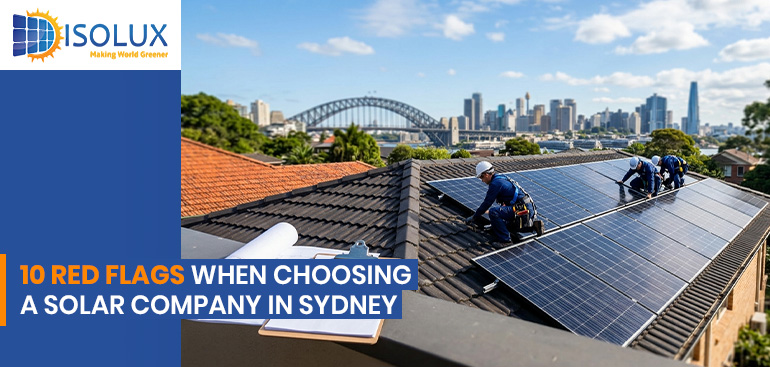

Sydney is one of the strongest solar markets in Australia. With an average of 4.5 to 6 peak sun hours per day, rising electricity prices, and generous government incentives under the federal Small-scale Renewable Energy Scheme (SRES), it is easy to understand why more than 40% of Sydney homes now have rooftop solar installed. But as the demand for solar has grown, so has the number of companies trying to cash in on it – and not all of them deserve your trust or your money.
The Australian solar industry has seen a significant rise in consumer complaints in recent years. CHOICE, one of Australia’s most respected independent consumer organisations, has reported a surge in members seeking help for problems with their solar PV systems. The Clean Energy Regulator has also conducted inspections, finding that a notable number of residential installations are underperforming, not configured correctly, or in some cases, genuinely unsafe.
Making the wrong choice when selecting a solar installer in Sydney can cost you thousands of dollars, years of stress, and in worst-case scenarios, leave you with a dangerous system on your roof and no one to call. Let’s walk you through the 10 biggest red flags to watch out for before you commit – so your switch to solar energy is a smart investment, not an expensive regret.
Red Flag #1: They Cannot Prove SAA Accreditation or Proper Licensing
Perhaps the single most important thing to check before hiring any solar company in Sydney is whether their installers hold current accreditation with Solar Accreditation Australia (SAA). As of February 2024, Solar Accreditation Australia (formerly the Clean Energy Council) took over as the official body responsible for accrediting solar installers and designers across the country. Every installer legally needs to be SAA-accredited if they want their customers to claim the federal government’s Small-scale Technology Certificate (STC) rebates that reduce the upfront cost of going solar.
This is not a minor administrative formality. If your system is installed by a non-accredited person, you could lose access to thousands of dollars in government incentives, void your product warranties, and end up with a system that fails safety standards. A reputable company will have no hesitation in providing proof of their SAA accreditation number, which you can independently verify on the SAA website.
Similarly, watch out for companies that still advertise themselves as “CEC Approved Retailers.” The CEC Approved Retailer scheme was discontinued in February 2023 and replaced by the New Energy Tech Consumer Code (NETCC) program. While NETCC membership is voluntary, it represents a meaningful commitment to consumer protection standards. If a company is still using outdated credentials to market themselves, it raises questions about how up-to-date their practices really are.
A practical tip: When you speak with any solar company in Sydney, ask directly, “Can you provide the SAA accreditation number of the specific installer who will work on my property?” Any legitimate company will answer that question immediately and without hesitation.
Red Flag #2: The Quote Seems Suspiciously Too Cheap (or Strangely Too Expensive)
Pricing transparency is one of the clearest indicators of a trustworthy solar company. In 2025 and into 2026, a fully installed 6.6kW solar system in Sydney – the most popular size for residential homes – typically costs between $5,500 and $7,500 after the federal STC rebate is applied. A 10kW system averages between $9,500 and $12,000. These are well-established benchmarks, and quotes that fall significantly below them should trigger immediate caution.
When a solar company in Sydney offers you a 6.6kW system for, say, $3,000 or $3,500, something is wrong. The most likely explanations are that the company is using non-CEC-approved panels that will not qualify for rebates, that the inverter is significantly undersized or of very low quality, or that there are hidden costs buried in the fine print that will surface after you sign. Some installers also cut corners during the physical installation itself – rushing the job, using inadequate mounting hardware, or skipping critical safety steps – all to protect a margin that the price should not allow.
Equally, a quote that is dramatically higher than the Sydney market average without a clear explanation of premium products or extended services is also a yellow flag. Always get at least three written quotes from different Sydney solar installers and compare them line by line, looking at panel brand and wattage, inverter brand and model, racking system, warranty terms, and any additional costs for switchboard upgrades, rooftop complexity, or double-storey access fees.
A transparent solar company in Sydney will show you exactly how the STC rebate has been calculated and deducted from your quote, with no guesswork required on your part.
Red Flag #3: High-Pressure Sales Tactics and “Today Only” Deals
If a solar sales representative tells you that the deal they are offering will expire tonight, or that they cannot hold the price beyond this week, walk away. This is one of the oldest and most widely reported tricks in the book, and the Australian solar industry has unfortunately seen it used repeatedly.
The solar industry in Australia has had such a persistent problem with aggressive door-to-door solar salespeople that the general advice from experienced industry advocates is now: if someone knocks on your door selling solar or a battery storage system, politely decline and do not let them in. Legitimate solar companies in Sydney do not need to pressure you into a decision. A quality company is confident in their product and their pricing, and they will give you as much time as you need to review multiple quotes, speak with past customers, and make a well-informed choice.
High-pressure selling is particularly concerning because it is specifically designed to prevent you from doing the due diligence that protects you. The urgency is manufactured. There is no expiring deal. What there is, is a salesperson trying to stop you from comparing their offer to competitors, checking their reviews, or verifying their credentials. Any legitimate solar company in Sydney will encourage you to shop around, because they know their offer will stand up to scrutiny.
Be equally cautious of companies that insist both decision-makers in a household be present before they will quote – a tactic used to apply maximum social pressure to close the sale on the spot.
Red Flag #4: No Physical Address, ABN, or Verifiable Local Presence in Sydney
Sydney’s solar market attracts a steady stream of operators who appear from nowhere during periods of high demand, take deposits or full payments, and then disappear before the job is properly done or shortly after it is completed. These are sometimes called “cowboy” installers, and their victims are known as “solar orphans” – homeowners whose installer has gone out of business, leaving them with no way to claim warranties, request repairs, or get technical support.
In Australia, around 30% of solar systems are now considered “solar orphan” systems, meaning the company that installed them no longer exists. That is a sobering statistic. Before you sign a contract with any solar company in Sydney, do these basic checks. Search their ABN on the Australian Business Register (ABR) at abr.business.gov.au and note the date it was registered. A company that only registered its ABN in the past several months should be treated with significant caution – it may have been set up purely to exploit a government rebate or period of high demand before closing. Look for a company with at least five years of trading history.
Check that they have a verifiable physical office address in Sydney or the broader NSW area – not just a P.O. Box or a shared virtual office. Search their business name on Google Maps. Look at their social media presence and see whether they have consistent, long-term activity. A company with deep local roots in the Sydney community – one with relationships, reviews, and a reputation to protect – has far more reason to stand behind their work than a company that appeared online six months ago.
Red Flag #5: Vague or Missing Warranty Terms
A residential solar system is typically a 25-year investment. The panels themselves often come with performance warranties guaranteeing they will still produce at least 80% of their original rated output after 25 years. The inverter usually carries a manufacturer’s warranty of five to ten years, depending on the brand. But critically, there is another layer of warranty that is entirely within the solar company’s control – the workmanship warranty, which covers the quality of the installation itself.
A reputable solar company in Sydney will offer a workmanship warranty of at least five years, and many of the better operators offer ten years. This warranty covers the physical installation: the mounting system, the wiring, the connections between components, and anything that could go wrong due to how the system was put together rather than a manufacturing defect. If a solar company is vague about their workmanship warranty, or if it is limited to one or two years, that is a significant red flag. It may signal that they lack confidence in the quality of their own work, or that they plan to use subcontractors whose work they cannot fully vouch for.
Watch out also for a deceptive practice known as the “bait and switch.” Some installers include contract clauses allowing them to substitute “similar” components if the ones quoted are unavailable. This clause can be used to replace the premium panels or inverter you were quoted with cheaper alternatives, often without your knowledge. A legitimate Sydney solar company will inform you of any component changes and provide a revised quote for your approval. If the contract contains a broad clause allowing component substitution without your consent, insist on its removal before you sign.
Always request the full warranty documentation in writing before installation begins, and make sure you receive it again after the job is complete.
Red Flag #6: They Rely Entirely on Subcontractors for Installation
Many solar companies in Sydney operate on what is commonly known as a “sales and subcontractor” model. In this arrangement, the company you deal with is primarily a sales organisation. They take your order, collect your payment, and then hire freelance or subcontracted electricians to actually carry out the installation. While subcontracting itself is not always problematic, heavy or exclusive reliance on subcontractors can create serious accountability gaps.
The practical consequence of this model plays out most painfully when something goes wrong after installation. If your inverter faults, if panels develop a performance issue, or if there is a wiring problem, the sales company and the subcontracted installer can spend weeks pointing the finger at each other while you are paying full grid prices and waiting for someone to take responsibility. Experienced solar buyers in Sydney have reported waiting months to get post-installation issues resolved in these situations.
Companies that employ in-house, full-time installation teams operate differently. Because their installers are employees and not contractors paid per panel, they are not financially incentivised to rush the job. The company has direct control over installation standards, safety protocols, and quality checks. When something needs to be fixed, there is one party responsible, and that party is the company you contracted with.
When evaluating solar companies in Sydney, ask directly: “Do you use your own employed installation team, or do you subcontract the work?” An honest answer to this question tells you a great deal about what your post-installation experience is likely to look like.
Red Flag #7: The Quote Is Missing Critical System Details
A properly prepared solar quote is a detailed document. It is not a single-line price. When a solar company in Sydney provides you with a quote that lacks specifics, it is often because they do not want you to be able to compare it accurately against competitors, or because they are leaving themselves room to install inferior equipment.
A complete, trustworthy solar quote should clearly specify the brand, model, and wattage of the solar panels being installed; the brand, model and rated output of the inverter; the make of the mounting and racking system; the number of panels and total system capacity in kilowatts; the expected annual energy output in kilowatt-hours based on your specific roof orientation and Sydney’s solar irradiance data; a clear breakdown of all costs including installation labour, grid connection fees, and any potential extras for roof type or complexity; the STC rebate amount and how it has been calculated; and the full warranty terms for panels, inverter, and workmanship.
Some companies deliberately omit components from their initial quote – most commonly the inverter, the monitoring system, or critical safety switches – only to add them back as additional charges once you have committed. Others present misleading comparison sheets that show inflated competitor prices alongside their own, to make their quote look like a better deal than it actually is. Always verify quotes independently.
If a company cannot or will not provide a fully itemised written quote, that is a clear signal to look elsewhere for your solar installation in Sydney.
Red Flag #8: Negative Reviews, Unresolved Complaints, and No Track Record
Before you commit to any solar company, do thorough independent research on their reputation. Do not rely on testimonials on their own website – any company can curate positive feedback on their own platform. Instead, check independent review sites including Google Reviews, ProductReview.com.au, and SolarQuotes.com.au. These platforms host verified, unfiltered reviews from real customers who have had their systems installed.
Pay close attention not just to the overall star rating but to the specific content of negative reviews. Are there consistent patterns? Do multiple customers complain about the same issues – poor communication after installation, panels not performing as promised, warranty claims being ignored, or systems installed incorrectly? One or two negative reviews over several years of operation is normal for any business. A pattern of unresolved complaints, particularly around the same issues, is a serious warning.
Also, pay attention to how the company responds to negative reviews. A reputable Sydney solar company will acknowledge complaints professionally and work to resolve them. A company that responds defensively, aggressively dismisses unhappy customers, or simply ignores negative feedback is showing you exactly the level of service you can expect if you ever have a problem with your system.
Checking the Fair Trading NSW complaint register and the ACCC’s Scamwatch can also reveal whether a company has faced formal consumer protection action in the past.
Red Flag #9: Misleading Claims About Government Rebates and Savings
The financial incentives available for solar in NSW are genuinely attractive, which is exactly why they are so frequently misrepresented by less scrupulous solar companies. Inflated claims about government rebates and projected electricity savings are one of the most common forms of misleading conduct in the Australian solar industry.
Under the federal Small-scale Renewable Energy Scheme (SRES), Sydney homeowners receive Small-scale Technology Certificates (STCs) when they install an eligible solar system. A typical 6.6kW system in Sydney generates approximately 91 STCs, equating to a rebate of around $3,276 at current STC prices. This is a genuine and valuable incentive, but it is also a declining one – the number of STCs decreases annually and the scheme is scheduled to end in 2030, meaning the rebate becomes smaller each year.
Some less reputable solar companies in Sydney exaggerate the value of these rebates, present outdated STC calculations, or imply there are government programs that provide “free solar” to eligible households. No free solar panel programs are operating in NSW. Similarly, return-on-investment projections should be treated carefully. While a quality solar system in Sydney can genuinely deliver a payback period of five to seven years, depending on your energy usage and feed-in tariff rate, companies that promise payback in two to three years or project savings that seem impossibly high are almost certainly misleading you.
Always ask a solar company to show their workings for any financial projections, and cross-reference their claims against independent sources such as the Clean Energy Regulator, the NSW Government’s Energy Saver portal, and reputable publications like SolarQuotes.
Red Flag #10: Poor or Non-Existent After-Sales Support
Installing solar panels is not the end of your relationship with your installer – it should be the beginning of a long-term service partnership. A quality solar system in Sydney should perform reliably for 25 years or more, but like any sophisticated energy system, it will occasionally need monitoring, maintenance, or troubleshooting. The solar company you choose needs to still be around, still be contactable, and still be willing to help when that day comes.
This is where many of the cheaper or less established solar operators in Sydney fall short. Some companies are effectively designed to install systems quickly and move on, with minimal infrastructure for after-sales support. When their customers call with a performance issue or a warranty claim, they find the phone number no longer works, the email goes unanswered, or the company has simply closed its doors.
Before signing a contract, ask the solar company specifically what happens if your system is underperforming six months after installation. Ask how they handle inverter warranty claims. Ask whether they offer monitoring services and, if so, whether a real person reviews alerts or whether you are left to manage the monitoring app yourself. Ask for references from customers who had post-installation issues resolved – not just happy customers who had smooth installations.
The best solar companies in Sydney have dedicated service departments staffed by in-house technicians. They respond to service calls promptly, maintain clear records of your installation, and treat post-installation support as a core part of their business – not an afterthought.
Quick Checklist Before Hiring a Solar Company in Sydney
Making a confident, informed decision about solar in Sydney does not need to be complicated. Before signing any contract, run through these key checks.
Verify the installer’s SAA accreditation directly on the Solar Accreditation Australia website. Confirm the company’s ABN is registered and has been active for at least five years. Get a minimum of three fully itemised written quotes and compare them carefully. Check independent reviews on Google, ProductReview.com.au, and SolarQuotes.com.au. Confirm whether the company uses its own in-house installation team or relies on subcontractors. Ask for the full warranty documentation in writing before any money changes hands. Never respond to pressure tactics, door-to-door solicitations, or “today only” pricing. Cross-check any savings or rebate figures against independent government sources. Report suspected solar scams to the ACCC via Scamwatch or to NSW Fair Trading.
Why Sydney Homeowners Trust Isolux Solar
At Isolux Solar, we believe that every Sydney homeowner deserves a solar installation that is transparent, high-quality, and backed by genuine long-term support. As a fully SAA-accredited solar installer operating across Sydney and New South Wales, we use only Clean Energy Council-approved Tier-1 panels and components that meet Australian Standards. Our team of in-house, licensed electricians handles every installation – no subcontractors, no accountability gaps. And our commitment to our customers does not end on the day we drive away from your property.
Whether you are comparing your first solar quotes or trying to make sense of a confusing market, our team is here to provide honest, no-pressure advice. If you are ready to get a transparent, fully itemised solar quote for your Sydney home, contact Isolux Solar today on 1300 552 452 or visit us at isolux.com.au.
Frequently Asked Questions About Choosing a Solar Company in Sydney
What is the most important thing to check before hiring a solar installer in Sydney?
The single most important check is SAA accreditation. Ensure the person physically installing your system holds current accreditation with Solar Accreditation Australia, as this is required to claim federal STC rebates and ensures the work meets Australian Standards.
How much should a quality solar system cost in Sydney in 2025–2026?
A fully installed 6.6kW solar system in Sydney typically costs between $5,500 and $7,500 after the STC rebate. Quotes significantly below this range are a red flag indicating potential use of substandard components or installation shortcuts.
What is a “solar orphan” and how do I avoid becoming one?
A solar orphan is a homeowner whose solar installer has gone out of business, leaving them unable to claim warranties or access technical support. To avoid this, choose a solar company with at least five years of trading history, a verifiable ABN, and a strong reputation for post-installation support.
Can I report a dodgy solar company in Sydney?
Yes. You can report suspected solar scams or misleading conduct to the Australian Competition and Consumer Commission (ACCC) via Scamwatch, to NSW Fair Trading, or by lodging a complaint with Solar Accreditation Australia if the installer holds SAA accreditation.
Does Isolux Solar offer free solar quotes in Sydney?
Yes. Isolux Solar provides free, no-obligation, fully itemised solar quotes for homes across Sydney and NSW. Call us on 1300 552 452 or visit isolux.com.au to get started.