
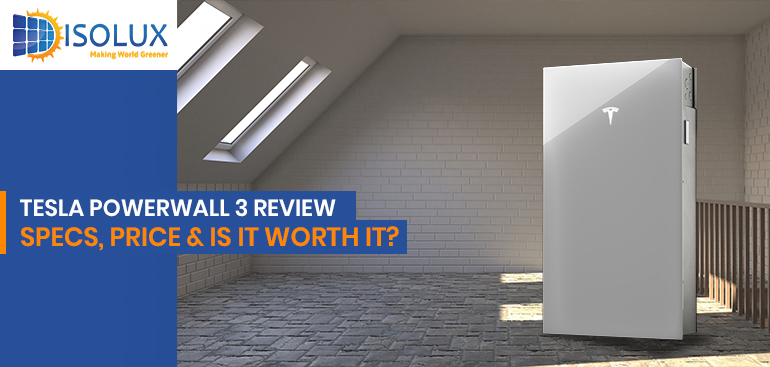

When Australians search for the best home battery storage system in 2026, one name consistently rises to the top of the list: the Tesla Powerwall 3. As an authorised Tesla Powerwall installer with over a decade of experience fitting battery storage systems across Sydney and NSW, the team at Isolux Solar has had plenty of hands-on experience with this unit. In this in-depth Tesla Powerwall 3 review, we cover everything an Australian homeowner needs to know before making a decision – from technical specifications and real-world performance to pricing, rebates, installation, and honest pros and cons.
Whether you are installing solar for the first time or adding battery storage to an existing system, this guide will help you decide whether the Tesla Powerwall 3 is the right investment for your home in 2026.
What Is the Tesla Powerwall 3?
The Tesla Powerwall 3 is Tesla’s latest generation residential home battery storage system. Launched in 2023 and now widely available across Australia, it represents a major architectural shift from its predecessor. Rather than being a standalone battery that pairs with a separate solar inverter, the Powerwall 3 is an all-in-one unit that combines a solar inverter, battery storage, and an energy management system into a single sleek package.
In practical terms, this means that when you install a Powerwall 3, you no longer need to purchase a separate hybrid inverter. The solar panels connect directly to the Powerwall 3, which handles conversion, storage, and distribution all in one step. For Australian households going solar for the first time, this significantly simplifies the installation process and can reduce overall system cost.
Tesla has deployed over 750,000 Powerwall units globally, reflecting how mainstream home battery storage has become worldwide. In Australia specifically, with electricity prices in NSW averaging 35 to 40 cents per kilowatt-hour in 2026, the case for pairing solar panels with a capable home battery has never been stronger.
What Is New in the Tesla Powerwall 3 Compared to Powerwall 2?
To understand how significant the Powerwall 3 upgrade is, it helps to look at what changed from the Powerwall 2, which was launched back in 2016 and served as the benchmark for residential battery storage in Australia for many years.
The Powerwall 2 was an AC-coupled unit, meaning it had an internal AC inverter and could be retrofitted relatively easily onto any existing solar system. It offered 13.5 kWh of usable storage and a continuous power output of 5 kW, which was more than adequate for the average Australian home at the time.
The Powerwall 3 keeps the same 13.5 kWh storage capacity but dramatically improves almost everything else. The most notable change is the move to DC coupling with a built-in solar inverter, which eliminates conversion losses that occur in AC-coupled systems. Where the Powerwall 2 delivered 5 kW of continuous power output, the Powerwall 3 delivers up to 11.5 kW, which is more than double. Peak power output jumps from 7 kW to 15 kW, making it capable of running energy-intensive appliances such as ducted air conditioning, pool pumps, and EV chargers simultaneously during a blackout.
Round-trip efficiency also improved meaningfully. The Powerwall 2 operated at around 90% round-trip efficiency, while the Powerwall 3 achieves approximately 97%, meaning less solar energy is wasted during the storage and discharge cycle.
Perhaps equally important for new buyers, the Powerwall 3 switches from nickel manganese cobalt (NMC) battery chemistry to lithium iron phosphate (LFP). LFP batteries are less susceptible to thermal runaway, do not contain cobalt, and are widely regarded as the safer and more environmentally sound chemistry for residential applications.
One important caveat for existing Powerwall 2 owners: the two systems are not compatible with each other. If you currently have a Powerwall 2 and want to add storage, you would need to add another Powerwall 2 or replace the entire system. The Powerwall 2 has also been removed from the CEC-approved product list, meaning it no longer qualifies for Australia’s federal battery rebate.
For more details on the differences, read our dedicated Tesla Powerwall 3 vs Powerwall 2 comparison.
Tesla Powerwall 3 Key Specifications
| Specification | Tesla Powerwall 3 |
| Usable Storage Capacity | 13.5 kWh |
| Continuous Power Output | 10 kW (Australia) / 11.5 kW (other markets) |
| Peak Power Output | 15 kW |
| Solar Input Capacity | Up to 20 kW of solar panels |
| Round-Trip Efficiency | ~97% |
| Battery Chemistry | Lithium Iron Phosphate (LFP) |
| Operating Temperature | -20°C to 50°C |
| Installation | Indoor or outdoor, floor or wall mount |
| Flood Resistance | Yes, rated for submersion up to 0.6 metres |
| Scalability | Up to 4 units (54 kWh total storage) |
| Expansion Units | Available at additional cost |
| Backup Power | Whole-home backup |
| Warranty | 10 years |
| Monitoring | Tesla app (iOS and Android) |
Note that in Australia, network connection requirements mean the continuous power output is capped at 10 kW in most states, and at 5 kW in Western Australia due to local grid export limitations imposed by Western Power.
How Does the Tesla Powerwall 3 Work?
Understanding how the Powerwall 3 works helps explain why its DC-coupled architecture is such an improvement over the previous generation.
In a traditional solar-plus-battery setup using AC coupling, the process involves multiple energy conversion steps. Solar panels generate direct current (DC) electricity. A string inverter converts this DC electricity into alternating current (AC) for use in the home. Any excess AC electricity then needs to be converted back into DC by the battery’s internal inverter before it can be stored. When you later draw on the battery, the DC electricity converts back to AC again. Each conversion step involves a small loss of energy, which adds up over time.
The Powerwall 3 eliminates two of these conversion steps. Because it contains a built-in solar inverter, the DC electricity from your solar panels flows directly into the battery for storage without the energy needing to first convert to AC and then back to DC. This direct DC pathway is why the Powerwall 3 achieves such high round-trip efficiency of approximately 97%.
During normal daytime operation, the Powerwall 3 prioritises powering your home from solar first. Any excess solar generation beyond your immediate household’s needs charges the battery. Once the battery reaches its target state of charge – which you can set via the Tesla app – surplus energy exports to the grid for a feed-in tariff credit. At night, the battery discharges to power your home, reducing the amount you draw from the grid.
During a grid outage, the Powerwall 3 switches automatically and almost instantaneously to backup mode, powering your entire home from stored solar energy. Because the Powerwall 3 can charge from solar panels even during a blackout, a fully charged Powerwall 3 paired with a good-sized solar array can potentially power your home for days or even weeks during an extended outage, depending on your energy usage.
Tesla Powerwall 3 Performance: Real Results for Australian Homes
Energy Storage Capacity and Runtime
The Powerwall 3’s 13.5 kWh of usable storage is well-matched to the average Australian household’s evening and overnight energy consumption. According to the Australian Energy Regulator, the average Australian household consumes approximately 15 to 20 kWh of electricity per day. A meaningful portion of that consumption happens during daylight hours when solar is generating, so the battery does not need to cover the entire daily usage.
In practice, a single Powerwall 3 paired with a 6.6 kW to 10 kW solar system covers most or all of a typical Sydney household’s evening and overnight electricity demand. Larger homes with higher consumption, EV owners, or households with ducted air conditioning running heavily may find that a single unit does not fully eliminate grid imports. In those cases, adding a Powerwall 3 Expansion Unit – which adds another 13.5 kWh of storage without requiring an additional inverter – is the most cost-effective way to scale up.
Power Output and Backup Capability
The Powerwall 3’s 10 kW continuous output is one of its most practically significant features for Australian households. To put this in context, a typical Australian home’s peak demand – running a ducted air conditioner, oven, hot water system, and a few other appliances simultaneously – sits somewhere between 5 kW and 10 kW.
The Powerwall 2 could only deliver 5 kW continuously, which meant it sometimes struggled to power high-draw appliances like ducted air conditioning or pool pumps during a blackout. The Powerwall 3 doubles that limit, comfortably supporting whole-home backup even for larger or more energy-intensive properties.
This is particularly relevant in Sydney, where summer temperatures regularly push households to run air conditioning heavily. A Powerwall 3 can keep your entire home cool during a summer storm-related outage in a way that a Powerwall 2 simply could not.
Round-Trip Efficiency
Round-trip efficiency measures how much energy you get back out of a battery for every unit you put in. The Powerwall 3’s approximately 97% round-trip efficiency is among the highest in its class. In comparison, the Powerwall 2 achieved around 90%, and many competing battery systems sit between 90% and 95%.
To understand why this matters practically: for every 100 kWh of solar energy you direct into a Powerwall 3, you get approximately 97 kWh back for home use. With a less efficient battery at 90%, you would only recover 90 kWh, losing 10 kWh to heat and conversion losses. Over a year of daily charging and discharging cycles, that difference translates into meaningful additional savings on your electricity bill.
Tesla Powerwall 3 Price in Australia 2026
As of 2026, the fully installed price of a Tesla Powerwall 3 in Australia ranges from approximately $13,000 to $16,500, before applying the federal battery rebate. After the 30% federal Cheaper Home Batteries rebate, which became available from 1 July 2025, the out-of-pocket cost drops significantly.
| Configuration | Approximate Installed Price (Before Rebate) | After 30% Federal Rebate |
| 1 x Powerwall 3 (13.5 kWh) | $13,000 to $16,500 | $9,100 to $11,550 |
| 1 x Powerwall 3 + 1 Expansion Unit (27 kWh) | $18,000 to $22,000 | $12,600 to $15,400 |
| 2 x Powerwall 3 (27 kWh) | $24,000 to $30,000 | $16,800 to $21,000 |
These are indicative price ranges. Your actual quote from an authorised solar installer like Isolux Solar will depend on your location, roof and switchboard configuration, and whether a new solar system is being installed at the same time.
What Is Included in the Installed Price?
A fully installed Tesla Powerwall 3 price in Australia typically includes the Powerwall 3 unit itself, the Tesla Backup Gateway (or Backup Switch where applicable), all mounting hardware, electrical wiring and switchboard connections, system commissioning and testing, grid connection paperwork, and connection to the Tesla app for monitoring. CEC-accredited installation by a certified Tesla installer is also included.
What may attract additional charges includes switchboard upgrades if your existing board cannot accommodate the Powerwall 3, additional conduit runs for complex installations, and any grid export limitation hardware required by your distributor.
Cost of Additional Expansion Units
Tesla Powerwall 3 Expansion Units contain the same 13.5 kWh of battery storage as the main unit but do not include an inverter. This makes them considerably cheaper per kWh than purchasing an additional full Powerwall 3. One Powerwall 3 can support up to three Expansion Units, providing a maximum of 54 kWh of storage from a single inverter. The Expansion Unit costs approximately $5,000 to $7,500 installed depending on timing and location, and also qualifies for the federal battery rebate.
Tesla Powerwall 3 Rebates and Government Incentives in Australia
Federal Cheaper Home Batteries Program
The Australian Government’s Cheaper Home Batteries Program, launched on 1 July 2025, is the most significant battery incentive available to Australian homeowners in 2026. It provides a 30% discount on eligible home battery installations, calculated as a reduction to the battery system’s price at the point of sale. The Tesla Powerwall 3 is an eligible product under this program.
On a fully installed Powerwall 3 system priced at $15,000, the 30% rebate translates to a saving of $4,500, reducing your out-of-pocket cost to approximately $10,500. The rebate is applied as an upfront discount by your installer – you do not need to claim it separately after installation. Isolux Solar handles all rebate paperwork as part of every Powerwall 3 installation.
It is important to note that as of 1 May 2026, the rebate calculation method changed to a tiered system based on usable battery capacity. The Tesla Powerwall 3 at 13.5 kWh sits comfortably within the tier that attracts the maximum rebate value.
For a detailed breakdown of how the new tiered structure works, read our 2026 Tiered Battery Rebate Guide.
State-Based Rebates and VPP Incentives
In addition to the federal rebate, several Australian states offer supplementary incentives that can further reduce your Powerwall 3 installation cost.
In NSW, homeowners who connect their Powerwall 3 to a Virtual Power Plant (VPP) can receive up to $1,500 in additional incentives through the NSW Peak Demand Reduction Scheme. A VPP allows your battery to contribute to grid stability during peak demand periods. You continue to benefit financially from stored solar energy while also receiving VPP participation payments.
Victoria offers a means-tested solar battery rebate of up to $4,174 for eligible households. South Australia’s Home Battery Scheme has provided incentives in previous years, and Queensland continues to develop its battery incentive programs. Contact the Isolux Solar team to confirm the current incentives available in your state at the time of installation, as these programs update frequently.
Tesla Powerwall 3 Installation: What to Expect
Can It Be Added to an Existing Solar System?
This is one of the most common questions Isolux Solar receives about the Powerwall 3, and the answer requires a nuanced explanation. The Powerwall 3 is primarily designed as a DC-coupled unit, meaning it works most efficiently when solar panels connect directly to it. For this reason, it is ideally suited to new solar-plus-battery installations where you are setting up everything at once.
However, the Powerwall 3 can also be added to some existing solar systems using AC coupling, where the existing inverter remains in place and the Powerwall 3 connects to the AC side of the system. This is a more complex configuration and may reduce the efficiency benefits compared to a fully DC-coupled setup. In some cases, particularly where an existing inverter is ageing or incompatible, a full system replacement may be the more cost-effective path.
Importantly, if you have an existing Powerwall 2, you cannot simply add a Powerwall 3 alongside it. The two generations use different communication protocols and can interfere with each other’s operation.
The best approach is to have an Isolux Solar consultant assess your existing system before committing to a Powerwall 3 installation. We will advise whether AC coupling is viable, whether your existing inverter should be retained, and what the most cost-effective configuration looks like for your specific roof and switchboard setup.
Is It Compatible with All Solar Panels?
The Powerwall 3 accepts up to 20 kW of solar panel input across six independent Maximum Power Point Tracking (MPPT) inputs. This means it can accommodate a wide range of panel configurations, orientations, and roof layouts. Whether your panels face north, east, west, or a combination, the Powerwall 3’s six MPPT inputs allow each string to be optimised independently, reducing the impact of shading or orientation differences.
All major Tier 1 solar panel brands – including Jinko, Trina, REC, Tindo, and SunPower – are compatible with the Powerwall 3. Isolux Solar installs only Tier 1 certified panels, ensuring your system performs optimally with the Powerwall 3 from day one.
Tesla App and Smart Energy Management Features
One of the genuinely impressive aspects of the Tesla Powerwall 3 experience is the Tesla app, which provides real-time visibility and intelligent control of your entire energy system. Solar industry experts consistently rate it as one of the most polished and user-friendly battery monitoring platforms available.
Through the Tesla app, you can monitor live solar generation, home consumption, battery charge level, and grid import or export – all in real time on your smartphone. The app sends push notifications when significant events occur, such as a grid outage triggering backup mode, your battery reaching full charge, or solar generation falling below an expected threshold.
Beyond monitoring, the app allows you to configure how the Powerwall 3 prioritises energy use. The main operating modes are Self-Powered mode, where the system maximises use of your own solar and battery energy before drawing from the grid; Time-Based Control mode, where the battery charges and discharges based on your electricity retailer’s time-of-use tariff to buy cheap and avoid expensive peak rates; and Backup Reserve mode, where you set a minimum charge level to always keep available for power outages.
Tesla’s Opticaster software, available in select markets, takes smart energy management a step further by using weather forecast data and machine learning to predict how much solar energy your system will generate and how much your household is likely to consume. It then optimises charging and discharging decisions accordingly, squeezing additional savings out of the system compared to a static operating mode.
The app also provides notifications about dynamic export limits, which is particularly relevant in NSW where some distributors apply live constraints on how much solar energy your system can export to the grid. Being informed of these limits in real time allows you to make better decisions about when to use appliances.
Tesla Powerwall 3 Warranty and After-Sales Support
The Tesla Powerwall 3 comes with a 10-year warranty that guarantees the battery will retain at least 70% of its original capacity at the end of the warranty period. The warranty is valid for unlimited charge cycles when the battery is used in standard operating modes, including solar self-consumption, time-based control, and backup reserve.
The 10-year warranty is standard for the residential battery industry in Australia, and Tesla’s warranty terms are broadly in line with competitors such as Sungrow, BYD, and Alpha ESS. What sets Tesla apart is the financial backing of a large, established company with a proven track record of honouring warranty claims and providing ongoing software support throughout the product’s life.
Tesla’s installer network in Australia is certified and regularly trained, and Isolux Solar is proud to be part of that network as an authorised Tesla Powerwall installer. This means any warranty service or support request is handled through official Tesla channels, with access to genuine replacement parts and firmware updates.
After-sales support is an area where Tesla performs particularly well. The company pushes regular over-the-air software updates to Powerwall units, improving functionality and performance without requiring a technician visit. Several features that were not available at launch – including improved VPP integration and enhanced time-of-use optimisation – have been added to existing Powerwall units through software updates, effectively improving the product after purchase.
Pros and Cons of Tesla Powerwall 3 for Australian Homes
Understanding both sides of the Powerwall 3 helps you make a genuinely informed decision rather than being swayed purely by marketing.
What makes the Powerwall 3 stand out is its combination of high-power output, an integrated solar inverter, excellent round-trip efficiency, LFP battery chemistry, whole-home backup capability, flood resistance, and one of the best monitoring apps on the market. For a household installing solar and battery together for the first time, it offers a genuinely all-in-one solution with minimal components and a single warranty relationship to manage.
Where the Powerwall 3 has limitations is also worth being upfront about. The upfront cost is at the premium end of the market, and while the federal rebate significantly reduces this, it remains one of the more expensive options per kWh compared to brands like BYD, Alpha ESS, or Sungrow. In Western Australia, the continuous output is restricted to 5 kW by Western Power’s network rules, which reduces one of its headline advantages in that state. The battery’s 5 kW maximum charging rate means it takes a minimum of approximately 2.7 hours to charge from empty to full under solar – a limitation if you are trying to take advantage of short, cheap off-peak grid windows. Additionally, the Powerwall 3 is not designed for off-grid use, so if you are looking to go completely grid-independent, you will need to look at dedicated off-grid battery solutions.
Some Australian homeowners have also reported that the Powerwall 3’s cooling fans can be noticeably loud when the system is working hard – worth considering if the installation location is near a bedroom or outdoor entertaining area.
How Does Tesla Powerwall 3 Compare to Other Batteries?
Tesla Powerwall 3 vs Powerwall 2
The Powerwall 3 is a clear upgrade over the Powerwall 2 in almost every measurable way – higher power output, better efficiency, safer battery chemistry, and built-in solar inverter. The only scenario where a Powerwall 2 might still be preferable is if you have an existing Powerwall 2 system and want to add a compatible unit, though this situation is becoming less common as the Powerwall 2 is phased out. For anyone starting fresh, the Powerwall 3 is unequivocally the better choice.
Read the full comparison in our Tesla Powerwall 3 vs Powerwall 2 guide.
Tesla Powerwall 3 vs Anker Solix X1
The Anker Solix X1 is a newer entrant to the Australian market that competes aggressively on price and offers impressive modular scalability, starting at 5 kWh and expanding in 5 kWh increments up to 30 kWh in a residential stack. Its round-trip efficiency of approximately 90.2% is solid, though it falls short of the Powerwall 3’s 97%. The Solix X1 uses AC coupling as its primary architecture, making it a strong retrofit option for existing solar systems. However, its continuous power output of 6 kW for single-phase setups is considerably lower than the Powerwall 3’s 10 kW, which limits its whole-home backup capability. The Powerwall 3 is the stronger performer for high-draw homes, while the Solix X1 offers better budget flexibility for staged upgrades.
For the full comparison, see our Tesla Powerwall 3 vs Anker Solix X1 review.
Tesla Powerwall 3 vs BYD Battery
The BYD Battery-Box Premium HVM is one of the most modular and flexible battery options on the Australian market, offering usable capacity ranging from 8.3 kWh up to 66.2 kWh in a single system. This makes it particularly attractive for large homes, small businesses, or anyone who wants significant storage from a single coherent installation. BYD also uses LFP chemistry, placing it on equal footing with the Powerwall 3 on safety and environmental grounds. Where the BYD falls short is power output – its discharge rate depends on the paired inverter rather than having its own built-in – and the overall system involves more components than the Powerwall 3’s single-unit simplicity. For homeowners who need very large storage capacity at a competitive price per kWh, BYD is a compelling alternative. For those who prioritise simplicity, whole-home backup power, and smart software, the Powerwall 3 has the edge.
Read more in our Tesla Powerwall vs BYD Battery comparison.
Tesla Powerwall 3 vs SENEC
The SENEC Home V3 is a German-engineered battery system known for its modular design and high efficiency rating of up to 98%. It starts at 4.5 kWh and expands with additional modules, making it well-suited for smaller households or those who want to start conservatively and scale up. SENEC is a premium product and comes at a premium price, often comparable to or exceeding the Powerwall 3’s cost. Where SENEC distinguishes itself is its exceptional efficiency and the precision of German engineering, which appeals to buyers who prioritise longevity and build quality above all else. For the majority of Australian households, comparing the two, the Powerwall 3’s higher power output, better software ecosystem, and stronger brand support network make it the more practical choice.
See the full breakdown in our Tesla Powerwall vs SENEC guide.
Who Is the Tesla Powerwall 3 Best Suited For?
The Tesla Powerwall 3 is not the right fit for every Australian household, and understanding who benefits most from it helps you make a confident decision.
It is an excellent match for homeowners installing a new solar system who want a single, integrated solution without the need to select and manage a separate inverter brand. Because the Powerwall 3 handles solar conversion and battery storage in one unit, the system is simpler to commission, easier to monitor, and comes with a single warranty relationship.
It is also an outstanding choice for medium to large homes with above-average electricity consumption – particularly those running ducted air conditioning, a pool pump, or an electric vehicle charger. The 10 kW continuous backup output means the Powerwall 3 can keep all of these running during an outage without any load-shedding.
Homeowners in areas prone to storm-related blackouts – such as parts of the Blue Mountains, the Central Coast, and northern Sydney suburbs – will find particular value in the Powerwall 3’s whole-home backup capability and its ability to continue charging from solar even during a grid outage, potentially extending battery autonomy to several days.
It is less suited to homeowners with a very small energy footprint who simply want to cover overnight baseload consumption. In that scenario, a smaller and more affordable battery may deliver adequate performance at a lower cost. It is also not appropriate for off-grid applications, where a purpose-built off-grid battery system with a generator backup is the correct solution.
Is the Tesla Powerwall 3 Worth It in Australia in 2026?
The honest answer is: yes, for most Sydney and NSW homeowners installing solar in 2026, the Tesla Powerwall 3 represents very strong value – particularly after the federal battery rebate.
To illustrate this with a real-world scenario: consider a typical four-bedroom home in Western Sydney with a quarterly electricity bill of $500 to $600. Installing a 10 kW solar system with a Powerwall 3 and taking the federal rebate brings the combined system cost down to a range that most households can recoup within five to seven years through reduced grid consumption, lower electricity bills, and feed-in tariff credits. After that payback period, the system continues generating savings for another fifteen to twenty years with minimal maintenance.
The mathematics become even more favourable when you factor in rising electricity prices. Australian residential electricity tariffs have increased substantially every year since 2020, and projections suggest this trend will continue. A locked-in solar and battery system effectively hedges your household against future price rises by reducing your grid dependency.
From a reliability standpoint, Tesla has one of the strongest track records in the residential battery industry. The company has been manufacturing home batteries for longer than almost any competitor, and the Powerwall product line has accumulated millions of real-world operating hours across diverse climates – including the hot, humid conditions of coastal NSW and Queensland.
The Powerwall 3 is not the cheapest home battery on the Australian market. If budget is the primary constraint and whole-home backup capability is not a priority, alternatives like the BYD Battery-Box, Sungrow SBR, or Alpha ESS Smile5 offer competitive storage at a lower price per kWh. However, if you value premium performance, a polished user experience, class-leading power output, and the peace of mind of a globally established brand with local installer support, the Powerwall 3 justifies its price premium clearly.
Frequently Asked Questions About the Tesla Powerwall 3
How much does the Tesla Powerwall 3 cost in Australia in 2026?
The fully installed price of a Tesla Powerwall 3 in Australia ranges from approximately $13,000 to $16,500 before the federal rebate. After the 30% Cheaper Home Batteries rebate, this reduces to approximately $9,100 to $11,550 for most eligible installations.
Does the Tesla Powerwall 3 qualify for the federal battery rebate in Australia?
Yes. The Tesla Powerwall 3 is an eligible product under the Australian Government’s Cheaper Home Batteries Program, which provides a 30% discount on the installed cost of eligible battery systems. Isolux Solar processes all rebate paperwork on your behalf as part of every installation.
Can I add a Tesla Powerwall 3 to my existing solar system?
In many cases, yes. The Powerwall 3 can be connected to an existing solar system using AC coupling. However, for the best efficiency, a DC-coupled installation with compatible panels connected directly to the Powerwall 3 is preferred. Contact the Isolux Solar team for a system compatibility assessment.
How many Powerwall 3 units do I need for my home?
For an average three to four bedroom Sydney home, one Powerwall 3 providing 13.5 kWh of storage is sufficient for evening and overnight coverage. Larger homes, EV owners, or households with high consumption may benefit from adding a Powerwall 3 Expansion Unit or a second Powerwall 3 unit.
Is the Tesla Powerwall 3 compatible with the Tesla app?
Yes. The Powerwall 3 uses the same Tesla app as the Powerwall 2. The app provides real-time monitoring of solar generation, home consumption, battery state, and grid interaction. It is available on both iOS and Android and is consistently rated as one of the best battery monitoring platforms available.
How long will the Powerwall 3 power my home during a blackout?
This depends on your household’s energy consumption and whether you have solar panels generating energy during the outage. A single Powerwall 3 fully charged at 13.5 kWh will typically power an average Australian household for 10 to 15 hours at normal consumption rates. With solar panels charging the battery during the day, the system can sustain backup power indefinitely during daylight hours in a blackout.
Does the Powerwall 3 work in Western Australia?
Yes, but its continuous output is limited to 5 kW in WA due to Western Power’s network connection rules, compared to 10 kW in other Australian states. This restricts its whole-home backup capability somewhat for WA households, though it remains a highly capable battery storage system.
Conclusion
After reviewing the specifications, real-world performance, pricing, rebate landscape, and comparing it against its closest competitors, the Tesla Powerwall 3 earns a strong recommendation for most Australian households considering home battery storage in 2026.
It delivers the highest power output in its class, an industry-leading 97% round-trip efficiency, a genuinely integrated all-in-one design that simplifies installation, whole-home backup that actually works for energy-hungry homes, safer LFP chemistry, and one of the best software monitoring platforms in the residential solar industry. With the federal 30% battery rebate bringing the out-of-pocket cost down to the $9,000 to $11,500 range for a typical installation, the Powerwall 3 sits at a price point that makes compelling financial sense for the majority of solar-owning households.
At Isolux Solar, we have installed Powerwall 3 systems across Sydney, the Central Coast, and wider NSW, and the feedback from our customers consistently highlights two things: how seamlessly the system integrates into their daily lives through the Tesla app, and how reassuring it is to have whole-home backup power during summer storms and grid outages.
If you are ready to explore whether the Tesla Powerwall 3 is the right fit for your home, the Isolux Solar team offers a free, no-obligation assessment that includes an energy bill analysis, a system recommendation, and a full cost and savings breakdown – with all available rebates already applied.
Get a Free Tesla Powerwall 3 Quote from Isolux Solar
Isolux Solar is an authorised Tesla Powerwall installer operating across Sydney and NSW. All prices quoted are indicative and subject to site assessment. Rebate values are current as of March 2026 and subject to change.