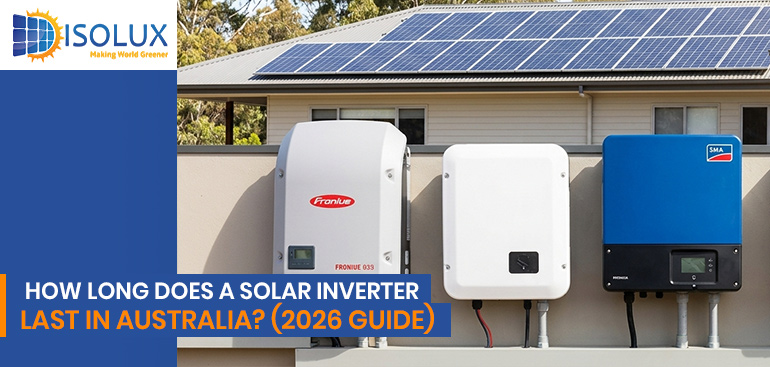

A solar inverter typically lasts between 10 and 15 years in Australia, though the exact figure depends on the type of inverter, the climate it operates in, and how well it has been maintained. If you have had solar panels on your roof for close to a decade, this is the question worth asking now, before a sudden failure catches you off guard.
Solar panels are built to outlast almost everything else on your roof. Most carry performance warranties of 25 years or more. The inverter, however, is a different story. It is the hardest working, most heat-exposed, and most electronically complex part of your entire solar system. Therefore, it is almost always the first component to wear out.
In this guide, we will break down exactly how long a solar inverter lasts depending on its type, what shortens or extends that lifespan, the early warning signs of failure, and when solar inverter repair makes more sense than a full solar inverter replacement. We will also cover solar inverter installation standards in Australia and simple solar inverter maintenance habits that can add years to your system’s working life.
How Long Does a Solar Inverter Last in Australia?
On average, a solar inverter in Australia lasts 10 to 15 years. This is shorter than the 25 to 30 year lifespan of solar panels, which is why most homeowners will need to replace their inverter at least once during the life of their solar system.
This 10 to 15 year window is not a fixed rule. It is an average drawn from how most residential string inverters perform under typical Australian conditions. Some inverters fail within 5 years due to poor installation or a manufacturing fault. Others, particularly well-built premium units installed in cool, shaded positions, can run reliably for close to 20 years.
The type of inverter you have makes the single biggest difference to this number. A budget string inverter baking in direct sun will not last as long as a premium hybrid inverter mounted in a shaded, well-ventilated garage. Climate matters too. Inverters installed in hot inland regions of Queensland or Western Australia generally age faster than those in milder coastal or southern climates, because heat is the number one cause of premature component failure.
String Inverters vs Hybrid Solar Inverters vs Microinverters
Not all inverters age the same way. The three main types used in Australian homes have noticeably different lifespans, largely because of how they are built and how hard they work.
String inverter lifespan
A string inverter connects a whole row, or “string,” of solar panels to a single central unit, usually mounted on a wall. This is the most common and most affordable type of solar inverter installation in Australia.
String inverters typically last 10 to 15 years. Because all your panels rely on one box, a single fault can take your entire system offline. Manufacturer warranties usually run from 5 to 10 years, with some premium brands offering paid extensions out to 15 or 20 years.
Hybrid solar inverter lifespan
A hybrid solar inverter does everything a string inverter does, plus it manages a connected battery, switching power between solar, battery, and grid as needed. This makes it the standard choice for any home with, or planning for, battery storage.
Because a hybrid solar inverter works almost continuously, charging during the day and discharging overnight, it tends to run hotter and harder than a solar-only string inverter. As a result, its typical lifespan sits slightly lower, around 10 to 12 years, even though build quality is often higher. If you are adding a battery to your home, it is worth choosing a hybrid inverter designed specifically for that workload rather than retrofitting an older string inverter.
Microinverter lifespan
A microinverter is a small unit fitted behind each individual solar panel, rather than one central box for the whole array. This decentralised design means that if one microinverter fails, the rest of your system keeps working normally.
Microinverters generally last 20 to 25 years, closely matching the warranty period of solar panels themselves. Many carry a manufacturer warranty of 20 to 25 years. The trade-off is a higher upfront cost, since you are buying one unit per panel rather than a single central inverter.
What Affects How Long a Solar Inverter Lasts?
Several factors influence how long a solar inverter holds up in real-world Australian conditions. Understanding them helps you protect your investment and spot problems early.
Heat and installation location
Heat is the leading cause of inverter failure. Inside every inverter, components called capacitors contain a liquid that slowly evaporates when exposed to high temperatures. For every 10°C rise in operating temperature, the working life of electronic components can be cut roughly in half.
This is why installation location matters so much. An inverter mounted in direct sun on a north-facing brick wall in Darwin or Alice Springs will age far faster than the same unit installed in a shaded, ventilated spot in Hobart. Always install your inverter out of direct sunlight, with enough clearance for airflow.
Component quality and brand
Cheaper inverters often use lower-grade capacitors and simpler cooling systems. Premium brands generally use higher-grade components and active cooling, such as smart fans, rather than relying on basic heat sinks alone.
A higher quality inverter typically costs more upfront. However, it often pays for itself through a longer working life, fewer repairs, and better energy conversion efficiency over time.
Grid voltage fluctuations
Australia’s electricity grid is not always perfectly stable. Voltage spikes or fluctuations, particularly in older suburbs or regional areas, place extra stress on an inverter’s internal circuitry. Over many years, this stress can shorten the unit’s working life and trigger more frequent fault codes.
A licensed installer can fit surge protection devices to reduce this risk, which is a worthwhile addition if your home has a history of voltage issues.
Battery integration and daily workload
Adding a battery to your solar system increases how hard your inverter works. A hybrid inverter charging and discharging a battery every single day experiences more thermal cycling than a solar-only string inverter that simply exports power during daylight hours.
This higher workload is one reason hybrid inverters tend to have a slightly shorter expected lifespan than solar-only string inverters of similar build quality, despite often being the newer and more advanced product.
Signs Your Solar Inverter Needs Repair or Replacement
Most inverters give some warning before they fail completely. Knowing what to look for can help you act before you lose solar generation altogether.
Watch for these warning signs. A blinking red or amber light on the inverter display, rather than the usual steady green, often signals a fault. Error codes or fault messages appearing on the screen are another clear signal, especially if they recur after a restart. A sudden or gradual drop in energy production, visible in your monitoring app, can point to declining inverter performance even before a full failure.
Unusual noises, such as a loud buzzing or clicking sound, are also worth investigating. So is the inverter shutting down repeatedly during the day, particularly on hot afternoons. Finally, if your monitoring app stops updating or shows the inverter as offline for no clear reason, it is time to call a technician.
If you notice any of these signs, do not wait. A failing inverter that keeps running in a degraded state can sometimes cause secondary damage to other components, turning a simple solar inverter repair into a more expensive solar inverter replacement.
Solar Inverter Repair vs Solar Inverter Replacement: Which One Do You Need?
Once a fault appears, the next decision is whether to repair the existing unit or replace it entirely. The right choice usually comes down to age, warranty status, and the cost of the fix relative to a new unit.
If your inverter is still within its manufacturer warranty period, solar inverter repair through the original installer or manufacturer is almost always the better option, since parts and labour may be covered at no cost to you. However, if your inverter is more than 8 to 10 years old and out of warranty, a major fault is often a sign that full solar inverter replacement makes more financial sense than ongoing repairs.
There is also a practical issue many Australian homeowners run into. An estimated one in three solar systems in Australia is now an “orphan” system, meaning the original installer or manufacturer is no longer trading. If this applies to your system, a warranty claim may not be possible, and replacement becomes the only realistic path forward.
As a general guide, a minor repair, such as replacing a fan or a small circuit board, might cost a few hundred dollars. A full replacement of a string inverter typically costs between 1,500 and 4,000 dollars including installation, depending on size and brand. If your existing system is approaching the end of its expected lifespan anyway, it is often more cost-effective to replace the inverter once rather than repair it repeatedly over the following years.
Solar Inverter Maintenance Tips to Extend Its Lifespan
Good solar inverter maintenance will not make a unit last forever, but it can meaningfully extend its working life and reduce the chance of an unexpected failure.
Keep the area around the inverter clean and free of dust, leaves, and cobwebs, since blocked vents trap heat inside the casing. Check your monitoring app every few weeks for unusual dips in production or recurring error codes, rather than waiting until something visibly goes wrong. Make sure nothing is stacked against or near the inverter that could restrict airflow, particularly in a garage or under-house installation.
Have a licensed solar technician inspect your system every two to three years, especially once it passes the 7 to 8 year mark. This check should include tightening any loose electrical connections, testing surge protection, and confirming the inverter’s settings still meet current Australian standards. Routine solar inverter maintenance like this is one of the most cost-effective ways to protect the investment you have already made in your solar system.
Solar Inverter Installation and Australian Standards (AS/NZS 4777)
Every grid-connected solar inverter installation in Australia must comply with AS/NZS 4777.2, the national standard governing inverter performance, and AS/NZS 4777.1, which governs installation requirements. Since February 2025, all new inverters connected to the grid must meet the AS/NZS 4777.2:2020 standard, with installation carried out according to AS/NZS 4777.1:2024.
To be eligible for federal Small-scale Technology Certificates, your inverter must also appear on the Clean Energy Council’s list of approved products. Using a non-approved inverter can void your warranty, delay your grid connection application, and disqualify you from available rebates.
This is why solar inverter installation should always be carried out by a Clean Energy Council accredited installer. A compliant installation is not just a legal requirement. It also ensures correct system sizing, proper surge protection, and inverter settings configured to your local network’s requirements, all of which directly affect how long your inverter will last.
How Much Does Solar Inverter Replacement Cost in Australia?
Solar inverter replacement costs in Australia vary depending on the type and size of unit you choose. A standard string inverter for a typical residential system generally costs between 1,200 and 2,500 dollars for the unit itself, with installation often bringing the total closer to 3,000 dollars.
Hybrid solar inverters, which include battery management hardware, usually cost more, typically ranging from 2,500 to 4,500 dollars installed. Microinverters are priced per panel rather than per system, generally between 150 and 250 dollars each, meaning a full residential array can cost several thousand dollars in total, though this is often offset by their much longer 20 to 25 year lifespan.
It is also worth checking whether replacing your inverter qualifies you for new Small-scale Technology Certificates, which can meaningfully reduce the out-of-pocket cost. A licensed installer can confirm your eligibility before any work begins.
Should You Upgrade to a Hybrid Solar Inverter When Replacing Yours?
If your existing string inverter has failed or is approaching the end of its life, replacement is the natural moment to consider upgrading to a hybrid solar inverter, particularly if you are thinking about adding a battery now or in the next few years.
A hybrid inverter installed today, even without a battery connected on day one, is generally battery-ready from the start. This avoids the cost and hassle of fitting a second inverter later, when you eventually decide to add storage. It also means your new inverter will be compliant with the latest AS/NZS 4777.2 standard and able to support current monitoring and grid-export features that older string inverters may lack.
That said, a hybrid inverter is not the right choice for every household. If you have no plans for battery storage and simply want the most cost-effective solar-only solution, a quality string inverter remains a sensible and proven option.
Conclusion
A solar inverter in Australia typically lasts 10 to 15 years, with string inverters at the lower end of that range, hybrid inverters often a touch shorter due to their heavier workload, and microinverters lasting considerably longer at 20 to 25 years. While your solar panels will likely outlive your home’s first inverter by a decade or more, knowing what shortens an inverter’s life, watching for early warning signs, and keeping up with simple maintenance can help you avoid an unexpected failure and get the most value from your solar investment.
If your inverter is approaching the 10 year mark, showing fault codes, or simply underperforming, it is worth getting a professional assessment before a small issue becomes a costly one. Isolux Solar‘s CEC-accredited team can inspect your existing system, advise honestly on repair versus replacement, and recommend the right inverter, string, hybrid, or microinverter, for your home’s needs and budget. Get a free quote from Isolux Solar today and keep your solar system performing the way it should.
Frequently Asked Questions
How do I know how old my solar inverter is?
Check your original solar installation paperwork or look at the manufacturing date printed on the inverter’s label, usually found on a sticker on the side or front of the unit.
Can a solar inverter be repaired instead of replaced?
Yes, in many cases. If the inverter is still under manufacturer warranty, repair is usually free or low cost. Once it is out of warranty and more than 8 to 10 years old, replacement is often more economical than ongoing repairs.
Does adding a battery shorten my inverter’s lifespan?
It can. A hybrid inverter managing daily battery charge and discharge cycles works harder than a solar-only string inverter, which is why hybrid units often have a slightly shorter expected lifespan of around 10 to 12 years.
What is the most common cause of solar inverter failure?
Heat is the leading cause. Excessive heat speeds up the breakdown of internal capacitors, which is why correct installation location and good ventilation matter so much for inverter longevity.