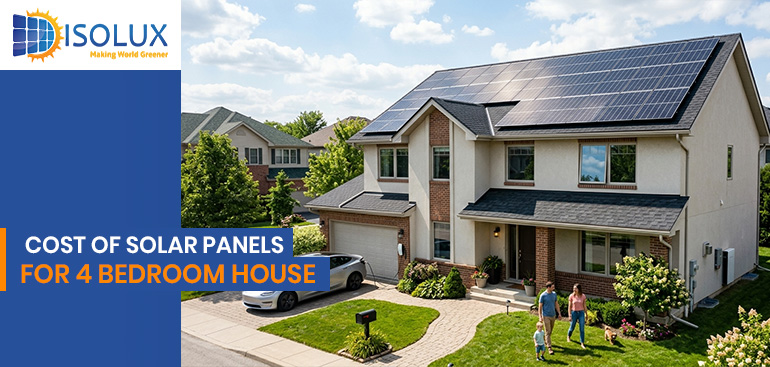

If you own a four-bedroom home and want to cut your electricity bills, solar is the smartest move you can make in 2026. The cost of solar panels for a 4 bedroom house in Australia ranges from $5,500 to $12,000 after government rebates. The exact price depends on your system size, location, and panel quality. In this guide, we break down everything you need to know – costs, savings, payback periods, and tips to get the best value.
How Much Does a 4 Bedroom House Electricity Bill Cost?
Before choosing a solar system, it helps to understand your current usage.
A typical four-bedroom Australian home uses between 20 and 30 kWh per day. This adds up to roughly 7,300 to 10,950 kWh per year. With NSW electricity now averaging 35 to 40 cents per kWh, most four-bedroom households spend $1,800 to $2,400 per year on grid electricity.
Therefore, installing solar panels can cut this cost significantly – sometimes by as much as 80%.
What Size Solar System Does a 4 Bedroom House Need?
Choosing the right system size is critical. Too small and you miss out on savings. Too large and you overspend unnecessarily.
6.6kW Solar System
This is the most popular choice for an average four-bedroom home. It suits households with quarterly bills of $250 to $400. A 6.6kW system generates approximately 9,500 to 10,500 kWh per year in Sydney. It typically uses 15 to 16 x 440W Tier 1 solar panels.
10kW Solar System
A 10kW system suits larger four-bedroom homes with higher energy use. It is ideal for households running ducted air conditioning, a pool pump, or an EV charger. This system generates approximately 14,900 to 15,300 kWh per year in Sydney. It suits quarterly bills of $450 to $600.
13.2kW Solar System
This is the right fit for very high-consuming households or EV owners with quarterly bills above $600. It generates approximately 18,900 to 19,300 kWh per year. However, it requires sufficient roof space and a compatible switchboard.
Cost of Solar Panels for 4 Bedroom House: Full Price Table
Here is a clear breakdown of the fully installed cost after the federal STC rebate in 2026:
| System Size | Panels Required | Installed Cost (After Rebate) | Best For |
| 6.6kW | 15 to 16 panels | $5,500 to $8,000 | Average 4-bedroom home |
| 10kW | 22 to 24 panels | $8,500 to $12,000 | Large family, pool, or EV |
| 13.2kW | 30 panels | $11,000 to $16,000 | Very high usage or EV owners |
All prices include panels, inverter, mounting hardware, labour, and grid connection paperwork.
Government Rebates That Reduce Your Solar Cost
Federal STC Rebate
The Australian Government’s Small-scale Technology Certificate (STC) scheme reduces your upfront cost immediately. In 2026, a 6.6kW system in Sydney attracts approximately $3,000 to $4,000 in STC rebates. This discount applies automatically on your installation invoice. Therefore, you do not need to claim it separately.
State-Based Rebates
Additional incentives are available depending on your state:
In NSW, households connecting a battery to a Virtual Power Plant (VPP) receive up to $1,500 in additional incentives. In Victoria, eligible homeowners access up to $1,400 through the Solar Homes Program. In South Australia, the Home Battery Scheme offers further savings on battery storage. In Queensland, new battery incentive programs continue to develop.
Also, the federal Cheaper Home Batteries Program launched in July 2025 offers a 30% discount on eligible battery installations – on top of your solar rebate.
Real-Life Example: 4 Bedroom Home in Western Sydney
Let us look at a real example to make this concrete.
A four-bedroom family home in Parramatta has a quarterly electricity bill of $520. They work from home two days per week and run a 5kW ducted air conditioning system.
They installed a 6.6kW solar system from Isolux Solar using Tier 1 Jinko panels and a Sungrow inverter. The gross cost is $8,200. After the federal STC rebate of $3,400, their net cost is $4,800.
The system generates approximately 10,200 kWh per year. At a 45% self-consumption rate, the family avoids buying 4,590 kWh from the grid, saving $1,744 at 38 cents per kWh. They also export 5,610 kWh at 7 cents, earning $393 in feed-in credits. Total annual savings: $2,137.
Payback period: $4,800 ÷ $2,137 = 2.25 years – approximately 27 months.
After payback, they save over $2,000 per year for the remaining 22+ years of the system’s life.
How Long Does Solar Take to Pay Off for a 4 Bedroom House?
The payback period for solar on a four-bedroom home in Australia typically falls between 3 and 5 years. However, high self-consumption households can achieve payback in as little as 2 to 3 years.
Several key factors influence this:
Self-consumption rate matters most. The more solar energy you use directly during the day, the faster you recover your investment. Running appliances during daylight hours – dishwashers, washing machines, pool pumps – significantly improves your payback speed.
Electricity tariff also plays a major role. Higher tariffs mean greater savings per kilowatt-hour of solar energy consumed. NSW households currently benefit from some of Australia’s highest retail electricity rates, which accelerates payback considerably.
Feed-in tariff rate adds further savings. NSW feed-in rates range from 5 to 9 cents per kWh. While lower than grid tariffs, they still contribute meaningfully to annual savings, particularly for larger systems generating surplus electricity.
System quality affects long-term performance. Tier 1 panels degrade at just 0.5% per year. Budget panels may degrade twice as fast, reducing output and extending payback over time.
Tips to Improve Your Solar ROI as a 4 Bedroom Homeowner
Getting the best return from your solar investment does not end at installation. Several practical steps can actively shorten your payback period and increase lifetime savings.
Shift appliances to daylight hours. Set your washing machine, dishwasher, and pool pump to run between 9 am and 3 pm using built-in timers. This directly increases your self-consumption rate and reduces grid imports.
Choose the right electricity retailer. Feed-in tariff rates vary significantly between retailers. Shopping for the best solar plan at installation – and reviewing it annually – can add hundreds of dollars to your yearly savings.
Add battery storage when ready. A battery allows you to store surplus daytime solar for evening use. With the federal 30% battery rebate now available, 2026 is an excellent time to include storage. Also, connecting your battery to an NSW VPP earns up to $1,500 in additional incentives.
Keep panels clean. Dirty panels lose 5% to 15% of output. A simple annual clean maintains peak performance and protects your payback timeline.
Monitor your system regularly. Use your inverter app to track daily generation. A sudden drop in output often signals a maintenance issue that, if addressed early, prevents prolonged underperformance.
How Does the Cost Compare Across Australian States?
Solar installation costs vary modestly across Australia. However, payback periods also vary due to differences in electricity tariffs and sunlight hours.
| State | Avg. Installed Cost (6.6kW) | Avg. Payback Period |
| NSW (Sydney) | $5,500 to $8,000 | 3 to 5 years |
| VIC (Melbourne) | $5,000 to $7,500 | 3.5 to 5.5 years |
| QLD (Brisbane) | $4,500 to $7,000 | 2.5 to 4 years |
| WA (Perth) | $4,500 to $7,000 | 3 to 5 years |
| SA (Adelaide) | $4,500 to $6,500 | 2.5 to 4 years |
Queensland and South Australia consistently achieve the fastest payback due to high solar irradiance and, in SA’s case, Australia’s highest electricity tariffs. NSW homeowners also benefit from strong payback due to high grid electricity rates.
For a detailed breakdown of Sydney-specific solar costs, read our How Much Do Solar Panels Cost in Sydney? guide.
Is the Cost of Solar Panels for a 4 Bedroom House Worth It?
Absolutely. Even at the higher end of the price range – a $12,000 10kW system for a large four-bedroom home – the mathematics are compelling.
At $3,000 per year in savings, that system pays for itself in four years. It then saves $3,000 per year for the following 21 years, delivering approximately $63,000 in lifetime savings before accounting for electricity price increases, which make future savings worth even more in dollar terms.
Furthermore, solar panels increase property values. Australian research consistently shows that solar-equipped homes sell faster and at higher prices than comparable properties without solar, adding $15,000 to $30,000 to valuations in NSW.
The cost of solar panels for a 4 bedroom house has also never been lower. Falling system prices, rising electricity tariffs, and generous government rebates in 2026 have created the most financially favourable environment for solar investment in Australia’s history.
Frequently Asked Questions
How many solar panels does a 4 bedroom house need in Australia?
Most four-bedroom homes need between 15 and 24 panels, depending on system size. A 6.6kW system uses approximately 15 to 16 panels rated at 440W each. A 10kW system uses 22 to 24 panels.
What is the cheapest solar system for a 4 bedroom house?
A 6.6kW system is the most cost-effective starting point for most four-bedroom homes, costing $5,500 to $8,000 after the federal rebate. For detailed pricing, compare our Residential Solar Packages.
Do I need battery storage for a 4 bedroom house?
Battery storage is optional but increasingly popular. With the federal 30% battery rebate now available, adding a battery significantly improves your energy independence and reduces evening grid consumption. Read more about Solar Battery Storage.
How much does a 10kW solar system cost for a large 4 bedroom home?
A 10kW solar system costs approximately $8,500 to $12,000 fully installed after rebates in NSW. For full details, visit our 10kW Solar System Guide.
Get a Free Quote for Your 4 Bedroom Home
Every four-bedroom home is different. The best way to know exactly what solar will cost for your home – and how quickly it will pay for itself – is to get a personalised quote based on your actual energy bill, roof configuration, and location.
Isolux Solar provides free, no-obligation quotes that include a full cost breakdown, savings estimate, payback period calculation, and all available rebates already applied.
Get Your Free Solar Quote Today
Isolux Solar has been a CEC-accredited solar installer in Sydney and NSW since 2013. Prices are indicative based on March 2026 market data. Individual quotes will vary based on site assessment.