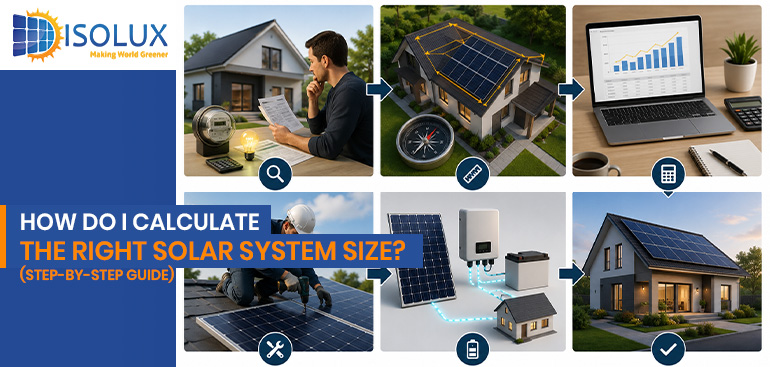

To calculate the right solar system size for your home, divide your average daily electricity consumption (in kWh) by your location’s peak sun hours, then multiply by 1.25 to account for system losses. For most Australian households using 15 to 25 kWh per day, this calculation points to a system between 6.6 kW and 10 kW.
That is the short answer. However, getting your Solar System Size right involves a few more practical steps that make the difference between a system that pays for itself quickly and one that either misses the mark or overspends your budget. This step-by-step guide walks you through every factor clearly, with real Australian examples throughout.
Step 1: Find Your Daily Electricity Consumption
The foundation of every solar sizing calculation is understanding how much electricity your household actually uses. Without this number, every other calculation is just guesswork.
How to Read Your Electricity Bill
Your electricity bill is the most accurate source of your consumption data. Look for a section labelled “Average Daily Usage” or “Average Daily Consumption” measured in kilowatt-hours (kWh). Most Australian electricity bills display this figure clearly.
If your bill shows a quarterly or monthly total instead of a daily average, simply divide the total kWh by the number of days in the billing period. For example, if your bill covers 90 days and shows 1,800 kWh used, your average daily consumption is 20 kWh.
On average, Australian homes use 11 to 23 kWh per day. However, your actual usage depends on household size, appliances, climate control habits, and whether you work from home. Therefore, use a full year of bills rather than a single quarter to find your truest average. Summer bills will be higher in states like Queensland due to air conditioning, while Victoria households often see higher winter consumption from electric heating.
What If You Do Not Have a Recent Bill?
If you are a new homeowner or do not have recent bills available, your electricity retailer can provide 12 months of historical consumption data on request. Alternatively, a rough estimate based on household size works as a starting point:
A single person or couple typically uses around 8 to 12 kWh per day. A family of three to four people generally uses 15 to 22 kWh per day. A larger household of five or more people with ducted air conditioning often consumes 25 to 35 kWh per day.
Also, consider whether your consumption is about to change. If you are installing an EV, switching from gas to electric appliances, or adding a pool, factor this into your baseline figure before sizing your system.
Step 2: Account for Peak Sun Hours in Your Location
Once you know your daily consumption, the next step is understanding how much solar energy your location actually receives. This is measured in peak sun hours (PSH), which represents the number of hours per day where solar irradiance averages 1,000 watts per square metre.
Peak sun hours are not the same as daylight hours. A city may have 12 hours of daylight but only 4.5 to 5.5 hours of genuinely productive solar generation. This is the figure that matters for sizing.
As a practical guide for major Australian cities:
Sydney and Brisbane typically average around 4.5 to 5.2 peak sun hours per day across the year. Melbourne averages around 4.0 to 4.5 hours. Adelaide sits at approximately 5.0 hours. Perth typically leads the mainland capitals with around 5.5 to 6.0 hours per day. Darwin and inland Queensland receive even more, often exceeding 6.0 hours.
Also, remember that winter generation is meaningfully lower than summer in most cities. Melbourne in winter may receive only 3.0 to 3.5 peak sun hours per day, which affects how much energy your system generates during those months.
Step 3: Apply the Solar System Size Formula
Now you have the two core inputs: your daily consumption and your peak sun hours. The calculation is straightforward.
The formula:
Daily consumption (kWh) ÷ Peak sun hours = Minimum system size (kW)
For example, a Sydney household using 20 kWh per day, with 4.8 peak sun hours:
20 ÷ 4.8 = 4.17 kW (minimum)
However, this result represents a system that just barely covers your consumption under ideal conditions. In practice, no solar system operates at 100% efficiency all day. Therefore, you need to add a buffer for real-world losses, which is covered in the next step.
Step 4: Factor In System Losses and Inefficiencies
A solar system does not convert 100% of sunlight into usable electricity. Panel temperature, wiring resistance, inverter conversion losses, dust accumulation, and minor shading all reduce real-world output by 15 to 25% compared to rated capacity.
The standard way to account for this is to multiply your raw calculation by 1.25 (which represents a 20% loss factor). This is a widely used industry buffer for Australian residential systems.
Updated formula with loss factor:
(Daily consumption ÷ Peak sun hours) × 1.25 = Recommended system size (kW)
Applying this to the Sydney example:
(20 ÷ 4.8) × 1.25 = 5.2 kW
This result represents the minimum recommended system size for reliable daily coverage. In practice, most installers would suggest rounding up to 6.6 kW for this household, for several important reasons covered in the next sections.
Step 5: Check Your Roof Space and Orientation
The formula above gives you a theoretical system size in kilowatts. The next question is whether your roof can physically accommodate that many panels.
How Much Roof Space Does Each System Size Need?
Each modern residential solar panel in 2026 measures approximately 1.7 metres by 1 metre and requires around 1.7 square metres of roof space. Standard panel wattages currently range from 400W to 470W per panel.
A 6.6 kW system using 440W panels requires approximately 15 panels. At 1.7 square metres each, you need around 25 to 30 square metres of usable roof space. A common 6.6 kW system might take up 29 to 32 square metres of roof area depending on the panel’s rated capacity.
A 10 kW system using 470W panels requires approximately 21 to 22 panels, needing around 36 to 38 square metres of clear roof space.
It is important to note that usable roof space is not the same as total roof area. Chimneys, vents, skylights, valleys, hips, and setback requirements from roof edges all reduce the area available for panels. Your installer will conduct a detailed roof assessment to identify exactly how many panels fit on your specific roof layout.
Best Roof Orientation for Solar in Australia
In Australia, north-facing panels produce the most energy year-round, as they receive the most direct sunlight throughout the day. East and west-facing arrays produce around 15 to 20% less output than north-facing installations but can still be highly effective.
A split east-west orientation across a dual-pitch roof actually delivers a useful advantage: it smooths your generation profile across the morning and afternoon, providing more consistent output rather than a sharp midday peak. This is particularly beneficial for households with higher morning and evening electricity usage.
South-facing panels are generally avoided unless there is no practical alternative, as they receive minimal direct sunlight across most Australian latitudes.
Also, roof pitch affects output. A pitch of 10 to 30 degrees is generally optimal for most of Australia. Very flat roofs may require tilt-frame mounting to achieve a more effective angle.
Step 6: Think About Your Future Energy Needs
One of the most common solar sizing mistakes is calculating only for today’s energy use. A solar system lasts 25 years or more, so sizing purely for your current consumption can leave you short within a few years.
Think about what your energy needs are likely to look like over the next three to five years.
Electric vehicle:
An EV adds roughly 2,000 to 4,000 kWh per year to your household consumption, which equals approximately 5 to 11 kWh of additional daily usage. A standard 6.6 kW system generally cannot cover both home use and regular EV charging. Therefore, if you own or plan to buy an EV, size your system accordingly from the start.
Switching from gas to electric:
Induction cooktops, heat pump hot water systems, and electric space heaters add meaningful load. A heat pump hot water system replaces gas and adds roughly 1,500 to 3,000 kWh per year if run off solar.
Adding a home battery:
To get real value from a battery, your solar system needs to generate enough surplus during the day to fill the battery after covering your daytime household needs. This typically requires a system at least 2 kW larger than your bare consumption-based calculation suggests.
Installing a pool:
A pool pump running 6 to 8 hours per day can add 5 to 10 kWh of daily consumption. Sizing for this load now avoids the cost and complexity of upgrading your system later.
Adding panels later can be harder than it seems and it can be relatively cheap to buy a bigger system since you are already spending the upfront amount for installation. The additional cost of going from 6.6 kW to 10 kW is often modest compared to the long-term benefit.
What Is the Average Solar System Size in Australia?
Australia’s average residential solar system size has grown substantially over recent years. In September 2025, the average newly installed system reached 10.9 kW, up from 9.8 kW just a month earlier, driven by falling panel prices and growing household energy needs including EVs and battery storage.
Australia’s most popular residential system size has consistently been around 6.6 kW. However, larger systems of 8 kW to 10 kW or more are becoming increasingly common, especially for battery-paired installations. Nationally, 4.2 million or 29% of Australian houses now have rooftop solar installed. Coverage exceeds 40% in cities like Perth, Adelaide, and Brisbane.
The shift toward larger systems reflects two key trends. First, panel prices have fallen by approximately 15% in the past year, making larger systems more affordable than ever. Second, homeowners increasingly recognise that a larger system provides more flexibility, better battery charging, and greater protection against future load increases.
Solar System Size Guide: Which Size Suits Which Household?
The following guide matches common Australian household types to recommended system sizes. These are starting points based on typical consumption patterns. Your actual recommendation may differ based on your specific energy data.
5 kW system suits small households of one to two people with daily consumption of around 10 to 15 kWh. It generates approximately 18 to 22 kWh per day in Sydney. This size is a practical minimum for single-person homes or small units with limited roof space.
6.6 kW system is Australia’s most widely recommended size and suits the majority of three-to-four person households with daily consumption of 15 to 22 kWh. It generates approximately 24 to 28 kWh per day in Sydney and is the most popular size because it extracts maximum value from a standard 5 kW single-phase inverter by exploiting the Clean Energy Council’s 133% panel-to-inverter clipping rule. A 5 kW inverter can legally pair with 6.6 kW of panels, which is why this combination dominates the Australian residential market.
10 kW system suits larger households of four or more people with daily consumption above 22 kWh, or any household planning to charge an EV, run a pool, or add a battery. It generates approximately 38 to 44 kWh per day in Sydney. A 10 kW system typically requires three-phase power or two separate 5 kW inverters, depending on your grid connection.
13.2 kW system suits high-consumption homes with daily usage above 30 kWh, large air conditioning loads, or commercial-residential hybrid situations. It generates approximately 50 kWh or more per day in sunny conditions and is increasingly popular as panel prices fall and electricity costs rise.
Should You Oversize Your Solar System?
The term “oversizing” refers to installing a panel array larger than your inverter’s rated capacity. Under Australian standards, you can oversize panels up to 133% of inverter capacity without losing eligibility for the federal STC rebate. This is known as the 20% rule.
For example, a 5 kW inverter can legally pair with 6.6 kW of panels (6,600W ÷ 5,000W = 132% of inverter capacity). The benefit of this arrangement is that the panels generate more energy in low-light morning and afternoon conditions, while the inverter simply clips any excess during peak midday production.
In practical terms, this rarely results in lost energy for most households. Also, the additional cost of the extra panels is modest but the generation benefit across a full year is meaningful. This is one reason why 6.6 kW is Australia’s dominant system size: it delivers more kilowatt-hours per dollar than a straight 5 kW configuration.
However, oversizing beyond the 133% threshold is not permitted under Australian Standards. Your installer will confirm the right panel-to-inverter ratio as part of the system design process.
How Solar System Size Affects Battery Pairing
If you are planning to add a battery now or in the future, your solar system size needs to account for more than just daily consumption. A battery only delivers its full value when your solar system generates enough surplus to fill it consistently.
Consider a practical example. A Sydney household uses 20 kWh per day. A 6.6 kW system generates approximately 26 kWh per day in summer. After covering 10 kWh of daytime household load, approximately 16 kWh of surplus is available to charge a battery. A 14 kWh battery fills comfortably from this surplus on most days, with some energy still exported.
However, if the same household had a 5 kW system generating only 20 kWh per day, almost all solar output covers daytime usage, leaving minimal surplus for battery charging. The battery would rarely fill to capacity, dramatically extending the payback period.
The general recommendation for battery-paired systems is to oversize your solar array by at least 2 kW above your bare consumption-based calculation. This ensures consistent battery charging and maximum self-consumption without relying on grid top-ups.
Furthermore, homes intending to add a battery often size their solar system bigger to ensure enough surplus energy is generated during the day. Choosing a larger system upfront is more cost-effective than upgrading later, as the bulk of installation labour and equipment costs are incurred once.
Common Mistakes When Calculating Solar System Size
Avoiding these common errors will save you money and frustration over the life of your system.
Sizing only for current consumption.
Many homeowners install a system that covers today’s usage but does not account for future loads like an EV or heat pump. A common mistake is sizing a solar system purely for current consumption and then adding an EV or heat pump a year later, wishing the system were larger. Build future loads into your initial calculation.
Using the lowest electricity bill.
Some homeowners size based on their minimum-usage quarter, which is usually winter. However, summer consumption in Australia is typically significantly higher due to air conditioning. Always use a 12-month average, or better yet, size based on your highest consumption season.
Ignoring roof orientation and shading.
A north-facing roof in Sydney is very different from a heavily shaded east-facing roof in Melbourne. Panel output can vary by 20 to 30% depending on these factors. Always ask your installer to confirm expected output for your specific roof layout.
Choosing the cheapest quote without checking system size.
Two quotes may differ by $2,000, but if one system is 6.6 kW and the other is only 5 kW, you are comparing very different products. Always compare quotes on a per-kW basis rather than total system price.
Not planning for inverter compatibility.
If you plan to add a battery in the future, your inverter needs to be battery-compatible. Installing a basic string inverter today and adding a battery later typically requires replacing the inverter as well, doubling your upgrade costs. Avoiding these common errors will save you money and frustration over the life of your system.
Use the SunSPOT Solar Calculator for a Free Estimate
The Australian Government’s SunSPOT solar and battery calculator is a useful free tool for getting an independent sizing estimate before requesting quotes from installers.
SunSPOT was developed by solar engineers at the University of New South Wales (UNSW) and is operated as a government initiative. Add your electricity bill information or interval meter data to the SunSPOT solar and battery calculator to get an estimate of a suitable system size.
Unlike quotes from solar sales companies, a SunSPOT estimate does not make recommendations about brands or models of solar panels, inverters or batteries, nor will it share your details with third parties. You can access SunSPOT at energy.gov.au/solar.
This tool is a good starting point for independent sizing research. However, a professional on-site assessment from a CEC-accredited installer will always provide a more accurate result, as it accounts for your specific roof geometry, shading patterns, switchboard condition, and grid connection type.
Frequently Asked Questions
What solar system size do I need for an average Australian home?
For most Australian households using 15 to 22 kWh per day, a 6.6 kW system is the most commonly recommended starting point. Larger families, those with EVs, or households planning to add battery storage should consider 10 kW or more.
How do I calculate my solar system size?
The standard formula is: (Daily kWh consumption ÷ Peak sun hours) × 1.25 = Recommended system size in kW. For example, a household using 20 kWh per day in Sydney (4.8 peak sun hours): (20 ÷ 4.8) × 1.25 = 5.2 kW, rounded up to 6.6 kW in practice.
How many panels does a 6.6 kW solar system need?
A 6.6 kW system using 440W panels requires approximately 15 panels. With 470W panels, you need approximately 14 panels. Each panel occupies around 1.7 square metres of roof space, so the full system needs approximately 25 to 32 square metres of usable north or north-east facing roof area.
What is the average solar system size installed in Australia in 2026?
The average newly installed residential solar system reached 10.9 kW in September 2025, reflecting a strong trend toward larger systems driven by falling panel prices, growing household energy use, and increased battery storage uptake.
Is a 6.6 kW solar system enough for a family of four?
For a family of four using 18 to 22 kWh per day without an EV or pool, a 6.6 kW system typically covers daily needs well. However, if the family plans to add an EV, heat pump hot water, or a battery, a 10 kW system offers better long-term value and avoids a costly upgrade later.
What happens if my solar system is too small?
An undersized system will cover only part of your daily electricity needs. You will still draw from the grid during peak daytime hours and at night, reducing your savings and extending your payback period. Also, a small system may not generate enough surplus to charge a battery effectively.
Can I add more panels to my solar system later?
In some cases, yes. However, expanding an existing system is more complex and expensive than installing the right size from the start. You may need to upgrade your inverter, add new racking, and obtain additional approvals. It is nearly always more cost-effective to install a larger system upfront.
Does roof orientation affect what solar system size I need?
Yes. A north-facing roof in Sydney generates around 15 to 20% more output than an east or west-facing roof of the same panel area. This means a household with an east-facing roof may need a slightly larger system to achieve the same daily output as a comparable north-facing installation.
Get a Professional Solar Assessment Today
Calculating the right solar system size is not complicated once you understand the core inputs. Start with your daily consumption, apply your location’s peak sun hours, add a 25% buffer for losses, check your roof space, and plan for future loads. For most Australian families, a 6.6 kW to 10 kW system covers the full spectrum of daily needs in 2026.
At Isolux Solar, our accredited team conducts detailed on-site assessments across Sydney and New South Wales. We analyse your actual consumption data, assess your roof layout, and design a system sized precisely for your home, your budget, and your plans for the next 25 years.
Book your free solar assessment today at isolux.com.au