
Every week, Sydney homeowners are opening electricity bills and seeing rates they were not expecting. Feed-in tariffs that used to make exporting solar worthwhile have dropped to as low as 5 cents per kWh in 2026. At the same time, grid electricity costs have risen above 35 to 45 cents per kWh in many NSW plans.
The answer for many families is a 14kWh Solar Battery. It is the most discussed capacity size in Australia’s home battery market right now, and with good reason. A 14 kWh system sits at the exact threshold where the federal government’s Cheaper Home Batteries rebate delivers its maximum financial benefit. It also aligns closely with the typical evening energy demand of a Sydney family of three to four people.
This guide explains what a 14 kWh battery can realistically do for your Sydney home, how to know if it is the right size, and what you can expect to save once it is installed.
What Does 14kWh Actually Mean?
Before diving into whether a 14 kWh battery is right for your home, it helps to understand what that number actually represents.
Kilowatt-hours (kWh) are a measure of energy. One kWh is the amount of electricity used when a 1,000-watt appliance runs for one hour. To put 14 kWh in practical terms: it is roughly enough to run a standard refrigerator for five days, power your home lighting for a full week, or run a ducted air conditioner at moderate output for approximately four to five hours.
In practice, a 14 kWh solar battery stores energy from your solar panels during the day and releases it in the evening and overnight when your panels are no longer generating. The goal is to reduce or eliminate the electricity you draw from the grid during the expensive peak tariff hours.
It is also important to distinguish between nameplate capacity and usable capacity. Most batteries use 90 to 100% depth of discharge on modern LFP (Lithium Iron Phosphate) chemistry. Therefore, a battery advertised at 14 kWh delivers close to 14 kWh of actual usable energy. Always confirm the usable capacity with your installer before purchasing.
How Much Electricity Does a Sydney Home Use Each Day?
Understanding your household’s consumption is the essential first step in choosing the right battery size. Sydney homes vary widely in their electricity use, but some general benchmarks give you a useful starting point.
A typical Sydney household of two to three people uses approximately 15 to 20 kWh of electricity per day. A larger family of four or five uses 20 to 30 kWh or more daily, particularly during summer when ducted air conditioning runs frequently.
However, the total daily usage figure is only part of the picture. What matters even more for battery sizing is your evening load: the electricity you consume after the sun goes down and your solar panels stop generating.
Research consistently shows that most Australian households use approximately 60 to 70% of their daily electricity in the evening and overnight hours. Cooking, lighting, air conditioning, entertainment systems, and EV charging all fall into this after-dark window. The remaining 30 to 40% is consumed during daylight hours when solar panels actively supply your home.
For a Sydney household using 20 kWh per day, this means approximately 12 to 14 kWh of demand falls in the evening window. This is the demand your battery needs to cover.
How to Calculate the Right Solar Battery Size for Your Home
You do not need to be an engineer to work out the right battery size. Three straightforward steps will give you a reliable estimate.
Step 1: Find Your Daily Electricity Usage
Locate your most recent electricity bill. Find the section labelled “Average Daily Usage” or “Average Daily Consumption” in kilowatt-hours. If your bill shows quarterly totals instead, divide the total kWh by the number of days in the billing period.
For example, if your bill shows 1,800 kWh used over 90 days, your average daily usage is 20 kWh. Also check a bill from your highest-usage season, typically summer in Sydney when air conditioning increases consumption significantly. Size your battery to cover your higher-usage periods for maximum benefit year-round.
Step 2: Estimate Your Evening Load
Multiply your average daily usage by 0.6 to 0.7. This gives you an estimate of how much electricity your household uses in the evening and overnight hours.
Using the example above: 20 kWh multiplied by 0.65 equals 13 kWh. This is your target evening load. A battery with approximately 13 to 14 kWh of usable capacity covers this load comfortably on most nights.
Step 3: Match Your Battery to Your Solar System
A 6.6 kW solar system in Sydney generates approximately 24 to 27 kWh on a typical sunny day. A larger 10 kW system produces approximately 39 to 44 kWh per day. Your battery needs to be sized so it can realistically fill to capacity each day from your solar output.
If your solar system generates 26 kWh per day and your household uses 8 kWh during daylight hours, approximately 18 kWh of surplus is available to charge your battery. A 14 kWh battery fills comfortably from this surplus on most days, with some energy still available for grid export.
If your solar system is smaller, say 5 kW generating around 20 kWh per day, a 14 kWh battery still fills in most seasons, though winter generation may sometimes leave it partially charged.
Why 14kWh Is the Sweet Spot for Most Sydney Homes
The term “sweet spot” has become widely used in the Australian solar industry to describe the 14 kWh capacity, and the evidence supports it clearly.
For a typical Sydney family of three to four people, a 14 kWh battery covers evening electricity demand on most nights without requiring any grid top-up. This is the primary goal for homeowners looking to maximise their solar self-consumption and eliminate peak-tariff electricity purchases.
According to independent solar analysts, 13 to 14 kWh is the sweet spot for a two-to-four person household with average energy use, covering most overnight loads with solar top-up the following day, with annual savings of $900 to $1,400.
For Sydney specifically, the case is even stronger. NSW electricity tariffs are among the highest in Australia, with peak rates regularly exceeding 40 cents per kWh. Every kWh you store and use from your battery instead of buying from the grid at those rates delivers meaningful savings. Therefore, a battery that reliably covers your full evening load delivers the maximum annual savings possible from a single system.
Also consider the practicality of scalability. Many battery brands, including Sigenergy, Sungrow, and GoodWe, offer modular systems that start at around 8 to 10 kWh and can expand to 14 kWh or beyond. This means you can start at a capacity that suits your budget today and add modules later as your needs or finances allow.
Also Read: Best Battery Size Under the New 2026 Rebate
The 14kWh Solar Battery and the Federal Rebate: A Perfect Match
Here is where the 14 kWh capacity becomes particularly compelling from a financial perspective. The federal government’s Cheaper Home Batteries Program has a built-in structure that makes this precise capacity the most rebate-efficient choice available to Australian homeowners.
How the Tiered Rebate Structure Works
From 1 May 2026, the federal battery rebate changed to a tiered system. The new structure provides the full STC factor at 100% for battery capacity from 0 to 14 kWh, at 60% for capacity between 14 kWh and 28 kWh, and at 15% for capacity between 28 kWh and 50 kWh.
In plain terms, every kilowatt-hour of battery capacity up to 14 kWh receives the full rebate. Once you cross the 14 kWh threshold, the marginal rebate rate drops significantly. A standard 14 kWh battery sits in the sweet spot of the 100% incentive tier.
Based on current STC pricing, a 14 kWh battery installed under the current rates attracts approximately $3,400 in federal rebate. This amount reduces your upfront cost directly at the point of sale. You do not fill out any forms or claim anything separately. Your accredited installer applies the rebate to your invoice before you pay.
What This Means for Sydney Homeowners
For a Sydney homeowner, the 14 kWh threshold creates a clear and compelling financial decision point.
A 10 kWh battery receives the full rebate but leaves some evening demand unmet on higher-usage nights. A 16 kWh battery covers your evening needs more generously, but the 2 kWh above the 14 kWh threshold attracts only 60% of the rebate rate, reducing your dollar-per-kWh rebate efficiency.
A 14 kWh battery delivers complete coverage of the average Sydney family’s evening demand while capturing every dollar of the highest rebate rate. This combination of practical energy coverage and maximum financial incentive is why 14 kWh has become the most recommended capacity for Sydney homes in 2026.
Additionally, New South Wales offers a bonus VPP (Virtual Power Plant) incentive of up to $1,500 through the PDRS scheme for eligible homeowners who connect their battery to an approved VPP program. A Sydney homeowner installs a 13 kWh battery and receives approximately $3,900 in federal rebate plus up to $1,500 from the PDRS VPP incentive, with combined savings potentially reaching $5,400. This incentive stacks directly on top of the federal rebate, further improving the financial case.
Which 14kWh Solar Battery Options Suit Sydney Homes in 2026?
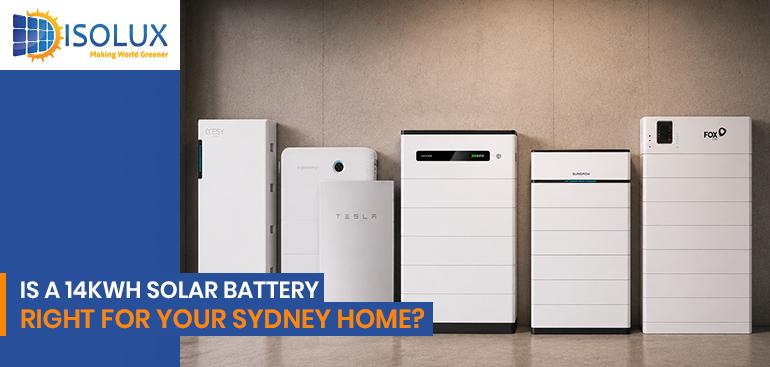
Several quality battery brands offer systems around the 14 kWh mark that are well-suited to Sydney conditions. The following options are CEC-approved, available through accredited NSW installers, and proven in Australian conditions.
Sigenergy SigenStor: Sigenergy’s modular system can be configured to 14 kWh using two 7 kWh modules or scaled to a custom capacity. The SigenStor is an all-in-one system with a built-in hybrid inverter, whole-home three-phase backup, and native EV DC charging capability. It is particularly well suited to Sydney homes with three-phase power or households planning to add an electric vehicle. The system’s AI-driven energy management automatically optimises charge and discharge timing around your tariff structure.
Sungrow SBR Series: The Sungrow SBR is Australia’s most-installed DC-coupled battery and one of the most cost-effective options at 12.8 kWh or 16 kWh. It suits Sydney homes installing solar and battery together with a Sungrow hybrid inverter. The SBR delivers reliable performance in Sydney’s summer heat and is backed by a 10-year warranty with a Sydney-based service team.
GoodWe Lynx F G2: At 12.8 kWh, the GoodWe Lynx F G2 falls just under the 14 kWh threshold while capturing the maximum rebate tier. It is one of the lowest-cost quality batteries in Australia at approximately $537 per kWh post-rebate. The Lynx works with GoodWe hybrid inverters and suits new system installations where the whole GoodWe ecosystem is installed together.
GoodWe ESA Series: The GoodWe ESA at 16 kWh is an all-in-one system that works with any existing solar inverter through AC coupling. It is the best option for Sydney homes that already have solar panels from another brand and want to add storage without replacing their current inverter. The ESA delivers 6 kW of continuous backup power and features a sub-4-millisecond switchover during blackouts. Your installer will recommend the most suitable product based on your existing system, roof type, energy usage, and budget.
How Much Can a 14kWh Solar Battery Save You in Sydney?
Savings depend on your electricity tariff, daily consumption, and how much solar your panels generate. However, real-world calculations for Sydney homes are encouraging.
Consider a practical Sydney example. A family of four in the Inner West uses 22 kWh of electricity per day. Their 8 kW solar system generates approximately 32 kWh on a typical sunny day. They consume about 10 kWh during daylight hours, leaving 22 kWh of surplus available to charge their battery and export to the grid.
Before adding a battery, 10 kWh of that surplus is exported each evening at a feed-in tariff of 6 cents per kWh, earning just 60 cents. The family then buys 13 kWh from the grid at night at 40 cents per kWh, spending $5.20.
After installing a 14 kWh battery, the same 13 kWh of evening demand is covered by stored solar. The daily savings are 13 kWh multiplied by the difference between the retail rate and the feed-in tariff: 13 × (40¢ minus 6¢) equals $4.42 per day. Over a full year, this amounts to approximately $1,613 in electricity savings.
At a net installed cost of approximately $7,500 to $9,500 after the federal rebate and NSW VPP incentive, payback arrives in approximately 5 to 6 years. The battery is then expected to continue performing well for 10 to 15 years, generating pure savings for the remainder of its life.
For families on time-of-use tariffs with peak rates above 40 cents per kWh, or those who participate in a VPP program and earn additional revenue by sharing stored energy during grid peak events, payback can be even faster.
When a 14kWh Solar Battery May Not Be Enough
A 14 kWh battery suits the majority of Sydney homes, but certain households may find their needs extend beyond this capacity.
Large homes with high energy consumption regularly exceeding 30 kWh per day are candidates for a larger system. If your evening load consistently reaches 18 to 20 kWh, a 14 kWh battery will cover most nights but will occasionally fall short during high-usage periods, particularly in peak summer when air conditioning runs late into the evening.
Households with an electric vehicle also benefit from extra capacity. Charging an EV overnight can add 8 to 15 kWh to your nightly electricity demand. A 14 kWh battery covers the home load but may leave little capacity for the car. In this scenario, a 20 to 24 kWh system delivers more comprehensive coverage.
Homeowners who want extended blackout protection through a multi-day outage also benefit from larger capacity. A 14 kWh battery covers one full night of typical household consumption, but provides limited reserve if grid power is unavailable for more than 24 hours.
However, for the majority of Sydney families with moderate energy use and no EV, 14 kWh is genuinely sufficient for daily operation and meaningful during short-term outages.
When a Smaller Battery Might Suit You Better
Not every Sydney household needs 14 kWh. Understanding when a smaller battery makes financial sense helps you avoid overspending on capacity you will not use.
A single person or couple using 10 to 12 kWh per day has an evening load of approximately 6 to 8 kWh. A 9.6 to 10 kWh battery covers this demand comfortably in most cases. Installing a larger battery simply means it rarely fills each day, reducing its effective utilisation and stretching the payback period.
Also, if your solar system is relatively small, such as 5 kW or less, it may not generate enough surplus to reliably fill a 14 kWh battery during the winter months. In this situation, a 10 kWh battery paired with plans to upgrade your solar system later is often the more practical approach.
The key principle is to match your battery to your actual evening load and your solar system’s real generating capacity, not to simply choose the largest system the rebate supports.
Solar Battery Installation in Sydney: What to Expect
Installing a battery in Sydney involves a straightforward process when you work with a CEC-accredited installer. Here is a brief overview of what to expect.
First, your installer conducts a site assessment to review your roof space, existing solar system, switchboard configuration, and electricity consumption. This assessment determines whether your switchboard needs an upgrade, whether a changeover switch is required for backup power, and which battery model is best suited to your home.
Installation typically takes one full day for a standard residential battery. The battery connects to your solar system, the installer configures the monitoring app, and your system begins operating immediately. The installer handles all federal rebate paperwork. Your discounted invoice already reflects the rebate amount.
In New South Wales, your installer can also register your system for the PDRS VPP incentive, which adds up to $1,500 to your total savings stack. This step is handled at installation and does not require any ongoing action on your part unless you choose to actively participate in VPP dispatch events.
After installation, most homeowners monitor their system through their battery brand’s app, which shows real-time solar generation, battery state of charge, household consumption, and grid interaction. This data helps you understand your energy use patterns and optimise your savings over time.
Ready to Find Out If 14kWh Is Right for You?
A 14 kWh solar battery is not the right answer for every Sydney home. However, for the majority of three-to-four-person households with a 6.6 kW to 10 kW solar system and typical evening consumption, it is genuinely the most cost-effective, rebate-efficient, and practically useful battery size available in 2026.
At Isolux Solar, our team helps Sydney homeowners make the right decision based on their actual energy data, not generic advice. We assess your home, calculate your real evening load, recommend the right battery size and brand, and handle every aspect of the installation and rebate process from start to finish.
Book your free solar battery assessment today at isolux.com.au
Frequently Asked Questions
Is a 14kWh solar battery enough for a Sydney family of four?
For most Sydney families of three to four people with average energy use of 18 to 22 kWh per day, a 14 kWh battery covers the full evening load on most nights. It is the most commonly recommended capacity for this household size in NSW in 2026.
Why is 14 kWh considered the battery sweet spot in Australia?
The federal Cheaper Home Batteries rebate provides its maximum rate for the first 14 kWh of battery capacity. Capacity above 14 kWh receives a significantly lower rebate rate. Because 14 kWh also aligns closely with the typical evening demand of an Australian family, it delivers both maximum rebate efficiency and practical energy coverage.
How much does a 14kWh solar battery cost in Sydney in 2026?
After the federal rebate, a 14 kWh solar battery system in Sydney typically costs between $7,500 and $10,500 installed, depending on the brand, installer, and whether any switchboard upgrades are needed. When the NSW VPP incentive of up to $1,500 is also applied, the net cost can reduce further.
How long does a 14kWh solar battery take to pay back in Sydney?
The typical payback period for a 14 kWh battery in Sydney is 5 to 7 years after rebates, depending on your electricity tariff and usage patterns. Families on time-of-use tariffs with peak rates above 40 cents per kWh generally achieve payback at the faster end of this range.
Can I add a 14kWh battery to my existing solar system in Sydney?
Yes. Many battery options, including the GoodWe ESA, Alpha ESS, and Sigenergy SigenStor, are designed to work with any existing solar inverter through AC coupling. Others, such as the Sungrow SBR and GoodWe Lynx, require a compatible hybrid inverter. Your installer will confirm which approach suits your current system.
Will a 14kWh battery keep my home running during a blackout?
Yes, most 14 kWh batteries with a backup function can power your essential appliances during a grid outage. On a typical day’s consumption, 14 kWh covers one full night of essential loads, including fridge, lighting, fans, and a few small appliances. Running ducted air conditioning through a blackout reduces this coverage significantly.
Does a solar battery in Sydney qualify for government rebates?
Yes. Any CEC-approved solar battery installed by an accredited installer alongside an existing or new solar system qualifies for the federal Cheaper Home Batteries Program. Sydney homeowners may also access the NSW PDRS VPP incentive of up to $1,500 on top of the federal rebate.
What is the best 14kWh solar battery for a Sydney home?
The right battery depends on your home’s phase connection, existing inverter brand, and goals. Sigenergy suits homes with three-phase power or EV plans. Sungrow SBR delivers strong value for new installations within the Sungrow ecosystem. GoodWe ESA is the best fit for retrofitting storage onto any existing solar system. An Isolux Solar assessment will identify the best match for your specific situation.