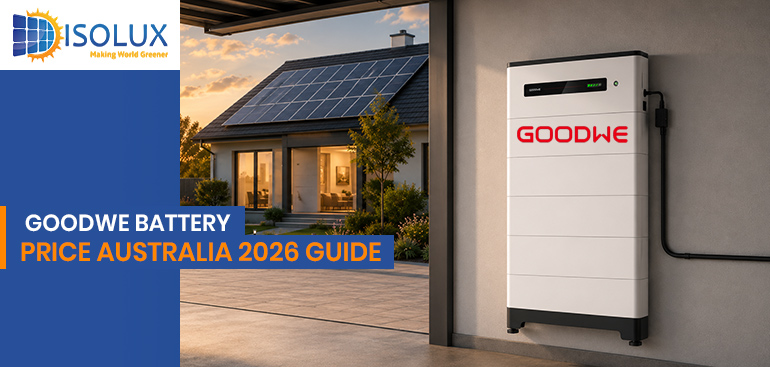

If you have been searching for the GoodWe Battery Price in Australia, you are not alone. GoodWe has quickly become one of the most talked-about solar battery brands in the country, and for good reason.
In 2026, the GoodWe battery range offers some of the most competitive pricing available among quality home storage systems. After the federal Cheaper Home Batteries Program rebate, a GoodWe Lynx Home F G2 (12.8 kWh) starts from approximately $6,876 installed. The newer ESA Series 16 kWh system costs around $6,995 to $9,500 installed after the rebate, depending on your location and installer.
These prices make GoodWe one of the most affordable high-quality battery options in Australia, coming in well below the prices of brands like Tesla Powerwall 3 and BYD. This guide walks through every model, every price point, and every rebate available so you can make a fully informed decision before requesting a quote.
Why More Australian Homeowners Are Choosing GoodWe
GoodWe is not a newcomer to the Australian market. The company was founded in China in 2010 and entered the Australian solar inverter market in 2012. Since then, it has built a strong reputation for reliable, affordable, and well-supported solar products.
GoodWe operates from a local office in Rowville, Victoria, with dedicated technical support and after-sales service teams based in Australia. This matters because it means homeowners are not left waiting on overseas support when something needs attention.
The brand is now the second-largest hybrid inverter manufacturer in Australia after Sungrow. In recent years, GoodWe expanded from inverters into battery storage, and their product range has matured significantly. Their newest platform, the ESA Series, launched in April 2025, has earned some of the strongest installer reviews of any new battery product in the market.
Also worth noting: GoodWe batteries are Clean Energy Council (CEC) approved and eligible for the federal battery rebate. Therefore, any quote you receive from a CEC-accredited installer will already apply the government discount at the point of sale.
GoodWe Battery Models Available in Australia
GoodWe offers three main residential battery product lines in Australia in 2026. Each suits a different type of home and installation scenario. All three use Lithium Iron Phosphate (LFP) chemistry, which is the safest and most thermally stable battery technology available for home use today.
GoodWe Lynx Home F G2: The Budget-Friendly Workhorse
The Lynx Home F G2 is a DC-coupled battery. It connects directly to a compatible GoodWe hybrid inverter, which means it is best suited to new solar installations or homes already running a GoodWe inverter.
It scales from 6.4 kWh up to 28.8 kWh per tower, using modular battery units that clip together. This makes it easy to start with a smaller capacity and expand later as your energy needs grow. For a typical three-to-four person household in Sydney or Brisbane, a 12.8 kWh configuration covers most overnight electricity needs comfortably.
The Lynx F G2 delivers approximately 95 to 96% round-trip efficiency and is rated for outdoor installation. However, it does require a compatible GoodWe inverter to operate, so it is not suitable for homes with an existing Fronius, SolarEdge, or Enphase system without an inverter upgrade.
GoodWe Lynx Home U Series: High-Voltage Efficiency
The Lynx Home U Series is a high-voltage battery that matches the architecture of the Sungrow SBR closely. It is slightly more efficient than the F Series at around 97% round-trip efficiency, making it a better fit for households with high daily cycling needs.
The U Series starts at 5.4 kWh per module and stacks to 32.4 kWh per tower. Like the F G2, it is DC-coupled and works best paired with a compatible GoodWe inverter. This series suits medium-to-large homes with 10 kWh or more of daily consumption.
GoodWe ESA Series: The All-in-One Flagship
The GoodWe ESA Series is the brand’s most advanced product and the one generating the most attention in 2026. It is an all-in-one energy storage solution that integrates the hybrid inverter, battery modules, and energy management system into a single sleek cabinet.
This design makes the ESA particularly attractive for homes that want to retrofit storage onto an existing solar system. Because it is AC-coupled, it works with any existing inverter brand, including Fronius, SolarEdge, Enphase, and Sungrow. There is no need to replace your current inverter to add the ESA battery.
The ESA Series scales from 5 kWh up to 48 kWh in a single stack using 5 kWh or 8.3 kWh modules. It delivers up to 6 kW of continuous backup power and features a less-than-4-millisecond backup switchover. This means your fridge, lights, and other critical appliances keep running during a blackout without any noticeable interruption.
The ESA also includes six layers of safety protection, including aerosol fire suppression and AI-driven arc fault detection. These are features typically found in much more expensive premium products.
In 2026, GoodWe also released a three-phase inverter option for the ESA with up to 29.999 kW capacity, making it suitable for larger homes and small businesses with higher power demands.
Detailed Guide: GoodWe Battery Review 2026
GoodWe Battery Price Breakdown by Model and Capacity
The table below outlines approximate installed costs for common GoodWe configurations in 2026. These figures include standard installation labour and GST. Prices vary depending on your state, installer, and installation complexity. Always obtain multiple quotes from CEC-accredited installers to confirm pricing for your specific situation.
GoodWe Lynx Home F G2:
A 9.6 kWh system costs approximately $5,500 to $6,635 installed after the federal rebate. A 12.8 kWh system costs approximately $6,876 to $8,000 installed after rebate. At roughly $537 per usable kWh post-rebate, the Lynx F G2 12.8 kWh is one of the lowest-cost quality battery options in Australia. This undercuts the comparable Sungrow SBR at approximately $646 per kWh, BYD HVM at $655 per kWh, and Tesla Powerwall 3 at $863 per kWh.
GoodWe Lynx Home U Series:
Pricing for the U Series sits slightly higher than the F G2 due to its high-voltage architecture. A 10 kWh configuration typically ranges from $7,000 to $9,000 installed after rebate. The U Series suits homes with higher daily energy needs and those who want marginally better round-trip efficiency.
GoodWe ESA Series:
The ESA Series is GoodWe’s best-value-per-kWh product for larger configurations. The 16 kWh model costs approximately $6,995 to $9,500 installed after rebate. On a per-kWh basis, the ESA 16 kWh comes in at approximately $331 per kWh supply-only before installation labour, which is the lowest cost per kWh of any major residential battery in Australia.
Larger configurations of the ESA scale the value further. A 19.2 kWh system costs around $7,945 to $10,500 installed after rebate. A 22.4 kWh system sits at approximately $8,365 to $11,000 after rebate.
For reference, a 48 kWh commercial-scale ESA configuration can reach $47,000 to $52,000 installed before rebates, though this size suits large homes or small businesses rather than typical residential households.
How the Federal Battery Rebate Reduces Your GoodWe Battery Price
The federal Cheaper Home Batteries Program, which became active on 1 July 2025, significantly reduces the upfront GoodWe Battery Price for eligible Australian homeowners. The rebate works through the Small-scale Technology Certificate (STC) mechanism and is applied at the point of sale by your accredited installer. You do not need to claim anything separately.
The rebate provides approximately $372 per usable kWh of storage. Therefore, for a 10 kWh GoodWe battery, this amounts to roughly $2,520 to $3,720 off your upfront cost.
From 1 May 2026, the rebate structure became tiered. The full rate applies to the first 14 kWh of storage. A reduced rate of 60% of the full amount applies to capacity between 14 and 28 kWh. A further reduced rate of 15% applies for capacity between 28 and 50 kWh.
For most residential homeowners choosing a 9.6 to 16 kWh GoodWe system, the full rebate rate still applies. The GoodWe Lynx F G2 at 12.8 kWh falls entirely within the first tier, capturing the maximum rebate per kWh available.
State Rebates That Stack on Top
In addition to the federal rebate, several Australian states offer battery rebates that you can claim alongside the federal discount.
New South Wales offers up to $1,500 through the PDRS VPP incentive for eligible households who connect their battery to a Virtual Power Plant program. South Australia offers up to $2,050 through the REPS scheme. Western Australia offers between $1,300 and $3,800, depending on your location and network provider.
Therefore, a homeowner in South Australia installing a GoodWe Lynx F G2 12.8 kWh system could potentially stack approximately $5,000 or more in total rebate value off their upfront cost. This dramatically improves the payback period.
How Long Does a GoodWe Battery Take to Pay for Itself?
Payback period is one of the most practical questions Australian homeowners ask when evaluating battery storage. The answer depends on your electricity tariff, daily consumption, solar system size, and state.
Consider a practical example. A Sydney household with a 10 kW solar system installs a GoodWe ESA 10 kWh battery at an installed cost of $9,500 after the federal rebate. The household uses approximately 25 kWh of electricity per day.
Before adding the battery, 8 kWh of daily solar production was being exported to the grid at a feed-in tariff of 5 cents per kWh. After installing the battery, that same 8 kWh is stored and used at night, avoiding grid purchases at 38 cents per kWh.
The daily savings are 8 kWh multiplied by the difference between the retail rate and the feed-in tariff (38¢ minus 5¢), which equals $2.64 per day or approximately $963 per year. At this rate, the system pays for itself in under 10 years.
In South Australia, where electricity rates exceed 45 cents per kWh in some plans and state rebates are available, the same system could pay back in as little as 6 to 7 years.
Across Australia in 2026, the typical payback period for a quality GoodWe battery sits between 5 and 8 years. After that, the battery generates pure savings for the remainder of its 10-plus year lifespan.
GoodWe Battery Performance: What to Expect in Australian Conditions
Real-world performance matters more than datasheet specifications. Fortunately, GoodWe batteries have earned consistent positive feedback from Australian installers and homeowners who have lived with them through a full range of seasonal conditions.
The LFP chemistry handles Australian heat well. In Queensland, where summer temperatures in garages regularly exceed 40°C, LFP cells degrade more slowly than older Nickel Manganese Cobalt alternatives. GoodWe’s battery management system actively monitors cell temperature and adjusts charge and discharge rates to protect performance over the long term.
Round-trip efficiency sits at 95 to 96% for the Lynx series and approximately 95% for the ESA Series. This means that for every 10 kWh of solar energy you store, approximately 9.5 kWh is available when you need it. Competing premium brands like Sigenergy achieve slightly higher efficiency at around 97%, but the practical difference in daily savings is modest.
The ESA Series stands out for its backup speed. At under 4 milliseconds switchover time, it protects sensitive electronics such as computers, routers, and medical devices during grid outages. This is faster than many competing mid-range batteries and on par with premium options costing significantly more.
The GoodWe app provides real-time monitoring of solar generation, battery state of charge, and household consumption. Customer feedback in 2026 is generally positive, with many users noting strong integration with smart energy retailers like Amber Electric, which allows the battery to automatically charge and discharge based on wholesale electricity prices.
GoodWe Battery Warranty: What Is Covered?
Every GoodWe residential battery sold in Australia comes with a 10-year product warranty. This covers manufacturing defects in materials and workmanship. GoodWe also provide a 10-year performance warranty that guarantees the battery retains at least 70% of its original usable capacity at the end of the warranty period.
The ESA Series goes a step further with an improved throughput warranty. The performance guarantee covers a minimum energy throughput of 3.65 MWh per usable kWh over the warranty period, whichever comes first. This is an above-market throughput commitment that reflects GoodWe’s confidence in the ESA’s LFP cell longevity.
One area worth clarifying with your installer before purchase is the warranty language around transport and labour costs. GoodWe’s warranty documentation states that transport and labour rates are available on request rather than publishing fixed amounts upfront. Ask your installer to clarify what is covered for on-site warranty visits in your region before signing off on the installation.
GoodWe’s Australian technical support team is based in Rowville, Victoria, and can be reached at 03 9918 3905. Warranty claims are processed through local channels rather than being referred overseas, which is a practical advantage for Australian homeowners.
GoodWe Battery vs Other Popular Brands in Australia
Understanding where GoodWe sits relative to competing brands helps you make a confident comparison when reviewing quotes.
GoodWe vs Sungrow Battery
These two brands are the closest rivals in the Australian market. Both offer modular LFP batteries at competitive price points. A GoodWe Lynx F G2 typically undercuts a comparable Sungrow SBR by 5 to 10% on a per-kWh basis. For new installations, GoodWe and Sungrow inverter-plus-battery bundles often come within $500 to $1,000 of each other. The choice frequently comes down to installer preference and which brand’s inverter ecosystem suits your existing system.
GoodWe vs Tesla Powerwall 3 Battery
Tesla remains Australia’s most recognised premium battery brand, but it comes at a significant price premium. The Tesla Powerwall 3 costs approximately $863 per kWh installed post-rebate, compared to GoodWe Lynx F G2 at $537 per kWh. Tesla’s advantages include a polished app experience, active thermal management, and stronger brand recognition. However, for households where financial payback is the primary goal, GoodWe delivers better value.
GoodWe vs BYD Battery-Box Battery
BYD is the most inverter-flexible battery in Australia, working with nearly any hybrid inverter brand. However, the BYD HVM costs approximately $655 per kWh post-rebate, compared to GoodWe’s $537 per kWh for the Lynx. The GoodWe ESA also offers inverter flexibility through AC coupling, closing much of the gap in versatility while maintaining a lower price.
GoodWe vs Sigenergy Battery
Sigenergy is a newer brand with impressive technology, including native EV DC charging, V2H capability, and 48 kWh per tower scalability. However, it typically costs $2,000 to $3,000 more than a comparable GoodWe system after rebates. For households not planning to add an EV, GoodWe delivers equivalent day-to-day performance at a noticeably lower cost.
Is the GoodWe Battery Right for Your Home?
GoodWe batteries suit a wide range of Australian households. Here is a practical guide to help you decide whether this brand is the right fit for your situation.
GoodWe is an excellent choice if:
You want reliable solar battery storage at one of the lowest per-kWh prices available from a quality brand. You are installing a new solar system and are happy to build within the GoodWe inverter ecosystem for maximum efficiency. You have an existing solar system from any brand and want to add storage without replacing your current inverter. In this case, the GoodWe ESA is specifically designed for you. You have moderate-to-large daily energy needs and want the option to scale your storage from 10 kWh up to 48 kWh over time. You want fast backup protection for your home during grid outages without paying the premium prices of Tesla or Sigenergy.
GoodWe may not be the best fit if:
You own or plan to purchase an electric vehicle and want native DC EV charging or V2H capability built into your battery system. In that case, Sigenergy is the stronger option. You prioritise the most polished app experience and brand recognition above all else, in which case Tesla Powerwall 3 is worth the premium. Your installer does not have specific experience with GoodWe ESA installations. As a product that only entered the Australian market in April 2025, it is worth choosing an installer with hands-on experience rather than going to the cheapest quote.
For most Australian homeowners in 2026, GoodWe delivers exactly what the majority need: safe LFP storage, strong performance, meaningful savings on electricity bills, and one of the most competitive upfront prices of any reputable brand on the market.
Get Your GoodWe Battery Quote Today
GoodWe offers some of the best value in solar battery storage available in Australia in 2026. Whether you are looking at the affordable Lynx F G2 for a new installation or the flexible ESA Series to add storage to your existing solar system, the savings are real and the technology is proven.
At Isolux Solar, our accredited installers work with GoodWe products across Sydney and New South Wales. We assess your home honestly, explain your rebate entitlements, and recommend the right system for your energy needs and budget.
Get your free GoodWe battery quote today at isolux.com.au
Frequently Asked Questions
What is the GoodWe battery price in Australia in 2026?
After the federal rebate, GoodWe battery prices range from approximately $5,500 for a 9.6 kWh Lynx system to around $9,500 for a 16 kWh ESA system, depending on your location and installer. Larger configurations scale accordingly.
Is GoodWe a good battery brand for Australian homes?
Yes. GoodWe is a publicly listed global manufacturer with a strong presence in Australia since 2012. Their batteries use proven LFP chemistry, carry a 10-year warranty, and are CEC approved. Customer reviews in 2026 are consistently positive, particularly for the ESA Series.
What is the difference between GoodWe Lynx and GoodWe ESA?
The Lynx series is a DC-coupled battery that requires a compatible GoodWe hybrid inverter. The ESA Series is an all-in-one system with a built-in inverter that works with any existing solar system through AC coupling. The ESA is more flexible for retrofits; the Lynx is more cost-effective for new installations within the GoodWe ecosystem.
Does GoodWe battery qualify for the federal rebate in Australia?
Yes. All GoodWe residential batteries are CEC approved and eligible for the federal Cheaper Home Batteries Program. The rebate provides approximately $372 per usable kWh, applied at the point of sale.
How long does a GoodWe battery last?
GoodWe batteries use LFP chemistry rated for at least 6,000 charge-discharge cycles. With daily cycling, this equates to well over 16 years of usable lifespan, significantly beyond the 10-year warranty period.
Can I add a GoodWe battery to my existing solar system?
Yes. The GoodWe ESA Series is specifically designed for retrofitting to any existing solar system through AC coupling. The Lynx series, however, requires a compatible GoodWe hybrid inverter. Your installer can assess which option suits your current setup.
What is the payback period for a GoodWe battery in Australia?
The typical payback period is between 5 and 8 years after the federal rebate, depending on your electricity tariff, daily consumption, state rebates, and solar system size. Homeowners on time-of-use tariffs in states with high electricity rates tend to achieve faster payback.
How does GoodWe battery price compare to Sungrow?
The GoodWe Lynx F G2 at $537 per kWh post-rebate is approximately 17% cheaper than the Sungrow SBR at $646 per kWh for a comparable 12.8 kWh configuration. For full system bundles (inverter plus battery), the two brands often come within $500 to $1,000 of each other.