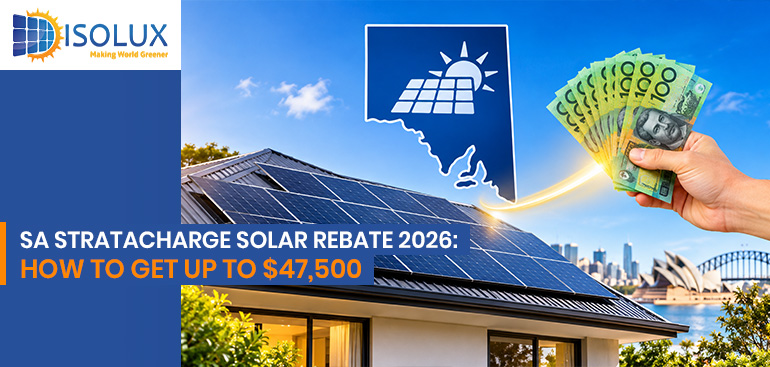

The SA StrataCharge Solar Rebate 2026 offers eligible South Australian strata communities grants of up to $47,500 for shared solar and battery systems. Applicants can also access an optional zero-interest loan of up to $47,500.
The $17.8 million program aims to make renewable energy more accessible for apartment residents and strata communities.
Unlike traditional residential solar rebates, StrataCharge focuses on shared installations rather than individual household systems.
Here’s how the funding works, who can benefit and how strata communities can apply.
What Is the SA StrataCharge Solar Rebate 2026?
StrataCharge is a South Australian Government program supporting shared rooftop solar and battery installations in eligible strata properties.
Launched in November 2026, the initiative addresses barriers that often prevent apartment residents from accessing solar energy.
Around 160,000 South Australian households live in strata and community-titled properties.
These buildings often have shared roofs, common electrical infrastructure and collective approval requirements.
As a result, installing solar panels can be more complicated than installing them on a standalone home.
StrataCharge helps address these challenges through financial assistance and practical guidance.
The program also supports discussions about system design, approvals and installation arrangements.
How Much Funding Can You Get Under StrataCharge?
The StrataCharge program provides two forms of financial assistance.
| Funding type | Maximum support |
| Solar and battery grant | Up to 50% of eligible costs, capped at $47,500 |
| Zero-interest loan | Up to $47,500 for remaining eligible costs |
| Combined potential support | Up to $95,000, including a repayable loan |
The grant reduces the amount applicants must pay for an eligible system.
Meanwhile, the optional loan can help finance the remaining installation costs.
However, a zero-interest loan is not free money. Applicants must repay the borrowed amount.
Example: How the $47,500 Grant Works
Consider a hypothetical shared solar and battery installation costing $80,000.
If the entire amount qualifies, the 50% grant could provide $40,000.
The remaining $40,000 could potentially be covered through an approved zero-interest loan.
Therefore, the strata community might avoid a large immediate payment.
However, loan approval, eligibility and repayment conditions still apply.
Who Is Eligible for the StrataCharge Solar Rebate?
The SA StrataCharge Solar Rebate targets eligible strata and community-titled properties in South Australia.
These may include apartment buildings and other properties operating under shared ownership arrangements.
However, living in an apartment does not automatically guarantee eligibility.
The application must satisfy the program’s requirements and approval process.
Strata communities should confirm their property type, proposed system and governance arrangements before proceeding.
The program’s delivery partner assesses eligibility and supports applicants through the process.
Can Individual Apartment Owners Apply?
StrataCharge supports shared solar and battery installations.
Therefore, an individual resident should not assume they can claim $47,500 for a personal apartment battery.
The funding is intended for eligible shared systems serving strata communities.
Residents should first discuss the opportunity with their strata committee or corporation.
What Solar and Battery Systems Does StrataCharge Support?
The program focuses on shared solar and battery systems designed for strata properties.
Rooftop solar panels generate electricity during daylight hours.
A shared battery can store available solar energy for use later.
For example, apartment residents may benefit from stored electricity during evening periods when solar generation declines.
However, the actual savings depend on system design and how electricity is distributed.
How Does Shared Solar Work in Apartments?
A shared solar installation uses common rooftop space to generate electricity.
Depending on the design, that electricity may supply common areas or participating apartments.
Common-area electricity can include lighting, lifts and shared facilities.
Supplying individual apartments may require additional metering and energy-sharing equipment.
Therefore, a qualified installer should assess the building’s electrical infrastructure before recommending a system.
How to Apply for the SA StrataCharge Solar Rebate in 2026
Eligible strata communities can begin the application process through the program’s delivery partner, Brighte Capital.
The application process involves several important stages.
Step 1: Check Your Property’s Eligibility
Start by confirming whether your strata or community-titled property meets the program requirements.
Check the current application conditions before making financial commitments.
Step 2: Discuss the Proposal With Your Strata Corporation
Shared solar installations generally require agreement from the relevant property decision-makers.
Discuss potential costs, electricity savings and maintenance responsibilities.
Also establish how residents will share the benefits.
Step 3: Assess Solar and Battery Requirements
Review available rooftop space, electricity consumption and existing electrical infrastructure.
The proposed system should reflect the building’s actual energy requirements.
Step 4: Obtain a Suitable Installation Proposal
Work through the approved program process to obtain a system proposal.
The quotation should explain equipment specifications, installation costs and expected electricity savings.
Step 5: Confirm Funding and Approvals
Check the approved grant amount and any optional loan conditions.
Also confirm strata approvals, installation requirements and project timelines.
Avoid assuming funding is guaranteed before receiving confirmation.
Can Apartment Owners and Renters Benefit From StrataCharge?
Yes, both owner-occupiers and renters may benefit from shared solar and battery systems installed through StrataCharge.
However, individual benefits depend on how the building distributes electricity and savings.
For example, a system supplying participating apartments could reduce their grid electricity purchases.
Alternatively, a system supporting common areas may reduce shared electricity expenses.
These savings may benefit residents indirectly through building operating costs.
Therefore, strata communities should establish a transparent benefit-sharing arrangement before installation.
Can StrataCharge Cover the Full Cost of Solar and Batteries?
StrataCharge can potentially finance the full eligible installation cost through a combination of grant funding and an approved loan.
However, this does not mean the entire system is free.
For example, a qualifying $95,000 installation could receive a $47,500 grant.
An approved zero-interest loan could potentially cover the remaining $47,500.
The loan must still be repaid.
If the installation costs more than $95,000, additional funding may be necessary.
Likewise, ineligible expenses or lower approved funding could increase the amount payable.
Related Guide: How to Choose a Solar and Battery Installer in Australia
How to Choose an Approved Strata Solar and Battery Installer
Strata solar installations require experience with shared electrical infrastructure and multi-residential properties.
The StrataCharge program involves approved installation providers.
Participating retailers must meet applicable New Energy Tech Approved Seller requirements.
Relevant installer accreditation and electrical licensing are also important.
Before proceeding, confirm the provider’s eligibility under the program.
Ask about system warranties, maintenance responsibilities and electricity-sharing arrangements.
Also request clear information about any switchboard or metering upgrades.
Related Guide: Solar Battery Switchboard Upgrade Cost Australia
What Should Strata Communities Check Before Applying?
Before applying, review your building’s roof condition and available installation space.
Consider shading, structural requirements and the condition of existing electrical infrastructure.
The strata corporation should also understand ongoing maintenance and insurance responsibilities.
Importantly, ask how electricity savings will be measured and distributed.
Compare the proposed system’s total cost against realistic long-term benefits.
Finally, confirm current funding availability and approval requirements through the official application process.
Conclusion
Eligible South Australian strata communities can access up to $47,500 through the StrataCharge Solar Rebate by applying for approved shared solar and battery installations.
The program also offers optional zero-interest loans of up to $47,500 to help cover remaining costs.
However, eligibility, system approval and funding conditions must be confirmed before installation.
For apartment owners and strata communities, the initiative creates a new opportunity to explore shared renewable energy.
At Isolux, we help Australian property owners understand solar and battery solutions, installation requirements and long-term energy benefits.
Explore Isolux’s solar and battery resources to learn more about choosing a suitable renewable energy system.