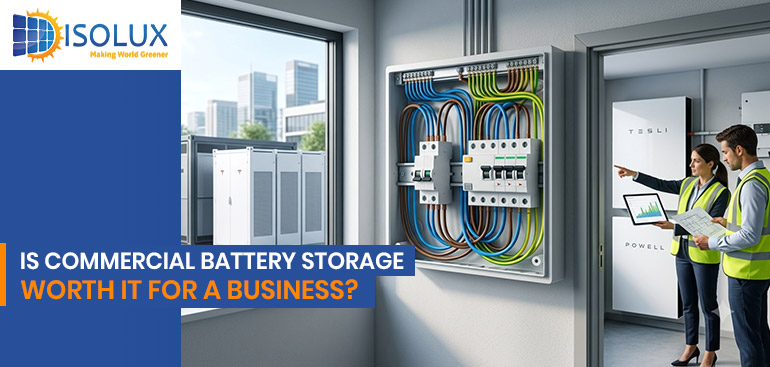

Commercial Battery Storage can be worth it for a business when the battery reduces expensive grid electricity, demand charges or wasted solar energy. However, the financial return depends on your electricity tariff, load profile, solar generation and battery size.
A battery is not automatically a good investment for every business. Therefore, businesses should assess their actual electricity data before investing in a Commercial Battery.
How Does Commercial Battery Storage Save Businesses Money?
A Commercial Battery stores electricity and releases it when the business needs it most.
For a business with solar, the battery can store surplus daytime generation. The business can then use that energy after solar production falls.
This can reduce electricity purchased from the grid. It can also increase the amount of solar energy consumed on-site.
Australian Government guidance identifies increased self-consumption, time-of-use savings and peak demand reduction as key battery value streams.
Solar Self-Consumption
Consider a warehouse that generates more solar power at midday than it uses.
Without storage, some surplus electricity may be exported. With a battery, suitable surplus can charge the battery.
The stored energy can then support evening operations. This can reduce reliance on grid electricity.
When Is Commercial Battery Storage Worth It?
Commercial Battery Storage is more likely to make financial sense when a business has one or more strong battery use cases.
A business with significant demand charges can use a battery for peak shaving. The battery discharges during selected periods of high demand.
Businesses with time-of-use tariffs can also shift energy consumption. They can store lower-cost energy and use it during higher-cost periods, subject to tariff conditions.
A battery can also suit businesses with substantial solar exports.
For example, a business operating until 9pm may have strong solar generation during the day. Storage can help bridge the gap between daytime generation and evening consumption.
When May a Commercial Battery Not Be Worth It?
A battery may provide less financial value when the business uses most electricity during sunny hours.
In this situation, solar may already meet much of the site’s daytime demand.
The case can also be weaker when demand charges are low and there is little evening consumption.
An oversized battery can create another problem. If it rarely cycles enough, much of its capacity may remain unused.
Therefore, battery sizing should follow the business’s energy profile rather than a standard package.
How Much Can a Commercial Battery Save?
There is no reliable single saving figure for every business.
Savings depend on the electricity tariff, battery capacity, power output, operating schedule and solar generation.
For example, a business using energy mainly from 9am to 3pm may gain less from storage than a site operating late into the evening.
A cold-storage facility can have a different profile again. Refrigeration may operate continuously, creating opportunities for demand management and stored-energy use.
The best estimate comes from analysing interval electricity data and modelling the proposed battery against the site’s tariff. NSW Government guidance provides a battery investment tool specifically for assessing business energy use, tariffs and potential returns.
Commercial Battery Storage and Demand Charges
Demand charges can be an important part of the commercial battery business case.
Unlike an energy charge, a demand charge can depend on the highest power demand recorded during a billing period.
A short period of high demand can therefore affect the electricity bill.
A Commercial Battery can discharge during selected demand events. This can reduce the power drawn from the grid at that time.
However, the battery must have enough power output to reduce the peak. It also needs an appropriate control strategy.The value therefore depends on the actual demand tariff and load profile.
Can a Commercial Battery Improve Solar Self-Consumption?
Yes. This is one of the most common reasons businesses combine solar and storage.
Imagine a business generates excess solar at 12pm but has high electricity demand at 6pm.
The battery can store suitable surplus energy around midday. It can then discharge later.
This allows more generated solar electricity to be used by the business instead of exported.
However, battery efficiency and operating settings also affect the final savings.
What About Backup Power for Businesses?
Backup power can add another reason to consider Commercial Battery Storage.
A properly designed system may support selected critical loads during a grid outage.
For example, a business may prioritise refrigeration, security systems, communications or essential equipment.
However, backup should not automatically be treated as the main financial justification.
The value of avoided downtime depends heavily on the business. A short outage may have limited impact on one company but create significant losses for another.
What Determines the Value of a Commercial Battery?
Several factors determine whether a Commercial Battery is financially suitable.
Your electricity tariff is important because it determines the cost of grid energy and demand charges.
Your operating hours also matter. A business using electricity after sunset may have greater opportunities to use stored energy.
Solar generation is another factor. High daytime exports can provide energy for battery charging.
Battery capacity and power output must also match the site’s requirements.
Finally, battery degradation, financing, maintenance and installation costs should form part of the business case.
How to Work Out If Commercial Battery Storage Is Right for Your Business
Start with your electricity bills and interval consumption data.
Identify when your business uses the most electricity. Then check when solar generates the most energy.
Next, identify demand charges and expensive tariff periods.
Your installer can then model different battery sizes against those patterns.
For example, a business may compare a 100kWh system with a 200kWh system. The larger battery is not automatically better.
If the business cannot regularly use the additional capacity, the extra investment may provide limited additional value.
Therefore, the right question is not simply “How big a battery can we install?”
It is “What battery size can create measurable value for our business?”
Also Read: 20kWh vs 50kWh vs 100kWh Commercial Battery: What Size Does Your Business Need?
Conclusion
Commercial Battery Storage can be worth it when a business has high demand charges, excess solar, expensive peak electricity or significant energy use outside solar hours. However, the return varies between businesses.
The strongest approach is to analyse your electricity tariff, load profile and solar generation before selecting a Commercial Battery.
A properly designed system can reduce grid purchases, improve solar self-consumption and manage selected demand peaks. It may also provide valuable backup power.
Therefore, businesses should base the decision on their actual energy data rather than a generic savings estimate.