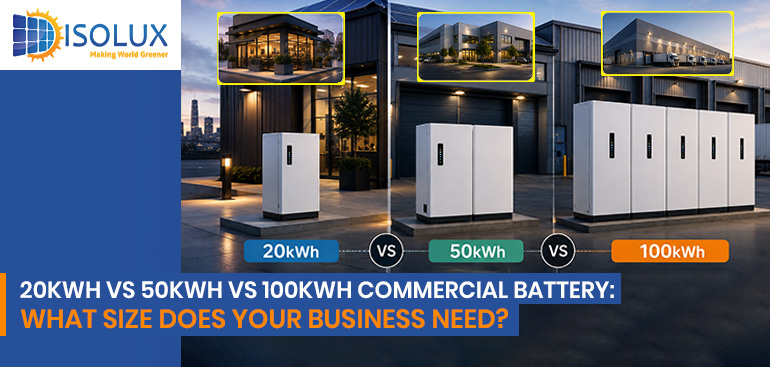

The right commercial battery storage size depends on your electricity use, solar generation, operating hours and energy goals. A 20kWh battery may suit a smaller business, while a 50kWh or 100kWh system may better suit businesses with higher energy demand.
However, there is no universal battery size for every business.
Two businesses can consume a similar amount of electricity but need very different batteries. Their operating hours, solar generation, peak demand and electricity tariffs may differ.
That is why choosing the largest battery available is rarely the best approach.
Instead, your commercial battery should store enough energy to meet a useful part of your demand. It should also charge regularly and discharge when the stored energy provides the most value.
For businesses considering a commercial solar battery, this guide compares 20kWh, 50kWh and 100kWh systems. It also explains how installers determine the right capacity for a commercial solar battery installation.
What Is Commercial Battery Storage?
A commercial battery storage system stores electricity for use at a later time.
Businesses can charge batteries from suitable excess solar generation. Depending on the system and electricity arrangement, charging from the grid may also be possible.
When the business needs electricity later, the battery can discharge stored energy.
This creates a simple energy flow:
Solar panels → Business loads → Excess solar → Battery → Later business loads
For example, a business may produce substantial solar energy at midday. However, its electricity demand may continue after the sun goes down.
A commercial solar battery can store suitable surplus generation during the day. The business can then use that stored energy later.
Battery storage can also support peak demand management and selected backup loads. However, these functions depend on the battery, inverter, controls and site design.
The NSW Government’s new business battery incentive also recognises these benefits. Eligible businesses can receive an upfront discount from 1 September 2026, with indicative discounts of about 20% to 30% for battery-only installations. Eligible solar and battery installations can receive about 30% to 40%.
Why Battery Size Matters for a Business
Battery capacity determines how much energy a system can store.
It is measured in kilowatt-hours, or kWh.
However, battery capacity is only one part of the sizing equation.
You also need to consider the battery’s power output, measured in kilowatts, or kW.
kWh vs kW: What Is the Difference?
Think of kWh as the size of the battery’s energy tank.
Think of kW as how quickly that energy can be delivered.
For example, a 50kWh battery does not automatically provide 50kW of power.
A system might have 50kWh of storage but a lower inverter output. Therefore, it may not support every business load simultaneously.
This distinction becomes important for businesses with large motors, air conditioning, refrigeration or manufacturing equipment.
A battery assessment should therefore consider both energy capacity and power requirements.
Why Usable Capacity Matters
The advertised battery capacity is not always the same as the energy available for everyday use.
Battery systems operate within defined limits. They may also reserve some capacity to protect battery health.
Therefore, businesses should compare usable capacity rather than looking only at the headline kWh figure.
20kWh vs 50kWh vs 100kWh Commercial Battery at a Glance
The three capacities provide useful reference points for businesses considering battery storage.
| Factor | 20kWh Battery | 50kWh Battery | 100kWh Battery |
| Storage capacity | 20kWh | 50kWh | 100kWh |
| General application | Smaller commercial sites | Small to medium commercial sites | Medium to larger energy users |
| Solar integration | Suitable | Suitable | Suitable |
| Energy shifting | Limited to moderate | Moderate to high | High |
| Space requirements | Lower | Moderate | Higher |
| Upfront system cost | Generally lower | Generally higher | Generally higher |
| Best suited to | Lower energy demand | Moderate storage needs | Higher energy demand |
These categories are only a starting point.
A 20kWh system could be too large for one business and too small for another. The same applies to 50kWh and 100kWh systems.
The NSW business battery incentive currently covers total battery capacities from 20kWh to 30MWh. Therefore, these three sizes represent only a small part of the commercial storage market.
What Is a 20kWh Commercial Battery Best For?
A 20kWh commercial battery can suit businesses with relatively modest electricity requirements.
It may be considered by smaller offices, retail premises, cafés, professional businesses and small workshops.
However, the business should have a clear reason for storing energy.
For example, a business may generate excess rooftop solar during the day. It could then use stored electricity later when solar generation falls.
Example: Small Retail Business
Imagine a small retail store with rooftop solar.
Most of its solar generation occurs between late morning and afternoon. However, the store continues operating into the evening.
A 20kWh battery could store some excess solar and release it later.
The system may be useful if the business regularly has enough surplus solar to charge the battery.
However, a 20kWh battery may not be suitable if the store has high refrigeration, air conditioning or machinery loads.
The installer should therefore review actual consumption before recommending the system.
What Is a 50kWh Commercial Battery Best For?
A 50kWh commercial battery provides substantially more storage than a 20kWh system.
It can be a useful middle-ground option for businesses with moderate electricity consumption.
Potential applications include restaurants, workshops, medium-sized retail sites, warehouses and professional facilities.
Example: Business With High Evening Consumption
Consider a business that generates significant solar power during the day.
Its solar production drops in the late afternoon. However, electricity consumption remains high until closing.
A 50kWh battery could store more surplus solar during suitable periods.
The stored energy could then support the business later.
However, the battery should not be sized simply because the business consumes 50kWh in a day.
Daily consumption and battery capacity are different measurements.
If the business consumes 100kWh per day, it does not automatically need a 100kWh battery.
The more important question is how much energy the business can economically store and use.
What Is a 100kWh Commercial Battery Best For?
A 100kWh commercial battery can suit businesses with higher energy demand and greater storage requirements.
Potential applications include larger retail sites, warehouses, agricultural operations and some manufacturing facilities.
Businesses with substantial solar generation may also consider larger storage capacity.
Example: Business With High Energy Demand
Imagine a warehouse with a large rooftop solar system.
The warehouse uses electricity during the day. However, its operations continue into the evening.
A 100kWh battery could provide a larger storage reserve than a 20kWh or 50kWh system.
It could also provide greater flexibility for shifting energy use.
However, a larger battery brings higher project costs and potentially more complex electrical requirements.
Therefore, the business should confirm that the battery will be used frequently enough to justify its additional capacity.
How to Choose the Right Commercial Battery Storage Size
The best commercial battery storage size starts with data.
Your installer should examine your electricity consumption, solar generation and operating patterns.
1. Review Your Daily Electricity Consumption
Start with your electricity bills.
However, monthly or annual totals do not tell the whole story.
Interval data can show when electricity consumption rises and falls during the day.
This helps identify opportunities for battery charging and discharging.
2. Check Your Solar System Size
Your existing or proposed solar system is another important factor.
A battery needs an appropriate charging source.
If your solar system produces very little excess electricity, a large battery may spend much of its time underused.
3. Understand Your Operating Hours
A business operating from 9am to 5pm has a different energy profile from a restaurant operating until midnight.
Similarly, warehouses and factories may have significant equipment loads during specific periods.
Therefore, battery sizing should reflect your actual operating schedule.
4. Look at Peak Demand
Short periods of high electricity demand can influence battery design.
A business may have moderate daily energy consumption but experience large demand spikes.
In this case, battery power output may matter as much as battery capacity.
5. Consider Backup Requirements
If your business needs backup power, tell your installer early.
Critical refrigeration, security systems, servers and communications equipment may require backup.
A battery designed for energy savings is not automatically a whole-building backup system.
How Much Energy Can 20kWh, 50kWh and 100kWh Batteries Store?
The easiest way to understand capacity is to think about energy consumption.
A:
20kWh battery stores 20kWh of energy
50kWh battery stores 50kWh of energy
100kWh battery stores 100kWh of energy
But how long can that energy run your business?
A simple estimate is:
Approximate runtime = usable battery capacity ÷ average load
For example, suppose a 50kWh battery has 45kWh of usable energy.
If the connected business load averages 10kW, the theoretical runtime is about:
45kWh ÷ 10kW = 4.5 hours
Real-world performance can be lower.
Battery losses, inverter efficiency, operating limits and changing loads all affect runtime.Therefore, this calculation should be used as an explanation, not a final system design.
Commercial Battery Storage and Solar: How Do They Work Together?
Commercial solar and battery storage can complement each other.
Solar panels generate electricity during daylight hours.
Businesses may use some of that energy immediately.
The remaining suitable generation can charge the battery.
Later, the battery can discharge when the business needs electricity.
This can increase the proportion of solar energy consumed on-site.
It can also reduce reliance on grid electricity during certain periods.
Should You Install More Solar Before Adding a Battery?
Sometimes, yes.
Suppose a business has a 100kWh battery but very little excess solar.
The battery may not receive enough solar energy to operate as intended.
In contrast, a business with substantial solar generation may have more charging opportunities.
This is why a commercial solar battery installation should assess the complete energy system.The battery should work with the solar array, inverter and business load.
20kWh vs 50kWh vs 100kWh Commercial Battery: Which Offers Better Value?
There is no universal winner.
The best-value battery is usually the one that can be charged consistently and discharged when it provides useful savings.
When a 20kWh Battery May Offer Better Value
A 20kWh battery may make sense when the business has relatively low energy demand.
It can also suit sites with limited excess solar.
Choosing a larger battery in this situation could increase upfront costs without providing enough additional value.
When a 50kWh Battery May Be the Sweet Spot
A 50kWh system may suit businesses with moderate energy consumption and meaningful excess solar.
It provides more storage than 20kWh without moving immediately into larger commercial systems.
For some businesses, this middle capacity could provide a good balance between storage and cost.
When a 100kWh Battery Makes More Sense
A 100kWh system may be more appropriate for businesses with higher energy demand.
It may also suit sites with larger solar arrays and substantial afternoon or evening consumption.
However, the extra capacity should be used regularly.
A battery that sits partially charged for long periods may not provide the expected financial return.
Commercial Battery Storage Installation: What Businesses Should Expect
Commercial battery installation requires more planning than simply selecting a battery cabinet.
Site and Energy Assessment
The installer should review your energy consumption and site conditions.
This assessment helps determine battery capacity and power requirements.
Battery and Inverter Selection
The battery and inverter must work together.
Your installer should check usable capacity, power output, charging rates and discharge rates.
Electrical and Network Requirements
Commercial systems may require electrical upgrades.
The site may also have specific network requirements.
These requirements should be identified before installation begins.
Installation and Commissioning
The installation must follow applicable Australian standards and manufacturer requirements.
Commercial battery projects may also require additional fire safety, planning or electrical considerations.
Monitoring and Ongoing Management
A good commercial system should provide suitable monitoring.
Monitoring helps businesses understand battery performance and energy use.
It can also help identify changes in consumption over time.
How Much Does Commercial Battery Storage Cost?
There is no single price for commercial battery storage.
The final cost depends on the entire system.
Battery capacity is one factor.
The inverter, electrical work, installation complexity, monitoring and site requirements also affect the price.
A 100kWh battery will generally require more equipment than a 20kWh system.
However, the cost per stored kWh can vary between systems.
Therefore, businesses should avoid comparing quotes based only on total price.
Instead, compare:
| Factor | Why It Matters |
| Usable capacity | Shows how much energy is available |
| Power output | Determines how much load can run |
| Battery warranty | Indicates coverage period |
| Cycle performance | Helps assess long-term use |
| Inverter | Determines system power capability |
| Installation | Covers labour and electrical work |
| Monitoring | Helps track performance |
| Backup capability | Determines resilience options |
| Future expansion | Supports changing business needs |
A professional quote should clearly explain what is included.
Does Your Business Need a 20kWh, 50kWh or 100kWh Battery?
These three sizes can provide a useful starting point.
A 20kWh battery may suit a smaller business with lower energy demand.
A 50kWh battery may suit a business with moderate consumption and meaningful solar surplus.
A 100kWh battery may suit a larger energy user with higher demand and stronger storage requirements.
However, these are not fixed rules.
Your business could need 30kWh, 75kWh, 150kWh or another capacity.
The correct size should come from your energy data.
For NSW businesses, there is also an additional reason to assess battery size carefully.
From 1 September 2026, eligible businesses can access an upfront battery discount. The NSW Government states that eligible batteries range from 20kWh to 30MWh.
The incentive provides indicative discounts of about 20% to 30% for battery-only projects. Installing eligible new or additional solar with the battery can increase the indicative discount to about 30% to 40%.
Therefore, battery sizing and incentive planning should happen together.
Common Commercial Battery Sizing Mistakes to Avoid
Choosing a Battery Based Only on Price
A cheaper battery is not always better value.
The system must deliver useful energy savings over its operating life.
Buying the Largest Battery Available
More storage does not automatically mean more savings.
An oversized battery may not charge or discharge fully often enough.
Ignoring Inverter Power
Battery capacity tells you how much energy is stored.
It does not tell you how much power the system can deliver at once.
Ignoring Existing Solar Generation
A battery needs an appropriate charging strategy.
A large battery paired with insufficient solar may be underutilised.
Forgetting Future Electricity Demand
Your energy needs may increase.
New machinery, refrigeration, EV charging or expanded operations can change your load profile.
Not Checking Backup Requirements
Backup power needs should be designed from the beginning.
Critical loads may require different battery and inverter specifications.
Comparing Batteries Only by Advertised kWh
Capacity is important.
However, warranty, usable capacity, power output, efficiency, safety, monitoring and installation quality also matter.
Get the Right Commercial Solar Battery for Your Business
The right commercial battery storage size is the one that matches your electricity demand, solar generation, operating hours and financial goals.
A 20kWh battery can suit some smaller businesses. A 50kWh system may provide a useful balance for moderate energy users. A 100kWh battery can offer greater storage for businesses with higher demand.
However, there is no universal battery size.
The best approach is to assess your electricity bills, interval consumption, solar generation and peak demand first. Then, compare different battery capacities based on expected usage and financial return.
For NSW businesses, the timing is also important. Eligible businesses can access the new NSW battery discount from 1 September 2026. The NSW Government states that the discount can be around 20% to 30% for battery-only installations and around 30% to 40% when eligible new or additional solar is installed with the battery.
Thinking about a commercial solar battery installation? Isolux Solar can help assess your business energy needs and identify a suitable solar and battery solution.1300 552 452
Book a Callback
Frequently Asked Questions
Is 20kWh enough for a small business?
A 20kWh battery can be enough for some smaller businesses. However, the correct size depends on electricity consumption, solar generation and operating hours. A site assessment should confirm whether 20kWh provides enough usable storage.
Is a 50kWh battery suitable for a commercial property?
A 50kWh battery can suit many small and medium commercial properties. It may be useful where the business has moderate electricity demand and excess solar generation. However, actual sizing should use the site’s energy data.
How long can a 100kWh commercial battery last?
A 100kWh battery does not have one fixed runtime. Runtime depends on the connected load. For example, a 100kWh battery supplying an average 20kW load could theoretically provide around five hours before losses and operating limits.
How many solar panels are needed for a 100kWh battery?
There is no fixed number of solar panels required for a 100kWh battery. The appropriate solar capacity depends on panel output, roof space, local conditions, electricity use and how quickly the battery needs to recharge.
Can a commercial battery run a business during a blackout?
Some commercial batteries can provide backup power. However, not every system supports whole-business backup. The inverter, battery output, switchgear and selected loads must be designed for backup operation.
What is the difference between kWh and kW?
kWh measures stored energy capacity. kW measures power output. A battery needs enough kWh to store useful energy and enough kW to deliver the required power.
How much does a commercial battery storage system cost?
Commercial battery costs vary according to capacity, inverter size, equipment, installation complexity and electrical requirements. A 20kWh system will generally cost less than a 100kWh system, but pricing should be assessed as a complete installation.
Is commercial battery storage worth it in Australia?
Commercial battery storage can be worthwhile when a business can regularly charge and discharge the battery at valuable times. The financial case depends on electricity tariffs, solar generation, energy consumption and battery costs.
Can I add a battery to my existing commercial solar system?
Yes, many existing commercial solar systems can be upgraded with battery storage. However, compatibility must be checked. Your installer should assess the existing inverter, solar capacity, switchboard and available connection options.