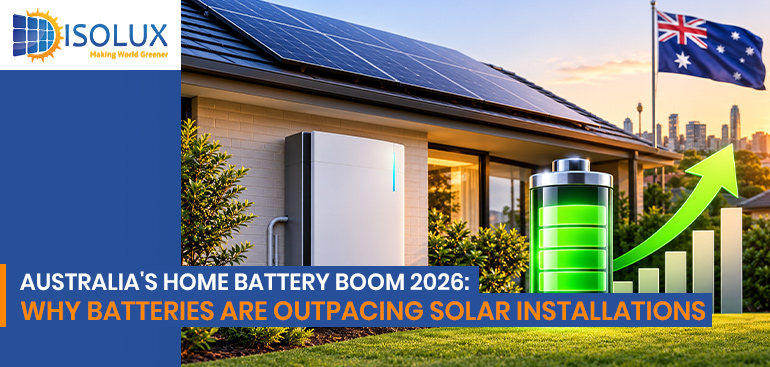

Australia is currently experiencing a massive home battery boom. People are investing in home battery systems to store excess solar energy, reduce reliance on the grid, and take more control of their energy costs.
The number has increased by 52% compared to the past 6 months.
While solar panels are still playing an important role, home batteries are becoming the next big investment for Australian households. So why are so many Australians investing in home batteries in 2026? And how can you ensure you are making the right decision? Find out
Why Are Home Batteries Increasing More Than Solar In Australia?
Australia has seen a huge rise in the number of people installing rooftop solar. There are millions of homes with solar panels installed. However, the following reasons are causing a shift in the industry.
A. Cheaper Home Batteries Program
The Cheaper Home Batteries Program introduced by the Federal Government is one of the main reasons we are seeing such a boom in home batteries.
This program commenced on 1st July 2025, providing eligible battery installations with discounted rates through the Small-scale Renewable Energy Scheme.
Eligible homeowners, businesses and community groups can get around a 30% discount on eligible battery systems ranging between 5 kWh and 100 kWh.
This incentivises homeowners to install a battery system. However, the exact percentage will vary based on eligible usable battery size, certificate factors, and timing of the installation.
B. Increased Electricity Costs & Lower Feed-In Tariffs
Many Australian homes are receiving low feed-in tariffs for exporting their excess solar electricity.
This means that buying electricity from the grid can be significantly more expensive.
A home battery can help with this.
You can store some of your unused solar electricity instead of sending it back to the grid.
C. More Energy Independence
Due to blackouts, extreme weather, and uncertainty with electricity costs, many homeowners are looking to become more independent with their electricity.
A correctly sized home battery can provide backup for selected circuits in your home during a blackout.
What Is Driving Australia’s Home Battery Boom In 2026?
The Clean Energy Council report shows how quickly home batteries are increasing.
Between January and June 2026:
276,011 home batteries were installed.
This is a 52% increase compared to the previous 6 months.
Approximately 1.89GW of solar was installed.
Over 4.5 million small businesses and homes now have rooftop solar.
More than 700,000 homes have a battery installed.
How Do Home Solar Batteries Work?
By storing excess electricity from your solar panels, home solar batteries are a great way to utilise your solar energy.
Understanding how they work can help you determine if you should get one.
During the day:
- Solar panels produce electricity.
- This is used to power your home.
- Any excess electricity is stored in your battery.
- Any remaining electricity can be exported to the grid.
During the evening:
- Solar panels will not produce as much electricity.
- Your home will use the stored electricity from your battery.
- You will use electricity from the grid if your home requires more energy than your battery can provide.
- This means you can increase how much of your solar energy you are using.
However, your battery will depend on the usable battery size, inverter output, home electricity usage, weather, and system efficiency.
What Size Home Battery Does Your Home Need?
Choosing the right battery size is one of the most important factors when deciding on your home installation. Below is a general guide:
| Battery size | Potential household suitability |
| 5–10 kWh | Smaller households with moderate evening usage |
| 10–15 kWh | Average households with moderate to higher electricity consumption |
| 15–20 kWh | Larger families and homes with higher evening demand |
| 20 kWh+ | High-consumption households with suitable solar generation and storage needs |
However, it is best to consider:
- Daily electricity usage.
- Evening/nighttime usage.
- Solar system size.
- Solar generation.
- Usable battery size.
- Inverter output.
- Future requirements (EV charging).
For a more detailed comparison, read 10kWh vs 15kWh vs 20kWh Solar Battery: Which Size Is Right for Your Home?
How Much Does a Home Battery Cost in Australia in 2026?
The price of your home battery will depend on the size, brand, compatibility with your inverter, complexity of installation, and electrical requirements.
Factors to consider when purchasing a battery:
- Battery size: Larger batteries will usually cost more. However, this will depend on the price per usable kWh.
- Compatibility with your inverter: If you have an existing solar system, you might need a compatible hybrid inverter or extra battery inverter.
- Older switchboards: may need to be upgraded.
- Installation requirements: Wiring, installation location, protection, and backup circuits.
- Government incentives: This will depend on current rules and eligible battery size.
For a more detailed price breakdown, explore ISOLUX’s guide on Solar Battery Price Australia 2026
Can You Add a Battery to an Existing Solar System?
Yes! Many existing solar systems can be upgraded with a battery.
This is known as a solar battery retrofit.
However, you will need to ensure it is compatible; there are two common configurations:
AC Coupled – This involves having a separate battery inverter to connect your battery to your home AC electricity. Many existing solar systems can be compatible with this.
DC Coupled – This involves connecting your battery with a compatible hybrid inverter.
What option you choose will depend on your existing equipment, system design, battery compatibility, and installation requirements.
What Should I Consider Before Installing a Home Battery?
As home batteries are becoming increasingly popular, it is important to ensure you are choosing the right products and installers.
Before signing any installation agreements, ensure:
- The product is accredited. Ensure it is on the correct Clean Energy Council approved products list.
- The installer is accredited. Ensure the installer has the correct accreditation from Solar Accreditation Australia.
- Installation is compliant with Australian electrical standards.
- Warranty. Know what warranty you are getting.
- Battery location. Ensure it can be installed in a suitable location with the correct ventilation, spacing, access, and protection.
- Backup. Know which circuits will be powered during a blackout.
- Government discount. Ensure you have written confirmation of what discount you are receiving.
Conclusion
Australia is currently going through a big change with home batteries. Solar panels have helped Australians produce their own clean energy. However, batteries are helping them decide when to use it.
With government incentives, rising electricity tariffs and increased awareness of energy independence, batteries are becoming an important consideration for Australian homeowners.
If you already have solar panels installed, this is the perfect time to consider whether adding a battery would be a good financial and practical decision.
The future of home energy is moving towards smarter storage.
At ISOLUX, we want to help Australian homeowners make informed decisions about their solar energy.
Frequently Asked Questions
Is The Australian Government Providing a Rebate for Home Batteries In 2026?
Yes! The Cheaper Home Batteries Program provides an incentive of around 30% for eligible battery systems connected to new or existing solar PV systems. This will depend on current eligibility and battery size.
What Is the Best Size Home Battery for Australian Homes?
This will depend on your home size, actual usage, and solar generation.
Can I Install a Solar Battery Without Replacing My Panels?
Yes, many existing solar systems can be upgraded with an AC-coupled or compatible DC- coupled battery.
How Long Do Home Solar Batteries Last?
Many modern home batteries come with a 10-year warranty. However, this will depend on the battery type, conditions, usage, and warranty.
Will My Home Battery Power My Home During a Blackout?
This will depend on the battery having the correct backup capabilities, system design, battery capacity, and power output.