
What Size Home Solar Battery Do You Need?
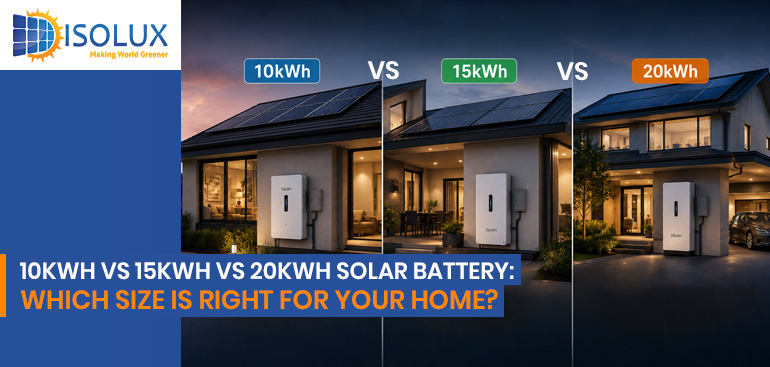
The right home solar battery size depends on your electricity use, solar generation, evening consumption and future energy needs. A 10kWh battery may suit a smaller household, while a 15kWh or 20kWh system may be better for homes with higher energy demand.
However, bigger does not always mean better.
A battery that is too small may leave you buying electricity from the grid after sunset. A battery that is too large may not charge fully often enough to justify its additional cost.
Therefore, the goal is to find a battery that works with your home’s energy profile.
In Australia, households are also using more electricity through air conditioning, electric vehicles, heat pumps and electric hot water. These changing loads can affect the right battery size.This guide compares 10kWh, 15kWh and 20kWh solar batteries. It explains how each size works, who it may suit and what to consider before installing a battery storage system.
What Does a Home Solar Battery Do?
A home solar battery stores electricity for later use.
Your rooftop solar panels generally produce the most electricity during daylight hours. However, many households use more electricity in the afternoon and evening.
Without a battery, excess solar electricity can be exported to the grid.
With battery storage, suitable excess solar can charge the battery instead.
The basic energy flow looks like this:
Solar panels → Home → Excess solar → Battery → Home later
For example, your solar system may produce excess electricity at 1pm.
Your household may not need that energy immediately.
The battery can store some of it for later use. You could then use stored energy after sunset when solar generation falls.
This can increase solar self-consumption and reduce reliance on grid electricity.
However, battery storage does not eliminate grid electricity use in every home. Your results depend on battery size, solar generation, weather, household consumption and system settings.
How Does Battery Storage Work With Solar Panels?
During the day, your solar system supplies your home’s electricity needs first.
If solar production exceeds your home’s demand, the battery can charge when the system is configured to do so.
Once the battery reaches its operating limit, additional surplus electricity may be exported.
Later, the battery can discharge to supply suitable household loads.
This is particularly useful for households that generate solar during the day but consume significant electricity after sunset.
What Is the Difference Between kWh and kW?
kWh measures energy capacity.
kW measures power.
This difference is important when comparing a solar battery.
A 20kWh battery does not necessarily deliver 20kW of power.
For example, a battery could have 20kWh of storage but a lower maximum output.
Therefore, you need to consider both capacity and power output.
A battery with enough kWh but insufficient power may struggle to support several high-demand appliances simultaneously.
10kWh vs 15kWh vs 20kWh Solar Battery Compared
The three battery sizes provide useful starting points for residential battery planning.
| Feature | 10kWh Battery | 15kWh Battery | 20kWh Battery |
| Storage capacity | 10kWh | 15kWh | 20kWh |
| General household use | Small to medium | Medium | Larger or high-use homes |
| Evening energy support | Moderate | Higher | High |
| Solar requirement | Moderate | Moderate to high | Higher |
| Physical space | Lower | Moderate | Higher |
| Relative upfront cost | Lower | Medium | Higher |
| Suitable for high energy users | Sometimes | Often | More suitable |
| Future electrification | Limited to moderate | Good | Stronger capacity |
These categories are not strict rules.
A household’s electricity profile matters more than the number of bedrooms alone.
For example, a three-bedroom home with an EV and pool could consume more electricity than a five-bedroom home with gas appliances and low daytime usage.Therefore, battery sizing should begin with energy data.
Is a 10kWh Home Solar Battery Enough?
A 10kWh home solar battery can suit households with moderate electricity consumption and suitable solar generation.
It may work well for a small family or household with relatively low evening demand.
A 10kWh battery can also make sense where the homeowner wants to reduce grid electricity use without investing in a larger system.
However, usable capacity matters.
A battery advertised as 10kWh may have a different usable capacity depending on its operating limits.
Example of a Home That Could Use a 10kWh Battery
Consider a two or three-person household.
The home has rooftop solar and uses most electricity during the evening.
During the day, solar panels supply the home’s immediate demand.
Excess generation charges the battery.
After sunset, the battery supplies part of the home’s electricity consumption.
This setup can work well when the household’s evening demand is moderate.
However, the battery may not cover the entire night.
The home could still use grid electricity when the battery reaches its discharge limit.
When Is 10kWh Too Small?
A 10kWh battery may become restrictive for households with high energy consumption.
For example, electricity demand can increase significantly with:
Large air conditioning loads, electric vehicle charging, pool pumps, electric hot water and multiple household appliances.
If the battery regularly reaches empty early in the evening, a larger capacity may provide greater value.
However, the answer depends on when those loads operate.
Is a 15kWh Home Solar Battery a Good Middle-Ground Option?
A 15kWh solar battery sits between the common 10kWh and 20kWh options.
It can suit households with moderate to higher electricity consumption.
It may also work well for homes with larger rooftop solar systems and significant evening energy use.
For some households, 15kWh can provide a useful balance between storage capacity and upfront cost.
Example of a Home Using a 15kWh Battery
Consider a four-bedroom home with rooftop solar.
The household uses electricity throughout the day.
However, demand increases in the afternoon when people return home.
Air conditioning, cooking, lighting and appliances can create a larger evening load.
A 15kWh battery could store surplus solar during suitable daylight hours.
The household can then use that stored energy after solar production decreases.
The battery may not cover every load all night.
However, it could reduce the amount of electricity purchased from the grid.
Why Choose 15kWh Instead of 10kWh?
The additional capacity can provide more flexibility.
This may be useful when the household has:
Higher evening consumption, more solar generation or growing electricity demand.
However, the additional capacity needs to be used.
If your 10kWh battery already meets most of your evening needs, moving to 15kWh may not provide enough additional savings to justify the cost.
Is a 20kWh Home Solar Battery Worth It?
A 20kWh home solar battery can suit larger households and homes with higher electricity consumption.
It may also suit households planning significant electrification.
Examples include homes with electric vehicles, large air conditioning systems, electric hot water and pool equipment.
However, 20kWh should not be treated as the default choice.
A large battery requires sufficient energy to charge.
If your solar system cannot regularly produce enough surplus electricity, the additional capacity may remain underused.
Example of a Home That May Need 20kWh
Consider a large Australian home with:
A substantial rooftop solar system, high evening electricity use, multiple air conditioning systems, pool equipment and an electric vehicle.
The home can generate significant solar electricity during the day.
However, much of its energy consumption occurs later.
A 20kWh battery provides more storage for shifting that solar energy into the evening.
The battery may also provide greater flexibility as household electricity demand grows.
When Could 20kWh Be Oversized?
A 20kWh battery could be unnecessarily large for a household with low energy consumption.
For example, if a home regularly uses only a small amount of electricity after sunset, much of the battery could remain unused.
That can weaken the financial case for paying for additional storage.
Therefore, a bigger battery is not automatically the best home solar battery.
The best system is the one that matches your energy profile.
How to Choose the Right Home Solar Battery Size
Choosing battery capacity requires more than looking at your monthly electricity bill.
An installer should examine your energy profile.
1. Check Your Daily Electricity Consumption
Start with your electricity bills.
Look at your average daily consumption.
However, the daily average does not show when you use electricity.
Two homes can consume 25kWh per day but have very different energy patterns.
One home may use most electricity during daylight.
The other may consume most energy after sunset.
The second home may have a stronger case for battery storage.
2. Analyse Your Evening and Night-Time Usage
This is one of the most important sizing factors.
Your battery stores energy for later use.
Therefore, the amount of electricity you consume after solar production falls is highly relevant.
If your evening consumption is consistently high, you may benefit from additional storage.
3. Check Your Solar System Size
Your solar system needs to generate enough energy to charge the battery.
A larger battery paired with a small solar system may not operate efficiently.
Your installer should examine solar generation throughout the year.
Seasonal changes matter too.
Winter solar production can be significantly different from summer production.
4. Consider Future Electricity Needs
Your energy requirements may change.
You might buy an EV.
You may install a heat pump.
You could replace gas appliances with electric alternatives.
You may also add more air conditioning.
Therefore, battery sizing should consider your likely future consumption.
5. Consider Your Backup Power Requirements
Backup power changes the system design.
If you want the battery to keep essential appliances running during an outage, tell your installer.
The system may need suitable backup functionality and sufficient inverter capacity.
A standard battery installation does not automatically provide whole-home backup.
How Long Can a 10kWh, 15kWh or 20kWh Battery Power Your Home?
Battery runtime depends on your home’s electrical load.
A simple calculation is:
Approximate runtime = usable battery capacity ÷ average household load
Consider a simplified example.
If your home has an average 2kW load:
| Battery | Theoretical Runtime* |
| 10kWh | About 5 hours |
| 15kWh | About 7.5 hours |
| 20kWh | About 10 hours |
*These are simplified calculations before accounting for battery and inverter losses, operating limits and changing household loads.
Your actual runtime can vary considerably.
A refrigerator may cycle on and off.
Air conditioning can change output.
Cooking can create a temporary demand spike.
Therefore, battery runtime is not a fixed number.
The important question is not simply how many hours a battery lasts.
It is whether the battery can store and deliver enough energy when your household needs it.
How Much Solar Do You Need to Charge a 20kWh Battery?
There is no universal number of solar panels required to charge a 20kWh battery.
The required solar capacity depends on panel output, location, weather, household consumption and battery charging limits.
For example, your home may produce plenty of solar energy at midday.
However, your appliances may consume much of that generation.
Only the remaining suitable energy can charge the battery.
Therefore, a 20kWh battery does not need a fixed number of solar panels.
A professional assessment should consider the relationship between your solar generation and battery capacity.
It should also consider seasonal performance.A system that charges easily in summer may have less surplus energy available during winter.
Should You Choose a Larger Solar Battery?
A larger battery provides more storage.
However, additional capacity only creates value when you can use it.
This is why battery utilisation matters.
Suppose a 10kWh battery regularly reaches full charge during the day and empties after midnight.
Increasing to 15kWh could provide useful additional storage.
However, if the battery rarely reaches full charge, moving to 20kWh may provide limited additional benefit.
When a Larger Battery Can Make Sense
A larger battery may be useful when:
Your home has high evening consumption.
Your solar system regularly produces substantial surplus energy.
You plan to add an EV or other electric loads.
You want more stored energy available overnight.
You have a suitable financial case for additional capacity.
When a Smaller Battery May Be Better
A smaller battery may be more appropriate when:
Your electricity consumption is moderate.
Your solar system is relatively small.
Most of your electricity is already used during daylight.
Your evening demand is low.
You want to minimise upfront investment.
The objective should be right-sizing, not maximum sizing.
Home Solar Battery Size and Solar Self-Consumption
One of the main reasons homeowners install battery storage is to use more of their own solar energy.
Without a battery, the basic pattern is:
Solar → Home → Excess solar → Grid
With battery storage, the pattern can become:
Solar → Home → Excess solar → Battery → Home later
This allows surplus daytime solar to support evening consumption.
That can be particularly valuable for households with low daytime occupancy.
For example, a family may leave home for work and school during the day.
The solar system can generate electricity while nobody is using much energy.
The battery can then store suitable surplus generation.
When the family returns home, stored energy can support evening loads.
This is one reason battery storage can be particularly useful for Australian homes with rooftop solar.
10kWh vs 15kWh vs 20kWh: Which Offers the Best Value?
There is no single capacity that provides the best value for every household.
Instead, compare the expected benefit against the additional cost.
When 10kWh May Offer Better Value
A 10kWh battery can provide strong value for a household with moderate energy consumption.
It may be enough to cover a substantial portion of evening electricity demand.
A smaller system can also require less upfront investment.
When 15kWh May Be the Sweet Spot
A 15kWh battery can provide a useful middle ground.
It may suit households where 10kWh feels restrictive but 20kWh would provide more capacity than necessary.
For a medium or larger household, this capacity can sometimes balance storage needs and system cost.
When 20kWh May Provide Better Long-Term Value
A 20kWh battery can make sense when the household regularly has enough surplus solar to charge it.
It can also suit homes with high evening consumption.
Future energy loads can further strengthen the case.
However, homeowners should calculate expected battery utilisation before choosing the larger system.
What to Look for in the Best Home Solar Battery
Battery size is only one part of the decision.
The best home solar battery should also match your inverter, solar system and household requirements.
Battery Warranty
Check both the product warranty and performance warranty.
Look at the warranty period and any capacity retention conditions.
Also check what happens if the battery does not meet the stated performance requirements.
Usable Capacity
Do not compare batteries only by their advertised capacity.
Check how much energy is actually available for everyday use.
This provides a more meaningful comparison.
Power Output
Check the battery’s continuous and peak power capabilities.
This helps determine which household loads it can support simultaneously.
Battery Chemistry and Safety
Modern residential batteries commonly use lithium-based technologies.
Different products can use different lithium chemistries.
Safety features, thermal management and installation requirements vary.
Therefore, homeowners should consider the complete battery system rather than chemistry alone.
Monitoring and Energy Management
Good monitoring can show battery charging, discharging and household consumption.
It can help you understand whether the system is performing as expected.
Smart energy management can also improve how solar and battery storage work together.
Solar Battery Installation: What Should Homeowners Expect?
A professional solar battery installation should start with an assessment.
Your installer should understand your home’s electricity consumption and existing solar system.
Home and Energy Assessment
The installer reviews your solar system, switchboard, battery location and energy consumption.
They should also identify any technical limitations.
Battery Sizing
Your energy data helps determine whether 10kWh, 15kWh or 20kWh is appropriate.
The installer should explain why the proposed capacity suits your household.
Inverter and System Compatibility
Battery compatibility matters.
Depending on your existing system, you may need a compatible hybrid inverter or another suitable configuration.
Your installer should assess the existing solar equipment before recommending a battery.
Installation and Commissioning
Battery installation must comply with applicable Australian electrical and installation requirements.
The system should also be commissioned correctly.
Monitoring After Installation
Monitoring helps homeowners track solar production, battery activity and household consumption.
This information can be useful for identifying unusual performance or changing energy needs.
How Much Does a 10kWh, 15kWh or 20kWh Solar Battery Cost?
There is no single price for a solar battery installation.
The final cost depends on the battery, inverter, installation and site requirements.
| Cost Factor | Why It Matters |
| Battery capacity | Larger batteries generally require more equipment |
| Usable capacity | Determines available stored energy |
| Inverter | Controls power conversion and output |
| Installation | Labour and electrical work affect total cost |
| Switchboard upgrades | Some homes require additional work |
| Backup functionality | Backup systems can add equipment |
| Monitoring | Provides system performance data |
| Battery location | Installation conditions affect complexity |
A 20kWh battery will generally cost more than a 10kWh battery.
However, price per kWh can vary between products.
Therefore, homeowners should compare complete installed systems rather than comparing battery capacity alone.
A cheaper battery may not offer better long-term value if it has lower usable capacity, weaker performance or limited support.
Common Solar Battery Sizing Mistakes to Avoid
Choosing the Largest Battery
A larger battery is not automatically more economical.
Unused capacity can reduce the financial return.
Buying Based Only on Price
The cheapest system may not provide the best combination of capacity, power, warranty and support.
Ignoring Evening Electricity Use
Battery storage is particularly valuable when stored solar can be used later.
Ignoring evening consumption can lead to poor sizing.
Ignoring Solar Generation
A large battery needs an appropriate charging source.
Your installer should model solar generation before recommending capacity.
Confusing kW With kWh
A battery can have plenty of storage but insufficient power output.
Always check both figures.
Forgetting Future Electricity Loads
Your energy requirements can increase.
Consider EVs, heat pumps, electric hot water and other future loads.
Assuming Every Battery Provides Backup
Some systems support backup power.
Others may not provide whole-home backup.
Always confirm exactly which circuits remain powered during an outage.
Get the Right Home Solar Battery for Your Energy Needs
The best home solar battery is not necessarily the largest battery. It is the system that matches your electricity consumption, solar generation and evening energy demand.
A 10kWh solar battery can suit households with moderate energy requirements. A 15kWh battery can provide a useful middle ground for homes with higher consumption. A 20kWh battery can suit larger or high-energy households with enough solar generation to charge it.
However, your home’s energy profile matters more than the battery’s headline capacity.
Before choosing a battery, review your electricity consumption and solar generation. Also consider future loads such as EV charging, electric hot water and air conditioning.
An experienced installer can then assess your home and recommend a suitable battery storage system.
If you are comparing solar battery options for your home, Isolux Solar can assess your energy needs and help you choose a suitable system for your property.1300 552 452
Book a Callback
Frequently Asked Questions
Is 10kWh enough for a house?
A 10kWh battery can be enough for some homes with moderate electricity consumption. However, your evening usage, solar generation and future energy needs should determine the final size.
Is a 15kWh battery enough for a 4-bedroom house?
A 15kWh battery can suit some four-bedroom homes, but bedrooms alone do not determine battery size. Electricity consumption, solar generation, air conditioning, pool equipment and EV charging are more important factors.
Is a 20kWh battery too big for a home?
A 20kWh battery is not necessarily too large. It can suit homes with high electricity use and sufficient solar generation. However, it may be oversized for a low-consumption household.
How long will a 10kWh battery last?
Runtime depends on the household load. At a constant 2kW load, 10kWh provides a theoretical five hours. Actual runtime will vary because household demand changes.
How long will a 20kWh battery last?
At a constant 2kW load, 20kWh provides a theoretical 10 hours. Real-world runtime can be shorter because of system losses, operating limits and changing appliance loads.
How many solar panels do I need for a 20kWh battery?
There is no fixed panel count. The required solar capacity depends on panel output, household consumption, location, weather and how much surplus solar is available for charging.
Is a bigger solar battery always better?
No. A larger battery is only beneficial when there is enough energy to charge it and enough demand to use the stored energy. Right-sizing can provide better value than simply choosing the largest system.
What is the best home solar battery size?
The best size depends on your household. A 10kWh system may suit moderate users, while 15kWh or 20kWh can suit homes with greater consumption. Your energy data should determine the final capacity.
Can I add more battery storage later?
Some battery systems support expansion. However, compatibility depends on the battery, inverter and installation design. If future expansion is important, discuss it with your installer before choosing the initial system.
Can a solar battery power my home during a blackout?
Some solar battery systems can provide backup power. However, backup capability depends on the battery, inverter, switchgear and system design. Whole-home backup is not automatic with every installation.