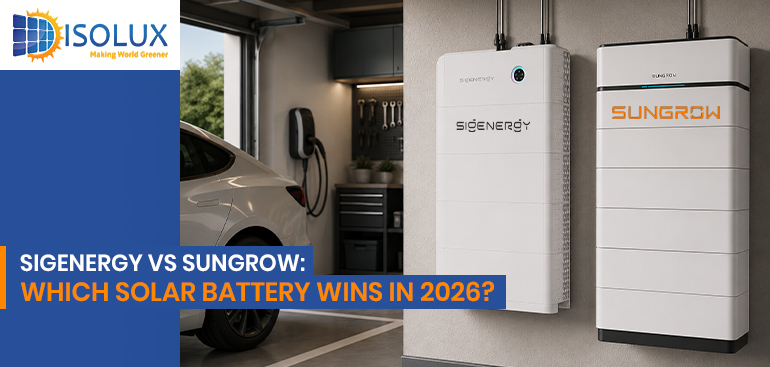

Choosing the right solar battery is one of the biggest decisions you will make as an Australian homeowner. The Sigenergy vs Sungrow Battery debate is one of the most searched topics in the Australian solar market right now. And for good reason.
Both brands offer high-quality, lithium iron phosphate (LFP) batteries. Both are Clean Energy Council (CEC) approved. Both are installed across thousands of Australian homes every year.
However, they differ significantly in design, features, scalability, and who they suit best. This guide breaks down every key difference so you can make a confident, informed decision.
Whether you are installing solar for the first time or adding a battery to your existing system, this comparison will help you find the right fit for your home and budget.
Brand Background: Who Makes These Batteries?
Before comparing specs, it helps to understand the companies behind these products. Their backgrounds tell you a lot about reliability, support, and long-term confidence.
Sungrow: 25+ Years of Solar Experience
Sungrow was founded in China in 1997. Today, it is one of the world’s largest manufacturers of solar inverters and battery storage systems. The company has shipped over 405 GW of inverters globally and has operated in Australia since 2012.
Sungrow’s strength lies in its track record. Australian installers and homeowners have relied on their products for well over a decade. The company has a dedicated Australian office and a Sydney-based service centre, which means warranty claims and technical support are handled locally.
If you value a brand with a proven long-term presence and a large installer network in Australia, Sungrow delivers exactly that.
Sigenergy: The Newer Brand Changing the Game
Sigenergy is a much newer company, founded around 2021. Despite its short operating history, it has grown rapidly in Australia and earned unusually high customer satisfaction ratings.
According to solar industry data from early 2026, Sigenergy holds one of the highest customer satisfaction scores of any battery brand available in Australia. Many experienced installers who previously recommended Sungrow have shifted their preference to Sigenergy after seeing consistent real-world performance.
One installer summed it up well: “Sigenergy is pretty much like Sungrow was five years ago. They have come in with revolutionary features that other batteries had never done.”
Sigenergy’s newer brand status is worth noting. However, their growing installer network, strong local support, and rapid product improvement make them a credible long-term choice for Australian homeowners.
Detailed Guide: Sigenergy Battery Review 2026: Price, Dimensions, Warranty
Battery Technology and Chemistry: Are They the Same?
Both Sigenergy and Sungrow use Lithium Iron Phosphate (LFP) chemistry, which is widely regarded as the safest and most durable option for home solar batteries in Australia.
LFP chemistry offers several important benefits for Australian conditions. It handles high temperatures well, which matters in states like Queensland, South Australia, and Western Australia, where summer temperatures regularly exceed 40°C. It also delivers more charge-discharge cycles than older NMC (Nickel Manganese Cobalt) battery types, meaning a longer usable lifespan.
Both batteries also include a Battery Management System (BMS) that monitors temperature, voltage, and charge levels in real time. This protects the battery from overcharging, deep discharge, and overheating.
The key difference in chemistry performance comes from Sigenergy’s IP66 weather protection rating, compared to Sungrow’s IP55 (SBR series) or IP65 (SBH series). A higher IP rating means Sigenergy offers stronger protection against dust and water intrusion, making it slightly better suited to harsh outdoor Australian environments.
In terms of round-trip efficiency, both batteries perform well. Sigenergy achieves approximately 97% round-trip efficiency, while Sungrow sits at around 95 to 96%. In practical terms, this means more of your stored solar energy is actually usable with Sigenergy.
Storage Capacity and Scalability: How Much Can You Store?
This is where the two brands start to diverge meaningfully. Scalability is a major consideration for homeowners who plan to add an EV, expand their solar system, or simply want room to grow.
Sungrow’s SBR series uses 3.2 kWh modules that stack together. On a single-phase system, you can reach a maximum of 25.6 kWh per tower. The SBH series uses 5 kWh modules and extends this to 30 kWh for single-phase homes. While multiple stacks can be combined for larger capacities, the per-tower maximum is lower than Sigenergy.
Sigenergy’s SigenStor starts at 8 kWh per module and scales up to 48 kWh in a single tower. This is a substantial difference. For a homeowner running a large household, a pool, ducted air conditioning, or an EV, the Sigenergy system offers far more headroom within the same physical footprint.
To put this in a practical example: a family in Sydney with a 10 kW solar system, a ducted air conditioner, and an electric vehicle could outgrow a Sungrow SBR system within a few years. The Sigenergy system, by contrast, can scale to meet that growing demand without requiring an entirely new installation.
For a typical three-to-four-person household with moderate energy needs, either brand handles daily requirements comfortably. However, if you plan ahead for future growth, Sigenergy’s modularity gives you a meaningful advantage.
Sigenergy vs Sungrow Battery: Blackout Protection and Backup Power
Blackout protection is one of the most important reasons Australians invest in home battery storage. Both brands offer backup capability, but the way they deliver it differs in important ways.
Sigenergy provides whole-home backup with near-instant switchover during a grid outage. The system is designed as a true Uninterruptible Power Supply (UPS), which means sensitive electronics such as computers, medical equipment, and smart home devices continue running without a flicker. This is a genuine advantage for households that cannot afford even a brief interruption.
The SigenStor also supports full three-phase backup. This matters for Australian homes with three-phase power connections, as many competing batteries can only back up a single phase. Sigenergy can direct 100% of stored power to whichever phase needs it most, handling unbalanced loads effectively.
Sungrow also supports whole-home backup and three-phase configurations. However, achieving full backup with Sungrow requires a separate changeover switch to be installed in addition to the hybrid inverter. This is an extra piece of hardware that some installers include as standard, and others charge additionally for. If this switch is not installed and the inverter fails, the circuits connected for backup will not work until the inverter is repaired.
Therefore, Sigenergy holds a slight edge in backup reliability and setup simplicity. Both can deliver effective blackout protection, but Sigenergy requires fewer external components to achieve the same outcome.
EV Charging and Smart Energy Management
This is arguably the area where Sigenergy pulls furthest ahead of Sungrow in 2026. As electric vehicle ownership rises rapidly across Australia, this capability is becoming more relevant to homeowners every year.
Sigenergy’s SigenStor supports both AC and DC EV charging natively. DC charging allows your EV to charge directly from rooftop solar, bypassing the standard AC-to-DC conversion that happens with a regular wall charger. This delivers approximately 15% more solar energy directly to your vehicle compared to standard AC wall charging. Additionally, Sigenergy supports Vehicle-to-Home (V2H) technology, which means your EV can power your home during a blackout or during peak grid pricing periods.
For a homeowner who already owns or plans to purchase an EV, this is a significant real-world benefit. Imagine returning home from work, plugging in your EV, and having the Sigenergy system automatically charge it using excess solar rather than grid electricity. On a hot summer evening, that same EV battery could power your home through the night.
Sungrow, by contrast, supports AC charging only. This is still entirely adequate for the majority of Australian households. However, it does not offer the native DC charging or V2H capability that Sigenergy provides.
Both brands also offer smart energy management apps. Sigenergy’s app provides detailed real-time monitoring, load management, and energy scheduling. Sungrow’s iSolarCloud app is reliable and user-friendly, though less feature-rich than Sigenergy’s platform.
Price Comparison: What Does Each Battery Cost in Australia?
Price is often the deciding factor for Australian homeowners. The good news is that both brands are more affordable than ever, thanks to the federal Cheaper Home Batteries Program, which provides an upfront discount of approximately $372 per usable kWh of storage.
Sungrow SBR and SBH Pricing After Rebate
The Sungrow SBR series is one of the most cost-effective mainstream batteries available in Australia. Based on installer quotes gathered in 2026, the pricing after the federal rebate is as follows.
A 9.6 kWh SBR system (SBR096) costs approximately $5,500 to $6,500 installed. A 16 kWh SBR system (SBR160) costs approximately $5,700 to $6,900 installed. The larger SBH series, which suits homes with higher storage needs, ranges from approximately $11,800 to $16,700 installed for 20 kWh to 40 kWh systems after rebate.
On a per-kWh basis, the SBR160 represents some of the best value of any quality battery in Australia, coming in at approximately $350 to $390 per usable kWh installed.
It is important to note that Sungrow batteries are DC-coupled and require a compatible Sungrow hybrid inverter. If you are installing solar and a battery together for the first time, this is not a complication. However, if you already have a non-Sungrow inverter, you will need to factor in inverter replacement costs.
Sigenergy SigenStor Pricing After Rebate
Sigenergy is priced slightly higher than Sungrow in most cases, though quotes from Australian installers in early 2026 show the gap is narrower than many expect. According to multiple installer comparisons, quotes for similarly sized systems come within a few hundred dollars of each other.
A Sigenergy SigenStor system typically starts at around $10,000 to $13,000 installed for a base 16 kWh configuration after the federal rebate. For those seeking to maximise the federal rebate, a fully stacked 48 kWh system can attract up to $15,000 in federal support.
The Sigenergy price includes the full ecosystem: a purpose-built hybrid inverter, the battery modules, the EV charger capability, and the AI-driven energy management system. When you account for everything included in the package, the value equation becomes much closer to Sungrow than the headline price difference suggests.
A Sungrow SBR system can undercut Sigenergy by $2,000 to $3,000 after rebates for similarly sized configurations. Therefore, if budget is the primary driver and EV integration is not a priority, Sungrow offers a genuinely strong value proposition.
State-based rebates can also be stacked on top of the federal discount. New South Wales offers up to $1,500 through the PDRS VPP incentive. South Australia offers up to $2,050 through the REPS scheme. Western Australia offers between $1,300 and $3,800, depending on your location.
Warranty and After-Sales Support
A battery is a long-term investment. Warranty coverage and the quality of after-sales support should factor heavily into your decision.
Sungrow offers a 10-year product warranty across both the SBR and SBH series. The warranty guarantees the battery will retain at least 70% of its original capacity at the end of 10 years or a set number of cycles (approximately 6,000 to 8,960 cycles, depending on the model). Sungrow’s Australian office and Sydney-based service centre handle warranty claims locally, which is a genuine practical advantage.
Sigenergy also offers a 10-year warranty with options for extended coverage on higher-cycle configurations. Customer feedback from Australian installers suggests Sigenergy’s support response time is impressive for a newer brand. One installer noted that a Sigenergy technician arrived on-site within 24 hours to address a minor issue, which is uncommon in the industry.
Both brands use CEC-approved installers, and both warranties require installation by an accredited professional to remain valid.
The honest difference here is longevity of track record. Sungrow has been operating in Australia since 2012 and has a well-established support infrastructure. Sigenergy is newer and has fewer years of local data to draw on. However, its rapid growth and strong initial support performance are encouraging signs.
Which Solar Battery Is Right for Your Home?
The right answer depends entirely on your household’s specific needs, current setup, and future plans. Here is a practical guide to help you decide.
Choose Sungrow if:
You want a proven, cost-effective battery with over a decade of Australian track record. You are installing a new solar and battery system together and are happy to stay within the Sungrow inverter ecosystem. Your daily energy needs are moderate and you are not planning to add an EV in the near future. You want the lowest possible upfront cost for a quality battery that will reliably do its job for 10-plus years.
Choose Sigenergy if:
You want the most advanced, future-proof battery available in Australia right now. You own or plan to purchase an electric vehicle and want native DC charging or V2H capability. Your home has three-phase power and you want seamless whole-home backup without extra hardware. You value smart energy management, a premium app experience, and the ability to scale to 48 kWh in a single tower. You want a system that handles EV charging, solar, battery, and energy management as one integrated platform.
For most Australian homeowners comparing these two brands in 2026, the choice comes down to this: Sungrow wins on price and proven reliability, while Sigenergy wins on technology, features, and future-proofing. If the price difference is within a few hundred dollars on your specific quote, Sigenergy’s feature set makes it the harder option to walk away from.
Ready to Install a Solar Battery in Australia?
Whether you are leaning towards Sigenergy or Sungrow, the most important step is getting a quote tailored to your home’s specific energy use, roof size, and future plans.
At Isolux Solar, our accredited installers work with both brands across Sydney and New South Wales. We assess your home honestly and recommend the system that delivers the best long-term value for your situation.
Get your free solar battery quote today at isolux.com.au
Frequently Asked Questions
Is Sigenergy better than Sungrow?
For technology, EV integration and scalability, Sigenergy holds an edge in 2026. However, Sungrow offers better value for budget-conscious buyers and remains one of the most reliable and well-supported batteries in Australia.
Can I add a Sigenergy battery to my existing Sungrow system?
Generally, no. Mixing battery brands from different ecosystems typically voids warranties and reduces efficiency. An on-site assessment by an accredited installer is the best way to understand your specific retrofit options.
Does Sungrow battery work without a Sungrow inverter?
No. Sungrow batteries are DC-coupled and only work with compatible Sungrow hybrid inverters. If you have an existing inverter from another brand, such as Fronius or SolarEdge, you will need to replace it to add a Sungrow battery.
What is the payback period for a solar battery in Australia?
The typical payback period for a quality solar battery in Australia is between five and eight years after the federal rebate. Actual payback depends on your household’s electricity usage, your electricity tariff, solar system size, and which state you live in.
Are Sigenergy and Sungrow eligible for the federal battery rebate?
Yes. Both brands are CEC-approved and eligible for the federal Cheaper Home Batteries Program. The rebate provides approximately $372 per usable kWh at the point of sale through an accredited installer.
Which battery is better for a three-phase home?
Both brands support three-phase backup. However, Sigenergy’s built-in three-phase asymmetric capability handles unbalanced loads more effectively and requires less additional hardware than the Sungrow equivalent.
How long do Sigenergy and Sungrow batteries last?
Both use LFP chemistry, which is rated for 6,000 cycles or more. With daily cycling, this translates to a lifespan well beyond the 10-year warranty period. Many LFP batteries continue performing reliably for 15 years or longer.