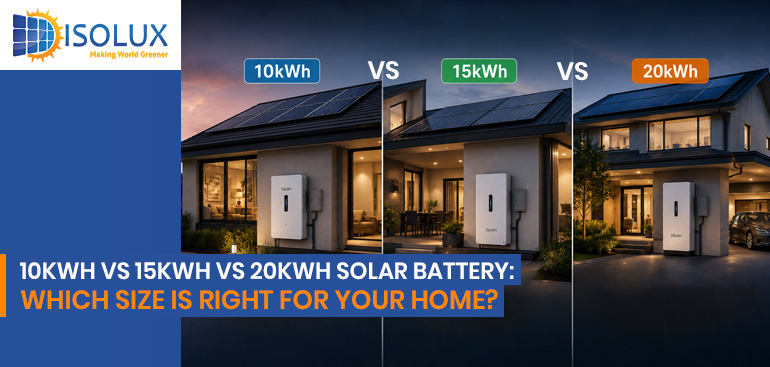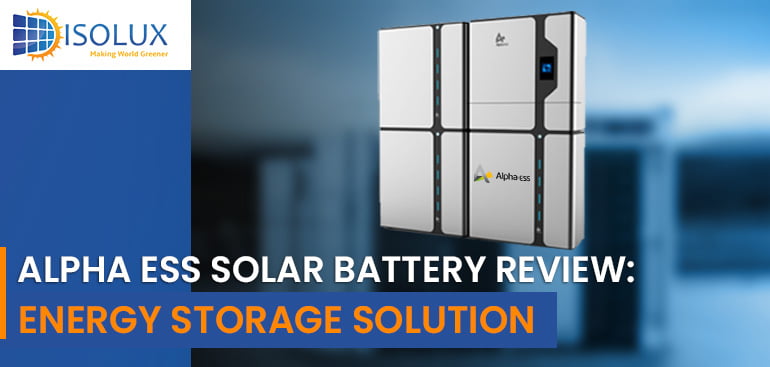
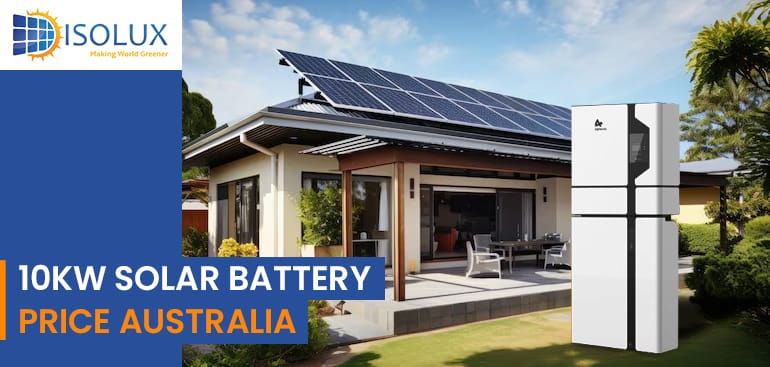

As more Australian households and businesses transition to renewable energy, solar batteries have become a powerful tool in maximising energy independence. Among them, the 10kW solar battery stands out as an ideal solution for medium to large homes and small businesses. But how much does a 10kW solar battery cost in Australia in 2026?
Let’s explore the 10kW solar battery price, factors affecting cost, popular brands, government rebates, and whether it’s a worthwhile investment for your energy needs.
What is a 10kW Solar Battery?
A 10kW (kilowatt) solar battery typically refers to a system capable of storing around 10 kilowatt-hours (kWh) of energy or more, allowing homeowners to store excess solar power generated during the day for use at night or during power outages.
This size battery is suitable for:
- Homes with 5-6 residents
- Average daily electricity consumption of 25–35 kWh
- Households aiming for greater energy self-sufficiency
- Businesses with moderate energy needs
How Much Does a 10kW Solar Battery Cost in Australia in 2026?
In 2026, the installed price of a 10kWh solar battery in Australia ranges from $10,500 to $13,800, including GST and standard installation.
This price varies based on brand, usable capacity, hybrid inverter requirements, and installation complexity.
Breakdown: Installed 10kW Solar Battery Price (2026)
| Battery Capacity | Installed Price (AUD) | Approx. Cost per kWh |
| 5 kWh | $6,200 – $8,000 | ~$1,350/kWh |
| 8 kWh | $9,000 – $10,800 | ~$1,180/kWh |
| 10 kWh (most popular) | $10,500 – $13,800 | ~$1,100/kWh |
| 13–14 kWh | $13,500 – $17,000 | ~$1,050/kWh |
| 15–17 kWh | $15,000 – $19,000 | ~$1,000/kWh |
If You Don’t Already Have Solar Panels
A quality 10kW solar panel system costs $8,000 – $12,500 after STCs.
So a 10kW solar + 10kWh battery package typically lands at:
$19,000 – $26,000 (before battery rebates)
What Affects the Price of a 10kWh Solar Battery?
A 10kW solar battery quote may look simple, but several factors influence the final cost.
1. Battery Chemistry & Safety Standards
Most modern batteries use Lithium Iron Phosphate (LFP) for:
- high safety
- long lifespan (6,000+ cycles)
- stable thermal performance
Higher-quality cell architecture increases cost but improves reliability.
2. Usable Energy vs. Nominal Capacity
A “10kWh” battery may only deliver 9–9.5kWh usable energy depending on the brand.
Batteries with higher usable output often cost more but provide better daily savings.
3. Backup Power & Hybrid Features
Adding features like:
- blackout protection
- built-in hybrid inverter
- EPS (Emergency Power Supply)
- smart home energy management
can increase the cost by $800–$2,200.
4. Installation Complexity
Prices rise if your home requires:
- switchboard upgrades
- metering updates
- rewiring
- wall structural reinforcement
- additional isolators
Older homes (pre-2000) often require extra work.
5. Location & Labour Costs
Metro areas like Sydney, Melbourne, Brisbane typically have more competitive pricing.
Rural locations may attract travel fees.
6. Market Conditions
Battery demand fluctuates based on:
- energy price increases
- policy changes
- new rebates
- stock availability
Prices can rise temporarily when new incentives launch.
2026 Solar Battery Rebates & Incentives in Australia
Battery incentives are stronger than ever, thanks to both state and national programs.
1. Federal Battery Rebate (Cheaper Home Batteries Program – Launched 2025)
This major rebate covers:
Up to 30% of installed battery cost
Capped at $370 per kWh (up to 50kWh systems)
This applies to:
- new solar+battery installs
- adding a battery to existing solar
No income eligibility limits.
For a typical 10kWh battery:
You can save $2,500 – $3,700 instantly.
2. State Incentives (2026 Updates)
NSW – Peak Demand Reduction Scheme (PDRS)
- Upfront discount: $1,400 – $2,200
- Extra VPP credits in certain networks
- Available for both existing and new solar systems
Victoria
- Battery rebate up to $2,950
- Interest-free loan up to $8,800
Queensland
Battery Booster scheme fully allocated but expected to return.
Keep an eye on the 2026–27 budget.
South Australia
- No direct rebate
- Strong annual VPP credits available
Western Australia
- Up to $5,000 (Synergy customers)
- Up to $7,500 (Horizon Power regional customers)
Northern Territory
- $400 per kWh, capped at $12,000
- One of the most generous schemes in Australia
ACT
- Interest-free loan up to $15,000
How Much Could Rebates Reduce a 10kW Battery Cost?
Example price calculation:
- 10kWh battery installed: $12,500
- Federal rebate (30% capped at $370/kWh): ≈ $3,000
- NSW PDRS rebate: ≈ $1,800
Final Price: ~ $7,700 For many households, this makes batteries more affordable than ever.
Average Australian Payback Period (2026): 6–11 years
City-by-City Payback Estimates
Assuming typical evening usage of 7–10kWh:
| City | Estimated Payback |
| Perth | 5–7.5 years (best in Australia) |
| Adelaide | 6–7 years |
| Sydney | 7–8 years |
| Brisbane | 7–8 years |
| Melbourne | 10–12 years |
| Canberra | 12–14 years |
| Hobart | 14+ years (cheapest grid rates) |
Higher evening consumption shortens payback because the battery cycles more frequently and offsets more grid energy.
Is a 10kWh Solar Battery the Right Size for Your Home?
A 10kWh battery is ideal if:
Your solar size is 6.6kW – 13kW
You use 7–12kWh at night
You’re on time-of-use tariffs (45–65c peak)
You want backup during blackouts
If you plan to charge an EV
You want shorter payback using rebates
Your solar size is 6.6kW – 13kW
You may prefer a smaller battery (5–8kWh) if:
– You use <4kWh at night
– Budget is tight
– Your home has minimal high-demand appliances
You may prefer a larger battery (13–15kWh or modular) if:
You have a large family
If you run pool pumps, ducted AC, EV charging
You want whole-home blackout backup
Isolux Solar can size the perfect system based on your usage patterns.
Is a 10kW Solar Battery Worth It?
Here’s why it can be a smart investment:
1. Energy Independence
Say goodbye to blackouts and grid dependency—especially useful during peak demand or emergencies.
2. Bill Savings
Slash electricity bills by up to 60–80% when combined with an efficient solar panel system.
3. Sustainable Living
Reduce your carbon footprint by using stored solar energy even after sunset.
4. Future-Proofing
As electricity rates rise and feed-in tariffs decline, solar batteries are a hedge against future energy costs.
Conclusion
If your household uses moderate to high electricity at night — or you want backup protection and long-term bill stability — a 10kWh solar battery is one of the best-value home upgrades in 2026.
With the new federal rebate, state incentives, and high electricity prices, many Australian homes can now install a quality 10kWh battery for $7,000–$9,000, making payback significantly faster than previous years.
For the best brands, professional installation, and reliable after-sales support, Isolux Solar provides a full range of premium batteries including Tesla, Sungrow, Sigenergy, Sonnen, Enphase, Alpha ESS, Solax, Growatt, Dyness, and more.
Why Choose Isolux Solar for Your 10kW Battery Installation?
Isolux Solar is a trusted name in solar panel and battery installations across Sydney. Here’s why homeowners and businesses choose us:
- High-performance battery systems
- Transparent pricing and expert guidance
- End-to-end solar solutions
- Support for federal and state rebate claims
Get a Free Quote for 10kW Solar Battery in Sydney
Looking to install a 10kWh solar battery in your Sydney home or business?
Contact Isolux Solar today for a free solar quote and let us help you power your future sustainably.
Frequently Asked Questions (FAQs)
1. What is the lifespan of a 10kW solar battery?
Most lithium-based 10kWh batteries last 10 to 15 years with a warranty of 10 years.
2. Can I retrofit a 10kW battery to my existing solar system?
Yes, but you may need a compatible hybrid inverter. Our team at Isolux Solar can assess your current setup.
3. Is a 10kW solar battery enough for my home?
If your home consumes 25–35 kWh per day, a 10kW battery will cover a significant portion of your night-time usage.
4. How long will a 10kW battery power my home?
It can power a medium home for 6 to 10 hours depending on consumption and load types (AC, fridge, lights, etc.).