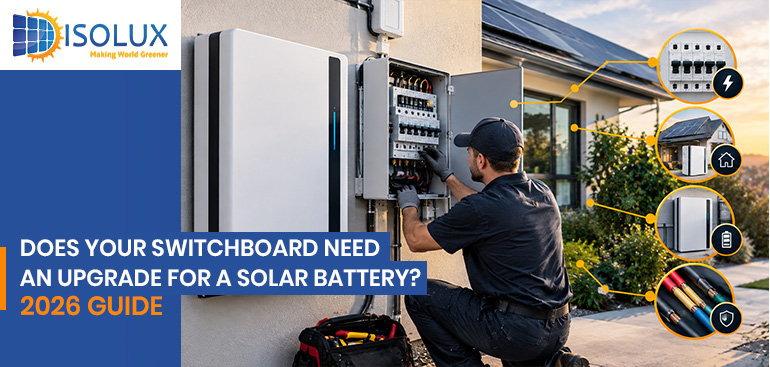

Installing a solar battery does not always require a switchboard upgrade. However, your switchboard must be assessed for capacity, wiring, safety switches and compliant battery connections before installation.
For many Australian homes, especially older properties, some electrical work may be needed. Therefore, checking the switchboard early can help avoid unexpected costs and installation delays.
It can also give you a clearer Solar Battery Price before you commit to the system.
What Does a Switchboard Do in a Solar Battery System?
Your switchboard distributes electricity between the grid, solar system, battery and household circuits. It also contains protective devices that help protect people and electrical equipment.
A solar battery adds another source of electricity to the property. Therefore, the existing switchboard needs to safely accommodate the new equipment.
The exact requirements depend on the battery, inverter, existing wiring and whether you want backup power.
When Does a Solar Battery Installation Need a Switchboard Upgrade?
Old Fuse Boards and Outdated Electrical Protection
Older homes may still have ceramic fuses or outdated switchboards. These boards may lack the space and protection needed for modern solar batteries.
A licensed electrician should inspect the board before installation. They can determine whether a minor modification or larger upgrade is required.
Not Enough Space for New Battery Circuits
A battery installation can require additional circuit protection and switching equipment.
If your switchboard is already full, your installer may need to add a larger enclosure or reorganise the existing circuits.
However, a full replacement is not always necessary.
Missing or Outdated Safety Switches
A safety switch helps disconnect a circuit when it detects a dangerous electrical leakage.
Battery systems can also operate as an alternative supply during a blackout. Therefore, the RCD protection on affected circuits must be suitable for the new system.
Current guidance confirms that Type AC RCDs cannot be newly installed in Australia. Existing Type AC devices may sometimes remain, depending on the circuit, inverter requirements and verification testing.
This is why your installer should assess the actual switchboard rather than assume every safety switch needs replacement.
Existing Wiring or Neutral Issues
Older homes can have wiring problems that were not obvious during normal operation.
Adding a battery may require circuits to be altered or separated. This can expose issues such as shared or crossed neutrals.
Battery backup systems also require correct neutral continuity and earthing arrangements. These requirements must be verified during installation.
How Is a Switchboard Checked Before Solar Battery Installation?
A qualified electrician should assess several areas before connecting the battery.
Switchboard Condition and Capacity
The electrician checks the enclosure, circuit breakers, busbars, cabling and available space.
They also need to consider the combined electrical sources. Solar and battery inverters can introduce additional current into the switchboard, so the board must be suitable for the system design.
Safety Switch and RCD Protection
The installer checks existing RCDs and determines which circuits will be affected by the battery.
For backup systems, the protection must operate correctly with the alternative supply. NSW guidance confirms that adding an alternative supply is treated as an alteration to the electrical installation.
Wiring, Earthing and Circuit Configuration
The electrician should also check wiring condition, neutral connections and earthing arrangements.
These checks are particularly important when adding a battery to an older solar installation.
Single-Phase vs Three-Phase Electrical Supply
Your home’s electrical supply also affects battery design.
A three-phase property may require different equipment and circuit arrangements from a single-phase property. Your installer should assess the complete electrical setup before recommending a battery.
Also Read: Single Phase vs. Three Phase Power: Understanding the Differences
Does Solar Battery Price Include a Switchboard Upgrade?
Not necessarily.
Some quotes include required electrical work. Others list switchboard modifications separately.
Therefore, always ask whether the Solar Battery Price includes:
The switchboard assessment, required safety-switch work, additional circuit protection, wiring changes and any necessary switchboard replacement.
A clear, itemised quote makes it easier to compare Solar Batteries accurately.
Also Read: Solar Battery Price Australia 2026: 10kWh, 15kWh & 20kWh Costs
What Happens If Your Switchboard Is Not Suitable?
An unsuitable board does not automatically mean you cannot install a battery.
Can the Existing Switchboard Be Upgraded?
Often, yes. A licensed electrician may be able to add equipment, improve protection or increase available space.
The solution depends on the board’s condition and the proposed battery system.
When Is a Full Switchboard Replacement Needed?
A replacement may be considered when the existing board is severely outdated, damaged, overloaded or unsuitable for the required equipment.
A professional assessment should determine the appropriate solution.
Can You Install a Solar Battery Without Upgrading the Switchboard?
Yes, in some homes.
A newer switchboard may already have adequate capacity, space and suitable protection. However, this should never be assumed from the switchboard’s appearance.
A proper electrical assessment is essential before installation. Australian guidance also requires battery installations to comply with relevant electrical and battery safety standards.
7 Questions to Ask Your Solar Battery Installer
Before signing a quote, ask whether your switchboard has been physically assessed and whether any upgrade is required.
Also ask whether safety-switch changes are included in the quoted price.
Confirm whether existing wiring could require additional work.
Ask which circuits will receive battery backup, if backup is included.
Check whether the quote covers all required electrical work.
Finally, ask what compliance documents and system diagrams you will receive after installation. NSW guidance recommends appropriate system documentation and compliance certification after electrical work.
Conclusion
Your switchboard may need an upgrade for a solar battery, but it is not automatically required. The answer depends on its age, capacity, safety switches, wiring, circuit configuration and the battery system being installed.
Therefore, have a qualified electrician assess the switchboard before accepting a Solar Battery Price. A proper assessment helps you understand the real installation requirements and avoid unexpected electrical costs.
For homeowners considering Solar Batteries in Australia, switchboard readiness should be part of the battery decision from the start.