
What Is the Solar Battery Price in Australia in 2026?
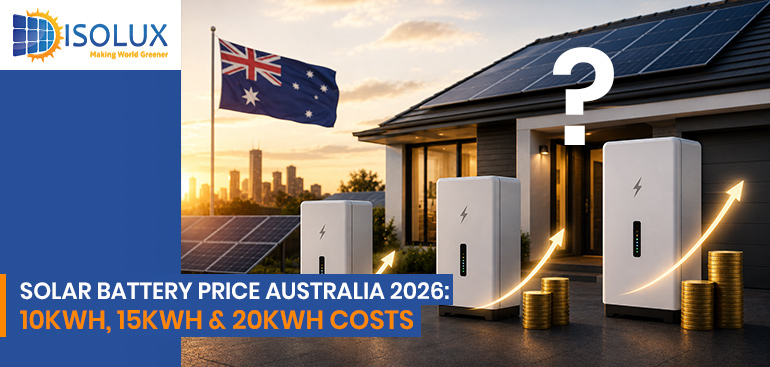
The Solar Battery Price in Australia in 2026 generally falls around $7,000 to $19,000 installed after the federal battery discount, depending on capacity, equipment and installation complexity. Current market guides put many 10kWh systems around $7,000 to $11,000 after the federal discount, 15kWh systems around $11,000 to $15,000, and 20kWh systems around $14,000 to $19,000.
Before incentives, the price can be considerably higher.
However, there is no single solar battery cost for every Australian home. Battery chemistry, usable capacity, inverter requirements, switchboard work and backup features can change the final quote.
The Australian Government’s Cheaper Home Batteries Program currently provides a discount of around 30% for eligible battery systems. The program applies to batteries connected to new or existing solar PV systems.
The discount changed from 1 May 2026. It now uses updated STC factors and capacity-based calculations. Therefore, the exact saving depends on the battery’s usable capacity and installation date.
For homeowners comparing prices, the most important question is not simply, “How much does a battery cost?”
It is:“How much will a suitable battery system cost after incentives, including installation?”
Solar Battery Price Australia 2026: 10kWh vs 15kWh vs 20kWh
Battery capacity is one of the biggest factors affecting price.
The following ranges provide a practical starting point for budgeting.
| Battery Size | Indicative Installed Cost Before Rebate | Indicative Cost After Federal Discount* | Typical Household |
| 10kWh | $8,000 to $12,000 | $7,000 to $11,000 | Small to medium household |
| 15kWh | $10,000 to $15,000 | $11,000 to $15,000 | Medium to large household |
| 20kWh | $14,000 to $20,000 | $14,000 to $19,000 | Large or high-use household |
*Market ranges overlap because battery brands and installation requirements vary. The “after discount” figures are indicative planning ranges from current Australian market data. They should not be treated as a guaranteed percentage reduction from the pre-rebate figures.
The table may appear unusual because some post-discount ranges overlap with pre-discount ranges.
That happens because different market guides use different equipment, installation assumptions and pricing dates.
A straightforward battery installation can cost less than a complex retrofit.
A premium battery can also cost more than a larger budget system.Therefore, compare the complete system rather than capacity alone.
10kWh Solar Battery Price in Australia
The 10kWh solar battery price remains one of the most relevant options for Australian households.
Current market guides place many installed 10kWh systems around $8,000 to $12,000 before incentives, while current post-discount guides commonly show around $7,000 to $11,000 installed.
A straightforward installation can sit near the lower end.
A premium battery or complex retrofit can move towards the higher end.
What Does a 10kWh Battery Installation Include?
A complete quote may include the battery, inverter or battery controller, electrical protection, cabling, labour, commissioning and monitoring.
Some homes may also require switchboard modifications.
This is why a battery-only online price should not be compared directly with an installed quote.
Who Is a 10kWh Battery Best Suited To?
A 10kWh battery can suit a household with moderate electricity consumption.
It can work particularly well when the home has enough rooftop solar to charge the battery during the day.
The battery can then supply stored energy after solar production falls.
However, homes with EV charging, pool equipment or high evening air-conditioning demand may need more storage.
15kWh Solar Battery Price in Australia
The 15kWh solar battery price generally sits between standard 10kWh systems and larger 20kWh systems.
Current Australian pricing guides commonly place 13kWh to 15kWh systems around $10,000 to $15,000 installed before incentives, with some current post-discount market estimates around $7,500 to $12,000 depending on equipment and installation.
A 15kWh battery can be a practical option for larger family homes.
It provides more stored energy than a 10kWh system.
However, it does not necessarily cost 50% more than a 10kWh battery.
Battery pricing is not perfectly linear.
Larger systems can sometimes offer a lower cost per usable kWh.
How Much Does a 15kWh Battery Installation Cost?
Expect the final price to depend on several factors.
The battery brand is important.
So is your existing inverter.
Your switchboard and cable routes can also affect labour.
Backup functionality can add further equipment.
Therefore, a 15kWh battery quote should always specify what is included.
Is a 15kWh Solar Battery Worth the Extra Cost?
It can be valuable for homes where 10kWh does not provide enough evening storage.
For example, consider a four-bedroom home with significant evening air-conditioning use.
A 15kWh battery could store more daytime solar for evening consumption.
However, additional capacity only creates value if the household can regularly charge and use it.
20kWh Solar Battery Price in Australia
The 20kWh solar battery price can vary significantly between brands and installations.
Current Australian guides commonly place 20kWh systems around $14,000 to $20,000 before incentives. Current post-discount market estimates range around $14,000 to $19,000, although some installers quote outside these ranges.
A 20kWh battery is a substantial residential storage system.
It can suit households with high electricity consumption.
It may also suit homes preparing for greater electrification.
How Much Does a 20kWh Battery Cost Installed?
The battery itself is only part of the total cost.
A 20kWh system may require a suitable inverter and electrical equipment.
A switchboard upgrade may also be necessary.
The installation location can affect labour.
Therefore, homeowners should request an itemised quote.
Who Should Consider a 20kWh Battery?
A 20kWh battery can suit larger homes with high electricity consumption.
It may also make sense for households with an EV, electric hot water, multiple air conditioners or pool equipment.
However, bigger is not always better.The Australian Government specifically advises homeowners to size batteries around their electricity use, solar output and inverter capacity. It also warns that an oversized battery can limit potential benefits.
Solar Battery Cost After Rebate in 2026
The solar battery cost after rebate is now an important part of the buying decision.
The federal Cheaper Home Batteries Program provides an upfront discount of around 30% for eligible battery installations. The program supports battery systems from 5kWh to 100kWh, although the discount calculation uses specific capacity rules.
The program changed on 1 May 2026.
The STC factor for May to December 2026 is 6.8.
The calculation also tapers for larger capacities. The first 14kWh receives the full applicable factor. Capacity above 14kWh and up to 28kWh receives a 60% factor. Capacity above 28kWh and up to 50kWh receives a 15% factor.
Therefore, you should not assume that a 20kWh battery receives exactly double the support of a 10kWh battery.
How Much Can the Solar Battery Rebate Save?
The exact discount depends on the eligible battery, usable capacity and STC value.
For example, a current market estimate of an installed 10kWh system might be around $8,000 to $12,000 before incentives.
After the applicable discount, current market guides show many 10kWh installations around $7,000 to $11,000.
For a 20kWh system, current post-discount market guides commonly show around $14,000 to $19,000.
These figures are not guaranteed rebate calculations.
Your installer should show the exact discount on the quote.
Is the Rebate Already Included in Advertised Battery Prices?
Sometimes.
This is one of the biggest reasons homeowners see different prices online.
One company may advertise the battery before incentives.
Another may advertise its installed price after the federal discount.
A third may advertise a battery-only price.
Therefore, always ask:
Is this price before or after the government discount?
Also ask whether installation, inverter equipment and electrical work are included.
Solar Battery Cost NSW: What Should Homeowners Expect?
The solar battery cost NSW depends on the same core factors as other Australian states.
However, NSW homeowners may also have access to additional incentives.
The NSW Government currently states that eligible households and small businesses can connect batteries to a Virtual Power Plant and receive an incentive. From 1 July 2026, batteries up to 50kWh are eligible for the NSW VPP incentive, although the upfront incentive is calculated using usable capacity available to the grid, up to 28kWh.
This NSW incentive can be combined with the federal Cheaper Home Batteries Program, subject to eligibility requirements.
Is Solar Battery Installation Cheaper in NSW After Rebates?
It can be.
However, homeowners should not assume a fixed final price.
The NSW VPP incentive depends on the provider and agreement.
The federal discount also depends on battery capacity and STC settings.
Therefore, your final price needs to be calculated from your actual system.
What Affects Solar Battery Cost in Sydney and Regional NSW?
Installation conditions can make a major difference.
For example, an easy garage installation may require less work.
A difficult installation can require additional cable runs or switchboard changes.
Other factors include:Existing solar inverter compatibility, three-phase power, battery location, switchboard capacity and backup requirements.
What Is Included in a Solar Battery Installation Cost?
A complete solar battery installation usually involves more than mounting a battery on a wall.
Battery Hardware
The battery provides the energy storage capacity.
Its usable capacity can differ from its headline capacity.
Therefore, compare usable kWh when reviewing products.
Inverter or Battery Controller
The inverter manages electricity conversion between your solar system, battery, home and grid.
Some installations can use existing compatible equipment.
Others require new inverter equipment.
Electrical Installation
Installation can include cabling, isolation, protection equipment and commissioning.
The exact requirements depend on your property and system design.
Switchboard Work
Older switchboards may require upgrades.
This can increase the final solar battery cost.
Monitoring and Commissioning
A good installation should include system setup and commissioning.
Monitoring can then help you track battery performance and energy flows.
Network and Compliance Requirements
Your installation must meet applicable Australian requirements.
The federal program requires eligible products and accredited installers.
The Australian Government advises consumers to use a CEC-accredited battery product and an installer accredited by Solar Accreditation Australia.
Why Does Solar Battery Cost Vary So Much in Australia?
Two batteries with similar capacity can have very different prices.
There are several reasons.
Battery Capacity
More storage generally means more hardware.
However, cost does not always increase proportionally with capacity.
Battery Brand
Established brands can charge more for hardware, software, warranty support and features.
A newer brand may offer a lower purchase price.
Price alone does not determine quality.
Usable Capacity
Always compare usable capacity.
A battery advertised at a particular nominal capacity may not provide all of that energy for everyday use.
Inverter Requirements
If your existing solar system is battery-ready, the installation may be simpler.
If it is not compatible, additional equipment can increase the cost.
Installation Complexity
Switchboard upgrades, long cable runs and difficult battery locations can increase labour.
Therefore, two homes buying the same battery may receive different quotes.
Backup Power
Backup capability can increase the total system cost.Whole-home backup can require additional equipment and system design.
Solar Battery Cost per kWh: Is It a Useful Comparison?
Comparing solar battery cost per kWh can help homeowners understand value.
The basic formula is:
Installed battery cost ÷ usable battery capacity = cost per usable kWh
For example, a $10,000 installed battery with 10kWh of usable capacity equals:
$10,000 ÷ 10 = $1,000 per usable kWh
However, do not use this number alone.
A battery with a lower cost per kWh may have different warranty terms or power output.
It may also provide different backup functionality.
Therefore, compare:
Price + usable capacity + power + efficiency + warranty + installation
This gives a more useful picture of value.
10kWh vs 15kWh vs 20kWh: Which Solar Battery Gives Better Value?
The best capacity depends on your home.
| Capacity | Indicative After-Rebate Cost | Best Suited To |
| 10kWh | $7,000 to $11,000 | Moderate energy users |
| 15kWh | $11,000 to $15,000 | Medium to high energy users |
| 20kWh | $14,000 to $19,000 | Large or high-use homes |
These are current market planning ranges. They are not fixed prices.
When a 10kWh Battery Offers Better Value
A 10kWh system can provide good value when your evening energy demand is moderate.
You also need enough solar generation to charge it.
When a 15kWh Battery Makes More Sense
A 15kWh system can work well for larger family homes.
It provides additional storage without moving directly to 20kWh.
When a 20kWh Battery Is Worth the Extra Cost
A 20kWh system can make sense when your home uses a lot of electricity.
It may also suit households with EVs and other high-energy appliances.
However, the battery needs enough solar energy to charge regularly.
What Factors Should You Consider Before Buying a Solar Battery?
Price is important.
However, it should not be the only factor.
Your Daily Electricity Consumption
Review your electricity bills.
Then examine how much electricity you use each day.
Evening and Overnight Usage
Battery storage is especially useful for shifting daytime solar into evening consumption.
Therefore, after-sunset usage matters greatly.
Existing Solar System
Your current inverter and solar capacity can affect installation costs.
Future EV Charging
An EV can significantly increase electricity consumption.
Consider this before choosing battery capacity.
Air Conditioning and Electric Appliances
High-load appliances can increase evening demand.
Battery Usable Capacity
Compare usable kWh rather than headline capacity alone.
Power Output
Check how much power the battery can supply at once.
Warranty
Review both product and performance warranty terms.
Backup Capability
Check whether backup is included.
Also confirm which circuits can operate during an outage.
Installer Experience
A battery is a long-term energy asset.
Installation quality matters.
The federal program also recommends checking installer accreditation and product eligibility.
Does a More Expensive Solar Battery Mean Better Quality?
Not necessarily.
A higher price can reflect better hardware, software, warranty support or backup features.
It can also reflect a more expensive installation.
However, price alone does not prove that one battery is better.
A budget battery can provide good value if it meets your requirements.
A premium battery can also make sense when its additional features justify the cost.
Therefore, compare the complete system.Look at usable capacity, power output, warranty, efficiency, monitoring and installer support.
How Much Does Solar Battery Installation Cost Separately?
Installation costs vary based on your existing solar system and property.
A battery-ready home may need less additional equipment.
A retrofit may require a new inverter.
Some homes also need switchboard upgrades.
Therefore, it is difficult to give one national installation price.
As a planning guide, current Australian installed battery pricing shows how installation and equipment are often combined in the final quote. Current guides put 10kWh systems around $7,000 to $11,000 after the federal discount and 20kWh systems around $14,000 to $19,000.
Always ask for an itemised quote.That makes it easier to understand the actual battery, installation and rebate components.
Solar Battery Price vs Solar and Battery System Price
These two prices should never be confused.
A solar battery price usually relates to adding storage.
A solar and battery system price can include:
Solar panels, inverter, battery, mounting equipment, electrical work and installation.
A new solar and battery system will therefore cost more than adding a battery to an existing suitable solar system.
For example, current market data shows a 10kWh battery-only installation can be substantially cheaper than a complete solar-plus-battery package.
This distinction is especially important when comparing online advertisements.
Always check exactly what the advertised price includes.
Is a Solar Battery Worth the Cost in 2026?
A solar battery can be worthwhile for the right household.
Its value comes from storing electricity when solar production is available and using that energy later.
This can increase solar self-consumption.
It can also reduce the amount of electricity purchased from the grid.
The federal battery discount has also reduced upfront costs for eligible systems.
However, savings vary between households.
Your electricity tariff, solar generation, battery utilisation and consumption pattern all affect the financial result.
Therefore, do not rely on a generic payback period.A professional assessment should use your actual energy data.
Common Mistakes When Comparing Solar Battery Prices
Comparing Hardware Prices With Installed Prices
A battery-only price is not equivalent to an installed system.
Ignoring the Rebate
Check whether the advertised figure includes the current government discount.
Looking Only at Battery Capacity
Two batteries with the same nominal capacity can have different usable capacity and performance.
Choosing the Cheapest Quote
A low price can be attractive.
However, check the equipment, warranty and installation scope first.
Forgetting Switchboard Costs
Electrical upgrades can increase the final price.
Not Checking Usable Capacity
The headline kWh figure does not tell the entire story.
Ignoring Warranty Terms
A longer warranty can provide additional confidence.
However, read the conditions carefully.
Choosing Too Much Storage
The Australian Government advises that bigger is not always better. An oversized battery may not provide the expected benefit if your solar system and energy use cannot utilise it.
Get an Accurate Solar Battery Price for Your Home
Solar Battery Price in Australia in 2026 varies by battery size, brand, installation requirements and available rebates, with 10kWh, 15kWh and 20kWh systems suited to different household energy needs.
A 10kWh system can be a practical choice for moderate energy users.
A 15kWh system can provide additional storage for larger family homes.
A 20kWh system can suit high-energy households with enough solar generation to charge it.
The current federal Cheaper Home Batteries Program can reduce the upfront cost of eligible systems. However, the actual discount depends on the battery’s usable capacity and applicable STC settings.
Therefore, do not choose a battery based on price alone.
Compare the complete installed system, including usable capacity, inverter requirements, installation, warranty and backup capability.
For NSW homeowners, additional VPP incentives may also be available. These can be combined with the federal battery discount when eligibility requirements are met.
The best solar battery is not necessarily the cheapest or largest battery. It is the system that provides the right storage for your home’s energy needs at a sensible installed cost.
If you are comparing solar battery costs in Australia, Isolux Solar can assess your existing solar system, electricity usage and battery requirements before recommending a suitable solution.
Frequently Asked Questions
How much does a solar battery cost in Australia in 2026?
A typical residential solar battery can cost around $7,000 to $19,000 installed after the federal discount, depending on capacity and installation. Current market guides put 10kWh systems around $7,000 to $11,000 and 20kWh systems around $14,000 to $19,000.
How much does a 10kWh solar battery cost?
A 10kWh solar battery commonly costs around $8,000 to $12,000 before incentives. Current post-discount market ranges are around $7,000 to $11,000 installed, depending on the brand and installation.
What is the 15kWh solar battery price in Australia?
A 15kWh system can cost around $10,000 to $15,000 installed before incentives. Current market estimates after the federal discount can be around $7,500 to $12,000, depending on the system.
How much does a 20kWh solar battery cost?
A 20kWh battery system can cost around $14,000 to $20,000 before incentives. Current post-discount market guides commonly place installed systems around $14,000 to $19,000.
How much does a solar battery cost after the rebate?
The current federal program provides an upfront discount of around 30% for eligible batteries. The actual amount depends on usable capacity, STC factors and the installation date.
What is the solar battery cost in NSW?
NSW solar battery costs vary by capacity and installation. Eligible households may also combine the federal battery discount with the NSW VPP incentive, subject to the program rules.
Does the solar battery rebate reduce installation costs?
The federal discount reduces the eligible upfront cost of the battery system. It does not mean every installation component receives a simple 30% reduction. Your installer should show the applicable discount on your quote.
Is a 10kWh or 20kWh battery better?
Neither is automatically better. A 10kWh battery can suit moderate energy users. A 20kWh battery can suit homes with higher consumption and sufficient solar generation.
How much does solar battery installation cost?
There is no single installation price. The cost depends on inverter compatibility, switchboard work, cable runs, battery location and backup requirements. These factors are usually reflected in the complete installed price.
What is the cheapest solar battery in Australia?
The cheapest battery is not necessarily the best-value option. Compare usable capacity, warranty, power output, efficiency, installation and support alongside the purchase price.
Is a solar battery worth it in 2026?
A solar battery can be worthwhile when your home has suitable solar generation and significant electricity consumption after sunset. The current federal discount can also reduce the upfront cost for eligible systems.