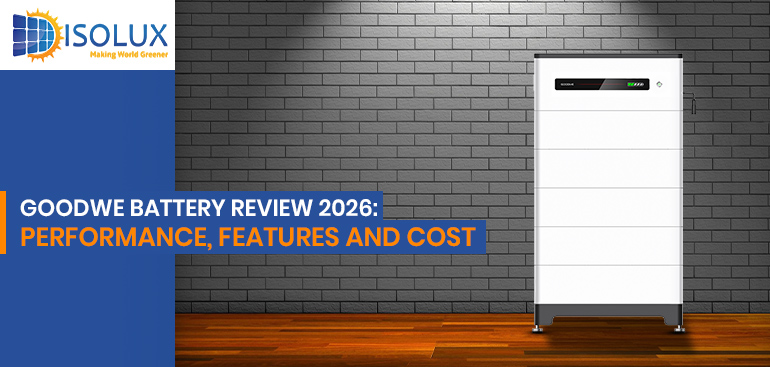

Thinking about adding battery storage to your solar system? The GoodWe Battery Review 2026 is exactly what you need before making that investment. GoodWe has rapidly grown from a trusted inverter manufacturer into one of Australia’s most talked-about home battery brands. With rising electricity prices across NSW, VIC, QLD, SA, and WA, more Australians are asking whether a GoodWe battery is worth installing. In this comprehensive review, we cover everything – from real performance data and technical specs to cost, payback periods, and how GoodWe compares to competing brands in 2026.
What Is the GoodWe Battery System?
GoodWe is a Chinese solar technology company founded in 2010 and headquartered in Suzhou, China. The brand entered the Australian inverter market in 2012 and expanded into home battery storage in 2020. Since then, GoodWe has earned a solid reputation for offering reliable, affordable, and well-supported energy storage solutions.
In Australia, GoodWe operates from its office at 2/6 Enterprise Drive, Rowville, Victoria, with dedicated technical support and after-sales service. This local presence is important because it means Australian homeowners are not left stranded when they need assistance.
GoodWe produces two main residential battery product lines in Australia today: the Lynx Series and the newer ESA Series. Both use Lithium Iron Phosphate (LFP) chemistry, which is widely considered the safest and most durable chemistry available for residential energy storage.
GoodWe Battery Review 2026: Key Specifications at a Glance
Understanding the technical specifications helps you make an informed decision. Here is what GoodWe’s leading battery products offer:
| Feature | GoodWe Lynx Home U | GoodWe ESA Series |
| Battery Chemistry | LFP (LiFePO4) | LFP (LiFePO4) |
| Module Capacity | 5.4 kWh (4.8 kWh usable) | 5 kWh or 8 kWh per module |
| Maximum Capacity | ~27 kWh (5 modules) | Up to 48 kWh |
| System Type | Battery only (with compatible inverter) | All-in-one (inverter + battery) |
| Inverter Compatibility | GoodWe hybrid inverters only | Built-in hybrid inverter |
| Backup Capability | Yes (with compatible inverter) | Yes (built-in) |
| Operating Temperature | Charge: 0–50°C / Discharge: -20–50°C | Charge: 0–50°C / Discharge: -20–50°C |
| Warranty | 10 years | 10 years |
| CEC Approved | Yes | Yes |
These specifications reflect GoodWe’s commitment to building systems that perform in Australia’s demanding climate – from Queensland’s tropical heat to Victoria’s cold winters.
GoodWe Battery Range in Australia: Lynx Series vs ESA Series
GoodWe offers two distinct product families in Australia. Knowing the difference helps you choose the right system for your home.
GoodWe Lynx Series
The Lynx Series is GoodWe’s established battery-only product line. It is a modular, low-voltage system designed to pair with a compatible GoodWe hybrid inverter. The most popular variant is the Lynx Home U Series, where each module stores 5.4 kWh of total capacity (4.8 kWh usable).
The Lynx is a “plug and play” system when used with a GoodWe inverter, making installation straightforward for certified installers. However, it is only compatible with GoodWe’s own hybrid inverters, so it cannot be retrofitted to third-party inverter brands.
One standout feature of all Lynx batteries is automatic reboot after a low-voltage shutdown event. This is a practical advantage that most competing batteries do not offer – it means your system recovers without requiring a manual reset or a technician callout.
Also Read: SAJ vs GoodWe Inverter: Which One Should You Choose?
GoodWe ESA Series
The GoodWe ESA Series is the brand’s flagship all-in-one system, launched at Australia’s Smart Energy Conference in April 2025. It combines a hybrid solar inverter and modular LFP battery storage in a single vertical cabinet – no separate gateway, no external backup device, and no complex wiring between multiple boxes.
The ESA is available in single-phase and three-phase configurations, making it suitable for a far wider range of Australian homes than the Lynx Series alone. This is a significant step forward for GoodWe.
GoodWe ESA Battery Review: The All-in-One Powerhouse
The ESA Series represents a genuine evolution in home battery design. Instead of mounting a solar inverter separately and cabling it to a standalone battery, the ESA stacks everything into one neat column. This design trend now dominates the Australian mid-to-premium battery market, and for good reason.
How the ESA System Works
The hybrid inverter sits at the top of the column. Battery modules are clipped underneath, with each module being either 5 kWh or 8 kWh in capacity. The system supports mixed module sizes within the same stack, which gives homeowners genuine flexibility over the life of the product. You could, for example, start with one 8 kWh module and add two more as your energy needs grow — or as your budget allows.
The maximum storage per ESA column is approximately 48 kWh, which comfortably covers even the largest Australian family homes, or homes with electric vehicles and high daytime air-conditioning loads.
Single-Phase and Three-Phase Options
The ESA is available in common single-phase inverter sizes of 5 kW and larger, as well as three-phase configurations for homes with three-phase power connections. Three-phase homes -common in newer suburban estates across NSW, QLD, and WA -have historically had fewer all-in-one battery options. The ESA fills that gap.
Built-In Backup Power
The ESA includes built-in blackout protection without requiring an external backup gateway device. During a grid outage, the system automatically switches to battery power, keeping your lights, refrigerator, and essential appliances running. The switchover is seamless and does not require any manual input.
GoodWe Battery Performance: How Well Does It Really Work?
Performance is ultimately what matters most, and GoodWe’s latest batteries perform well across the metrics that Australian homeowners care about.
Round-Trip Efficiency
The GoodWe ESA and Lynx batteries operate at a round-trip efficiency of approximately 97%, which is excellent for residential LFP systems. Round-trip efficiency describes how much of the energy you store can actually be retrieved and used. A system with 97% efficiency loses only 3% of energy through the charge-discharge cycle -meaning very little stored solar energy is wasted.
To put this in context: if you store 10 kWh of solar power, you will get back approximately 9.7 kWh to use at night. Over a year of daily cycling, this efficiency adds up to meaningful savings.
Cycle Life and Longevity
LFP chemistry is well known for its long cycle life. GoodWe’s batteries are rated for thousands of charge-discharge cycles before reaching 80% of their original capacity. For a system cycled once daily, this translates to a working life that comfortably exceeds the 10-year warranty period. This is a practical advantage over older lithium NMC (Nickel Manganese Cobalt) batteries, which degrade more quickly under the same daily cycling conditions.
Thermal Performance in Australian Conditions
LFP chemistry is also more thermally stable than NMC alternatives, which is important in Australian summers. GoodWe’s batteries are rated to charge in temperatures up to 50°C and discharge in temperatures as low as -20°C. This means the ESA and Lynx batteries cope well with extreme Australian heat, as well as cool southern state winters.
That said, like all battery systems, performance slightly degrades at temperature extremes. Installers typically recommend locating the battery in a garage, carport, or shaded outdoor area to minimise thermal stress.
GoodWe Battery Features That Australian Homeowners Will Love
Beyond the core storage function, GoodWe batteries include several features that make real-world ownership more convenient and rewarding.
Smart Energy Management via SolarGo App
GoodWe’s SolarGo app is available on iOS and Android and gives homeowners real-time visibility into their solar production, battery state of charge, grid import/export, and household consumption. The app is clean and easy to navigate, which is more than can be said for some competing products.
Through the app, you can set time-of-use charging schedules. This means you can program the battery to charge from the grid during cheap off-peak tariff windows and discharge during expensive peak periods -a strategy that can significantly cut electricity bills without any manual intervention.
Virtual Power Plant (VPP) Compatibility
GoodWe batteries are compatible with several Virtual Power Plant (VPP) programs operating in Australia. A VPP links your battery to a network of other home batteries. Your retailer can draw small amounts of stored energy during grid stress events in exchange for bill credits or payments. This is an increasingly valuable feature as more Australian states incentivise VPP participation.
Automatic Reboot After Voltage Events
As noted earlier, the Lynx and ESA systems both automatically reboot after under-voltage cutout events. This is a feature that competing budget brands often omit, and it prevents the frustration of discovering your battery has shut down and requires manual intervention to restart.
Expandable and Future-Proof Design
The modular design of both the Lynx and ESA systems means you are not locked into a fixed capacity at installation time. As electricity prices rise, as you add an EV charger, or as your household energy consumption grows, you can simply add battery modules rather than replacing the entire system.
GoodWe Battery Cost in Australia: What Should You Expect to Pay?
Cost is one of the most important considerations for any Australian homeowner weighing up battery storage. GoodWe positions itself as one of the better-value battery brands in the Australian market, and the numbers generally support that.
GoodWe Battery Pricing (2026 Estimates)
Battery pricing in Australia varies by state, installer, system size, and whether you are bundling with solar panels. The following are approximate installed costs for common GoodWe configurations in 2026:
| System Configuration | Approximate Installed Cost |
| GoodWe Lynx 5.4 kWh (1 module) | $3,500 – $5,000 |
| GoodWe Lynx 10.8 kWh (2 modules) | $6,500 – $9,000 |
| GoodWe ESA 10 kWh (all-in-one) | $8,000 – $11,000 |
| GoodWe ESA 16–20 kWh | $12,000 – $16,000 |
These figures are indicative. Always obtain multiple quotes from CEC-accredited installers in your area.
Federal Battery Rebate Impact
Australia’s federal battery rebate scheme, introduced in 2025, significantly reduces the upfront cost of eligible home batteries. GoodWe’s ESA Series is CEC-approved and eligible for this rebate. Depending on your state and system size, the rebate can reduce your out-of-pocket cost by several thousand dollars.
State-based incentives add further savings in some regions. For example, Victoria and South Australia have historically offered additional rebates or interest-free loan programs for battery storage that can be stacked with the federal scheme.
Always confirm current rebate eligibility with your installer, as rebate programs are subject to change.
GoodWe Battery Payback Period: A Real-Life Australian Example
The payback period is the time it takes for your battery savings to equal the total upfront cost. This is perhaps the most important number for any homeowner evaluating battery storage.
How the Payback Period Is Calculated
Your payback period depends on three key variables: the cost of your battery system, the value of electricity you avoid purchasing from the grid (based on your electricity tariff), and the feed-in tariff you currently earn for exporting solar.
The logic is straightforward. Every kWh of energy you draw from your battery instead of the grid is worth whatever your retailer charges for grid electricity. In Australia, peak electricity rates in 2026 range from approximately 30 cents per kWh in some Queensland plans to over 45 cents per kWh in parts of South Australia and New South Wales.
Sample Calculation: Sydney Family Home (NSW)
Consider a Sydney household with a 10 kW solar system adding a GoodWe ESA 10 kWh battery at an installed cost of $9,500 (after federal rebate applied).
The household uses approximately 25 kWh of electricity per day. Before adding the battery, 8 kWh of solar production was being exported to the grid each day at a feed-in tariff of 5 cents/kWh. After installing the battery, that same 8 kWh is instead stored and used at night, avoiding grid purchases at 38 cents/kWh.
Daily saving = 8 kWh × (38¢ – 5¢) = 8 × 33¢ = $2.64 per day
Annual saving = $2.64 × 365 = $963 per year
Payback period = $9,500 ÷ $963 = approximately 9.9 years This example shows a payback period just under 10 years, which sits comfortably within the 10-year warranty period. Therefore, from year 10 onwards, the system essentially generates free energy savings for the homeowner.
How State Electricity Rates Affect Payback
Payback periods vary significantly across Australian states because electricity tariffs differ. South Australian households, who pay some of the highest electricity rates in the country, can achieve payback periods as short as 7–8 years with an appropriately sized battery. Victorian households on time-of-use tariffs can also achieve strong returns, particularly those who shift evening consumption away from expensive peak periods.
Queensland homeowners should note that the state’s relatively lower electricity rates and strong solar irradiation mean the case for battery storage is slightly different -the savings per kWh stored are lower, but the volume of storable solar energy is higher. A properly sized system still delivers solid returns.
Factors That Affect Your GoodWe Battery Payback Period
Not all households will see the same payback period. Several factors push this number shorter or longer.
Your electricity tariff structure is the single biggest variable. Households on flat-rate tariffs benefit from batteries simply by replacing expensive grid electricity. Households on time-of-use tariffs can extract even more value by charging the battery at cheap off-peak rates and discharging during expensive peak windows.
Your solar system size also matters. A home with a large 13 kW or 20 kW solar array will generate significant excess energy during the day, much of which would otherwise be exported at a low feed-in tariff. A battery captures that surplus and redirects it to evening consumption, improving savings substantially.
Your household energy consumption pattern affects how often the battery cycles. A household that runs most of its energy-intensive appliances (dishwasher, air conditioning, EV charging) in the evening will benefit most from battery storage, as the battery can supply those loads directly.
The feed-in tariff you receive plays a supporting role. As feed-in tariffs have continued to fall across most Australian states through 2025 and 2026, the opportunity cost of exporting solar has reduced, making battery self-consumption more attractive by comparison.
Battery size relative to your needs is important. An undersized battery fills up quickly and cannot capture all available solar surplus. An oversized battery may not complete a full charge-discharge cycle each day, reducing the annual savings it delivers.
Tips to Improve Your ROI With a GoodWe Battery
Getting the most from your GoodWe battery is not complicated. These practical steps can meaningfully shorten your payback period.
Switch to a time-of-use electricity tariff if your retailer offers one. Program your GoodWe battery via the SolarGo app to charge from excess solar during the day and discharge during the expensive evening peak period. This strategy is particularly effective in NSW, VIC, and SA.
Run high-energy appliances during the day.
Dishwashers, washing machines, dryers, and pool pumps should run when the sun is shining. This keeps your battery’s stored energy available for nighttime use rather than daytime consumption.
Consider VPP participation.
If your retailer or a third-party VPP operator offers payments for accessing your stored energy during grid stress events, enrolling can provide additional revenue or bill credits that effectively shorten your payback period.
Size your battery correctly from the start.
At ISOLUX Solar, we help homeowners calculate their average evening energy consumption to recommend a battery capacity that maximises daily cycling without oversizing the system.
Keep the battery in a shaded, ventilated location.
Excessive heat is the primary cause of accelerated battery degradation. A garage or shaded carport location in most Australian climates is ideal. Avoid direct sun exposure.
GoodWe Battery vs the Competition: How Does It Stack Up?
The GoodWe battery, particularly the ESA Series, now competes directly with some well-established names in the Australian home battery market.
GoodWe vs Tesla Powerwall 3
The Tesla Powerwall 3 is a premium all-in-one system with a strong brand reputation and a polished app experience. However, it comes at a significantly higher price point -typically $14,000–$17,000 installed -and is a fixed-capacity system that cannot be expanded with additional modules. The GoodWe ESA, by contrast, is modular, more affordable, and offers three-phase compatibility. For homeowners who want flexibility and value over brand prestige, the GoodWe ESA is a compelling alternative.
GoodWe vs Sungrow
Sungrow is another Chinese brand with a strong Australian reputation. Like GoodWe, Sungrow offers modular LFP batteries at competitive price points. The two brands are closely matched on specifications and value. The choice often comes down to your installer’s preference and which system best suits your existing inverter brand.
GoodWe vs Fronius Reserva
The Fronius Reserva is a premium European option that prioritises build quality and a tight integration with Fronius inverters. It is generally more expensive than the GoodWe ESA and less flexible in terms of capacity options. For homeowners already invested in the Fronius ecosystem, it makes sense. For everyone else, the GoodWe ESA offers equivalent or better functionality at a lower cost. The bottom line from this GoodWe Battery Review 2026 is that GoodWe offers genuinely competitive products at a price point that makes battery storage accessible to a broader range of Australian households.
GoodWe Battery Warranty: What Is Covered?
GoodWe provides a 10-year warranty on its Lynx and ESA battery products. This covers manufacturing defects and capacity retention, with most models warranting a minimum 70–80% of original capacity at the end of the warranty period. This aligns with the industry standard among leading battery brands.
GoodWe’s Australian office provides local warranty support, which is an important practical distinction from some imported brands that require dealing with overseas support channels. Having a local technical support team at Rowville, Victoria, means warranty claims and service issues are handled domestically.
Always confirm the exact warranty terms with your installer, as specific capacity retention guarantees can vary between product models and installation configurations.
GoodWe Battery Pros and Cons
Every battery system has strengths and limitations. Here is an honest assessment based on our research and real-world data.
Strengths of the GoodWe Battery:
GoodWe batteries use LFP chemistry, which is the safest and most durable chemistry available for residential use. The modular design of both the Lynx and ESA Series allows capacity expansion over time without replacing the entire system. The ESA is an all-in-one design that simplifies installation and reduces potential failure points. GoodWe offers one of the more competitive cost-per-warranted-kWh figures in the Australian market. The automatic reboot feature after under-voltage events reduces the need for callouts. CEC approval and a local Australian support office provide reassurance for long-term ownership.
Limitations to Be Aware Of:
The Lynx Series is only compatible with GoodWe’s own hybrid inverters, which limits flexibility for homes with non-GoodWe inverters. The ESA Series is a newer product with a shorter field history than more established competitors. As with any battery brand, installation quality varies -using a reputable, CEC-accredited installer is essential to ensuring the system performs as expected.
Is the GoodWe Battery Right for Your Australian Home?
The GoodWe battery is likely to suit you well if you already have a compatible GoodWe hybrid inverter and want to add affordable modular storage. It is also a strong choice if you are building or upgrading a full solar and battery system and want an all-in-one ESA solution with single or three-phase options.
It is particularly well-suited to households with high evening electricity consumption, those on time-of-use tariffs, homeowners with or planning to add electric vehicles, and anyone looking for a CEC-approved, locally supported battery system at a competitive price point.
However, if you already have a non-GoodWe inverter and want the Lynx battery only, you will also need to replace your inverter. In that situation, it is worth comparing the total cost of a GoodWe switch against alternative all-in-one systems from other brands that may already be compatible with your existing setup.
At ISOLUX Solar, we provide honest, independent advice to help you make the right battery decision for your specific home, energy usage, and budget.
Conclusion
GoodWe has come a long way from being primarily an inverter brand. The GoodWe ESA is one of the most credible all-in-one battery systems available in Australia right now, and this GoodWe Battery Review 2026 reflects that. It is modular, safe, CEC-approved, well-supported locally, and priced competitively against premium European and American alternatives.
For most Australian homeowners, the key question is not whether GoodWe makes a quality product -it clearly does. The question is whether the right system size, the right tariff structure, and the right installer are in place to maximise your return on investment.
With electricity prices continuing to rise across NSW, VIC, QLD, SA, and WA, and with the federal battery rebate reducing upfront costs, 2026 is a genuinely good time to consider battery storage. The GoodWe ESA, installed by a reputable CEC-accredited installer, is a system that can deliver a payback period within its warranty window and years of ongoing savings beyond that.
Ready to see whether a GoodWe battery makes financial sense for your home? Contact ISOLUX Solar today for a free, obligation-free quote and personalised energy assessment.
Find here the Best Solar Batteries in Australia of 2026