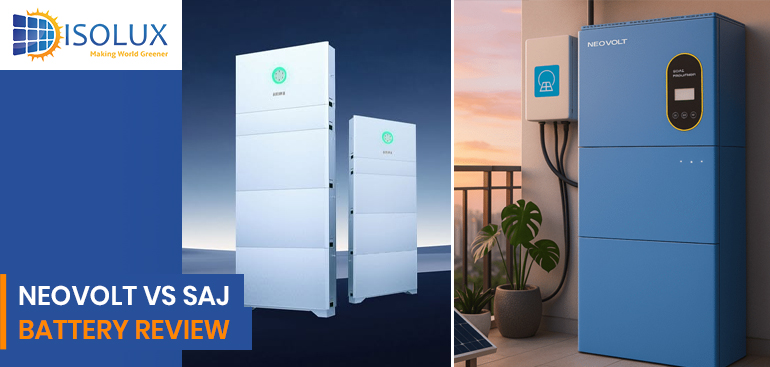

Australia’s home battery market has matured rapidly over the last few years. What was once considered a luxury add-on has become a strategic energy investment—helping households reduce grid dependence, protect against rising electricity prices, and maintain power during outages.
Two names that frequently appear in installer quotes and homeowner discussions are Neovolt and SAJ. Both brands position themselves as cost-effective lithium battery solutions, yet they appeal to slightly different buyer priorities.
In this in-depth comparison, we analyse Neovolt vs SAJ batteries from an Australian installer’s perspective—covering specifications, pricing, warranty strength, real-world performance, and long-term value. This guide is written to help homeowners make a confident, informed decision rather than chasing marketing claims.
Why Neovolt and SAJ Are Often Compared
Neovolt and SAJ share several characteristics that naturally put them side by side:
- Both offer LiFePO₄ (LFP) battery chemistry, known for safety and longevity
- Both target value-focused Australian households
- Both are commonly paired with hybrid solar inverters
- Both appear in mid-range pricing brackets, below premium brands like Tesla
However, their design philosophy, ecosystem approach, and warranty structures differ in important ways.
Brand Overview: Neovolt vs SAJ
Neovolt Battery – Brand Background
Neovolt is a relatively new name in the Australian battery space, designed to meet demand for affordable, modular home storage. Its popularity has grown quickly among installers offering competitive solar + battery packages.
Neovolt’s appeal lies in:
- Modular design that allows staged expansion
- Competitive upfront pricing
- Broad inverter compatibility
It is often selected by homeowners who want battery storage now without stretching budgets too far.
SAJ Battery – Brand Background
SAJ (Guangzhou Sanjing Electric) is a well-established global manufacturer with a strong track record in solar inverters. Unlike Neovolt, SAJ positions itself as a full ecosystem provider—offering inverters, batteries, and energy management under one brand.
Key strengths include:
- Long-standing engineering experience
- Tight integration with SAJ hybrid inverters
- Strong presence in both residential and light commercial sectors
SAJ tends to appeal to homeowners prioritising system integration and long-term reliability.
Battery Models Available in Australia
Neovolt Battery Models
Neovolt batteries are typically offered in modular low-voltage configurations suitable for most Australian homes.
Common characteristics:
- Stackable battery modules
- Typical usable capacity ranges from 5 kWh to 15+ kWh
- Designed for single-phase residential systems
Neovolt systems are often scaled to match:
- 6.6kW solar systems
- 10kW solar upgrades
- Households with moderate evening energy usage
SAJ Battery Models
SAJ batteries are designed to integrate seamlessly with SAJ hybrid inverters.
Notable traits:
- Modular expansion options
- High-voltage configurations for efficiency
- Suitable for both residential and small commercial systems
SAJ batteries are frequently installed in:
- New solar + battery packages
- Homes planning future EV or load expansion
Technical Specifications Comparison
| Feature | Neovolt Battery | SAJ Battery |
|---|---|---|
| Battery Chemistry | LiFePO₄ (LFP) | LiFePO₄ (LFP) |
| Usable Capacity | ~4.8–5 kWh per module | ~5–5.1 kWh per module |
| Depth of Discharge | Up to 90–95% | Up to 90–95% |
| Round-Trip Efficiency | ~90–92% | ~94–96% |
| Cycle Life | ~6,000 cycles | ~6,000–6,500 cycles |
| System Type | Low voltage modular | High voltage modular |
| Backup Capability | Yes (with compatible inverter) | Yes (native with SAJ hybrids) |
While both systems look similar on paper, SAJ’s high-voltage architecture typically delivers slightly better efficiency, particularly in larger systems.
Performance in Australian Conditions
Australian conditions are demanding—high summer temperatures, long daily cycling, and increasing grid instability.
From an installer perspective:
- Neovolt performs reliably in standard residential usage but relies heavily on correct inverter pairing and ventilation
- SAJ benefits from tighter inverter-battery communication, resulting in smoother charge/discharge behaviour during peak loads
Both batteries are well-suited to:
- Daily solar self-consumption
- Evening peak usage
- Backup during short grid outages
For homes in hotter regions, thermal management and installation quality play a larger role than brand alone.
Warranty, Lifespan & Degradation
| Warranty Aspect | Neovolt | SAJ |
|---|---|---|
| Product Warranty | 10 years | 10 years |
| Performance Guarantee | ~70–80% after 10 years | ~70–80% after 10 years |
| Cycle / Throughput Limit | Specified | Clearly specified |
| Expected Lifespan | 10–12 years | 12–15 years |
| Manufacturer Support | Installer-dependent | Strong OEM-backed support |
SAJ’s advantage here is clarity and structure in warranty documentation, which often translates to smoother claims if issues arise.
Inverter Compatibility & System Integration
This is where a key difference emerges.
Neovolt
Neovolt batteries are compatible with multiple inverter brands, including:
- Sungrow
- GoodWe
- Select hybrid inverter models
This flexibility makes Neovolt attractive for retrofit installations.
SAJ
SAJ batteries are optimised for SAJ hybrid inverters, resulting in:
- Cleaner system communication
- Faster backup response
- Fewer firmware conflicts
For new installations, SAJ’s integrated ecosystem can reduce long-term complexity.
Neovolt vs SAJ Battery Price in Australia
| System Size | Neovolt Installed Price | SAJ Installed Price |
|---|---|---|
| ~5 kWh | $5,500 – $7,000 | $6,500 – $8,000 |
| ~10 kWh | $9,000 – $11,500 | $10,500 – $13,000 |
| Cost per Usable kWh | Lower upfront | Slightly higher |
Neovolt generally wins on upfront affordability, while SAJ commands a premium for integration and long-term confidence.
Safety, Certifications & Compliance
Both brands:
- Are CEC-approved
- Comply with Australian electrical standards
- Use LiFePO₄ chemistry for improved fire safety
- Include battery management systems (BMS)
From a compliance standpoint, neither presents red flags when installed by an accredited professional.
Pros and Cons Summary
Neovolt – Strengths
- Lower upfront cost
- Flexible inverter compatibility
- Modular expansion
Neovolt – Limitations
- Shorter track record in Australia
- Warranty experience depends heavily on installer
SAJ – Strengths
- Strong engineering heritage
- Integrated inverter-battery ecosystem
- Clear warranty structure
SAJ – Limitations
- Higher upfront cost
- Less flexible for non-SAJ inverters
Which Battery Is Better for Your Home?
- Choose Neovolt if you want an affordable battery now and flexibility with existing solar hardware
- Choose SAJ if you value system integration, long-term support, and plan future energy upgrades
There is no universally “better” battery—only a better fit for your household’s energy goals.
Installer Insight from Isolux Solar
From real-world installations, we see:
- Neovolt suits price-sensitive homeowners entering battery storage
- SAJ delivers smoother long-term performance for integrated systems
- Installation quality matters more than brand selection alone
Correct system sizing and inverter matching are critical to long-term satisfaction.
Conclusion
Neovolt offers excellent entry-level value, while SAJ delivers engineering confidence and ecosystem reliability. Both can perform well in Australian homes when installed correctly.
The right choice depends on:
- Budget
- Existing solar setup
- Long-term energy plans
Frequently Asked Questions
Is Neovolt a good battery in Australia?
Yes, particularly for homeowners seeking affordable, modular storage with flexible inverter compatibility.
Are SAJ batteries reliable long term?
SAJ has a strong global track record, and its integrated systems often age more predictably.
Which battery is better for a 10kW solar system?
Both work well, but SAJ’s high-voltage design can offer efficiency advantages at larger capacities.
Get Expert Battery Advice
Every home’s energy profile is different. Isolux Solar assess usage patterns, solar output, and future needs before recommending a battery—ensuring long-term value, not just short-term savings.
Speak with our team today for a tailored battery recommendation built for Australian conditions.