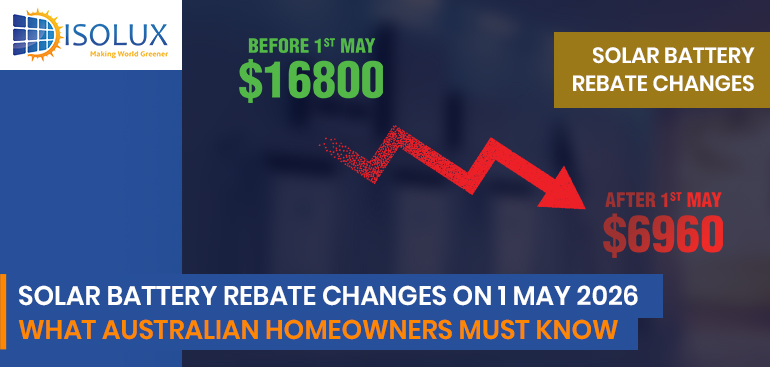

Australia’s solar battery market is about to shift in a major way. The Federal Government’s Cheaper Home Batteries Program, which has driven battery affordability since mid-2025, is introducing new rules that come into effect on 1 May 2026. These changes will directly influence how much homeowners receive as a rebate, particularly for larger battery systems. As a result, thousands of Australians are reassessing their installation plans to make sure they maximise savings before the rebate structure changes.
This guide explains exactly what is changing, how the new tiered system works, what the cost impacts look like, and whether you should install a battery before May 2026.
Why the 1 May 2026 Battery Rebate Changes Matter
The 2026 update affects everyone planning to install a battery, regardless of whether they live in New South Wales, Victoria, Queensland or South Australia. Under the current scheme, rebates apply evenly across eligible battery sizes. After 1 May 2026, the calculation becomes more selective. Smaller and mid-sized batteries will continue to receive strong incentives, but higher-capacity systems will see reduced support.
Because battery demand is rising quickly, many installers predict a surge in bookings leading up to the deadline. This trend has already been reported by several Australian energy organisations, with some installers warning of limited stock and extended wait times as the deadline approaches.
What Exactly Is Changing on 1 May 2026?
The biggest shift is the introduction of a new tiered multiplier system within the Small-scale Technology Certificate (STC) framework that governs the Cheaper Home Batteries Program. Until now, battery rebates were calculated using a single multiplier regardless of battery size. From May onwards, that multiplier will drop in stages as battery capacity increases.
This means that larger batteries will still receive a rebate, but the amount will be noticeably lower. Smaller batteries used for essential-load backup or evening energy consumption will continue to receive strong support.
The revised rules aim to encourage balanced battery sizing and ensure rebate costs remain sustainable across the next decade.
Understanding the New Tiered Battery Rebate System
The new structure divides batteries into capacity bands. As a battery becomes larger, its rebate reduction grows. This applies to the usable capacity of the battery rather than the total storage specification.
The tiers begin around the 14 kWh mark, which is now considered the “neutral” point at which rebates start to decrease. Once a system exceeds the 28 kWh threshold, the reductions become more pronounced.
This shift is designed to encourage energy-efficient home design and prevent unnecessary oversizing of battery systems. It also promotes more even grid participation during peak periods.
How the New STC Formula Works for Different Battery Sizes
Under the new framework, the STC multiplier decreases progressively. For example, a system below 14 kWh receives closer to the full rebate. A battery between 14 kWh and 28 kWh receives a reduced multiplier, while systems above 28 kWh receive the lowest multiplier of all.
Although the exact dollar value depends on the STC market price at the time of installation, the pattern is clear. Homeowners who install larger systems after May 2026 will receive significantly smaller discounts. This is particularly important for households that rely heavily on large air-conditioning systems, electric vehicle charging or multi-storey home demands.
Why Larger Batteries Receive Lower Rebates After May 2026
Large batteries, while valuable, place greater cost pressure on the rebate scheme. They are also not always necessary for typical household energy patterns. Research from Australian solar organisations indicates that most homes achieve optimal performance with a system sized around 10–15 kWh.
By reducing the rebate for oversized systems, the Federal Government aims to encourage right-sized installations and keep the program financially stable well into the future.
This ensures that the rebate remains available for more households rather than being consumed disproportionately by those investing in very large storage banks.
Real-World Cost Impact for Australian Households
The financial impact of the May 2026 changes varies depending on battery size. Smaller systems will see little change. Mid-sized systems around 10–14 kWh may experience a modest adjustment. Large systems above 28 kWh will see the most significant reduction.
As a result, homeowners planning to build whole-home backup solutions or integrate multiple energy-intensive technologies may pay several thousand dollars more if they install after May. Industry analysts have already noted an increase in quotes for larger systems as customers try to secure the higher rebate before the cut-off.
Should Australian Homeowners Install a Battery Before 1 May 2026?
If you are considering a battery installation and your preferred system is larger than 14 kWh, installing before the deadline can lock in a higher rebate. Even for mid-sized batteries, the financial difference can be meaningful, particularly when combined with rising electricity prices.
However, the decision should be based not only on rebate size but also on your home’s energy needs. Smaller households that primarily want blackout protection may not need a large system, meaning the rebate reduction will have a limited impact on them.
What Happens If You Install After May 2026?
Installing after the deadline is still worthwhile. Solar batteries continue to deliver excellent long-term value regardless of rebate levels. Nevertheless, it is important to understand that your upfront cost will increase, especially for larger systems. The new rebate structure may influence which battery model you choose, and for many households, the 10–14 kWh range will become the value sweet spot moving forward.
How the New Rules Affect Hybrid Inverters and Whole-Home Energy Systems
The rebate changes do not alter compatibility or technical requirements, but they can influence overall system design. Homeowners who want to pair large battery banks with hybrid inverters or integrate them into three-phase systems may need to reconsider capacity or staging.
Because hybrid inverters and advanced modular systems often support expansion, some households may choose a staged installation strategy to take advantage of different rebate periods. This trend is especially common in larger homes that want long-term flexibility.
Will the 2026 Changes Affect VPP Incentives or NSW Support Programs?
These changes do not alter the NSW Virtual Power Plant (VPP) incentive, which remains available in 2026 and provides additional financial benefits to households that join an approved VPP. NSW does not offer a standalone solar panel rebate, but federal STC discounts and battery incentives continue to apply.
When combined with the federal battery rebate, VPP payments create a strong overall value proposition for eligible homes. Many families use VPP participation to offset part of the long-term payback period.
The Best Battery Sizes Under the New 2026 Rebate Structure
Because rebates decline in stages after 14 kWh, the mid-range segment emerges as the most cost-effective. Many Australian installers now consider the 10–14 kWh range ideal for typical household energy patterns. This capacity covers nighttime consumption, provides reliable backup and remains aligned with the stronger part of the rebate curve.
Larger systems will still make sense for homes with heavy loads, but the reduced incentives mean that design decisions must be more deliberate.
Also Read: Best Battery Size Under the New 2026 Rebate: Why 14 kWh Is the Sweet Spot
Frequently Asked Questions About the May 2026 Battery Rebate Changes
Many homeowners want to know if their rebate will disappear completely. It will not. Instead, the rebate will change proportionally based on battery size. Other common questions relate to installation dates, booking availability and whether hybrid inverter systems will qualify. All approved battery systems that meet the program requirements will continue to receive support; only the calculation method is changing.
Conclusion
The May 2026 rebate changes introduce a new era of battery incentives in Australia. Smaller systems will continue to receive substantial support, while larger setups will face greater reductions. Homeowners considering a large battery should strongly evaluate installing before 1 May to secure the higher rebate. Those planning smaller systems will find that the financial impact is less significant.
Regardless of the timing, a solar battery remains one of the strongest long-term energy investments, especially as electricity prices continue to rise.
Get a Pre-May 2026 Battery Installation Quote with Isolux Solar
Isolux Solar is a Clean Energy Council Member and Solar Accreditation Australia certified, offering expert battery installations across Sydney, Wollongong, Blacktown, Schofields and Wagga Wagga. Our team can help you understand how the new rules affect your home and advise on the best system size for maximising both performance and rebate value.
You can request a personalised, obligation-free quote in less than 30 minutes on isolux.com.au