
Australians continue to embrace solar power to cut energy costs and reduce emissions — and 2026 has brought new updates to NSW’s solar and battery incentives, including changes to state programs and adjustments to federal rebates. While some state-based rebates have ended, new federal and NSW government solar rebate programs are making solar and battery storage more affordable than ever.
If you’re planning to install solar panels or add a solar battery system in NSW, here’s the latest information on rebates, eligibility, and how to maximise your savings this year.
2026 Update Summary
- NSW battery rebate (PDRS) ended on 30 June 2025
- Federal battery rebate continues in 2026 (~30% discount)
- Tiered battery rebate reductions start 1 May 2026
- NSW VPP battery incentive still active (up to $1,500)
- NSW no longer offers a solar panel rebate
- Solar installation discounts still available via STCs
NSW Battery Rebate Update (2026)
The NSW Peak Demand Reduction Scheme (PDRS) — which previously offered rebates of up to $2,400 for solar batteries — ended on 30 June 2025.
But there’s good news. Two new programs now help NSW residents save thousands on battery storage:
1. Federal Cheaper Home Batteries Program
The Federal Cheaper Home Batteries Program continues in 2026, offering an upfront discount of around 30% on eligible battery systems installed through approved providers.
From 1 May 2026, the rebate amount begins reducing under a new tiered framework, with larger batteries receiving smaller discounts.
For example, a $10,000 battery could qualify for a $3,000 rebate under this program.
2. NSW Virtual Power Plant (VPP) Incentive
In partnership with the federal program, the NSW Government now offers up to $1,500 for households or small businesses that connect their new battery to a Virtual Power Plant (VPP).
This means you can earn money by sharing stored energy with the grid during peak times — improving energy reliability and reducing your bills.
The NSW VPP incentive remains active in 2026, offering up to $1,500 for eligible households that connect their new battery to a Virtual Power Plant.
Solar for Apartment Residents Grant
NSW’s Solar for Apartment Residents Program supports multi-unit buildings to install shared solar systems.
Eligible strata properties and apartment residents can receive up to 50% off installation costs, helping renters and apartment owners benefit from solar energy.
Applications are open until 30 March 2026.
NSW Solar Panel Rebate 2026
NSW does not offer a standalone solar panel rebate in 2026. However, solar panels remain heavily discounted through the Federal STC program, which reduces solar installation costs by approximately $2,000–$4,000 depending on system size.
Check Your NSW Solar Rebate Eligibility
To qualify for the NSW Solar Rebate, certain criteria must be met:
1. Household income must be under $180,000 per year.
2. Property value must not exceed $3 million.
3. Install a solar system using Solar Accreditation Australia (SAA) approved components and an SAA-certified installer.
4. Low-income households also access interest-free loans or swap their annual energy rebate for a solar panel system through the Rebate Swap for Solar initiative.
Interest-Free Loans
Alongside rebates, eligible NSW homeowners can take advantage of Zero-interest loans to lower the upfront cost of installing solar systems. These loans make transitioning you to solar more budget-friendly by enabling you to spread out payments while reaping the benefits of solar energy from day one.
The solar rebate in NSW is a financial incentive designed to reduce the upfront cost of installing solar power systems. It primarily works through the Small-scale Renewable Energy Scheme (SRES) run by the federal government and is supplemented by state-based programs like in NSW Solar Rebate.
How to apply for the NSW Solar Rebate?
Step 1: First, check the NSW government’s website to see if you are eligible.
Step 2: If you are eligible, choose a SAA Accredited Licensed Solar Electrician in Sydney.
Step 3: Get a quote from solar panel installer in Sydney.
Step 4: If you are happy with the quote, go ahead and sign a contract with the installer to install the system.
Step 5: The solar panel installer will then apply for the rebate for you through the NSW government’s online portal.
Step 6: Once the rebate application is approved, the installer will deduct the rebate amount from the total cost of the solar system.
Step 7: You will then need to pay the remaining cost to the installer.
Step 8: After you make the payment, the installer will install the solar system and provide you with all the necessary documents and warranties.
Change in the NSW Solar Rebates Every year
The NSW Government continues working toward its 2050 net-zero emissions goal, but there is no state-based solar panel rebate in 2026. Instead, solar panel discounts come through the Federal Small-scale Renewable Energy Scheme (STCs).
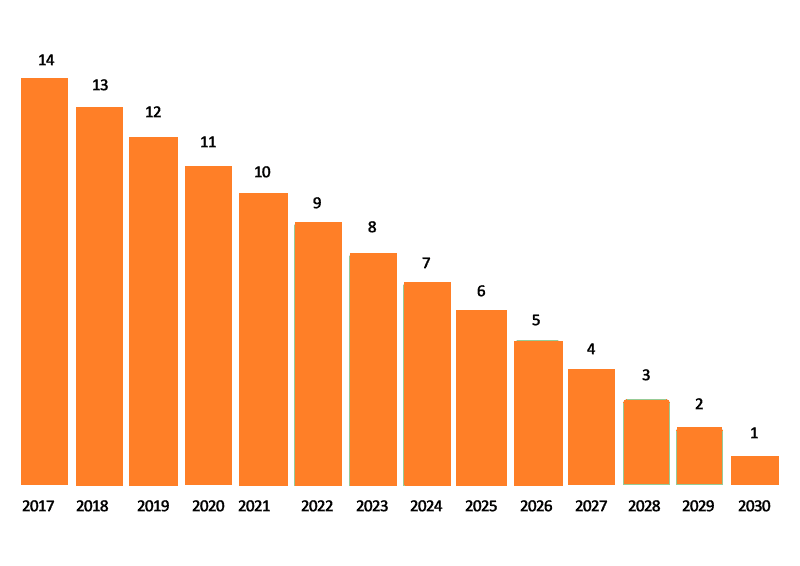
STCs reduce every year on January 1 as part of a gradual national phase-out that will finish in 2030, which means the solar discount is slightly lower each year.
If you are installing solar in 2026, your STC rebate will be lower than it was in 2025.
Solar Rebate Phase Out
As the rebate decreases by 4-5% each year, homeowners should act quickly to take advantage of current rebate and maximize savings.
Also read: When Does the Government Solar Rebate End
How Much is the NSW Solar Panel Rebate 2026
The rebate is mainly calculated through the STC (Small-scale Technology Certificates) scheme, and the value of your rebate depends on the size of your solar system and its location. The number of STCs assigned to a system is influenced by factors like system size and sunlight exposure (which is divided by zone).
Here’s an approximate estimate of the STC rebates for various solar system sizes in NSW based on current market trends (In 2026, STC values generally range between $33 and $38 depending on market conditions.):
1. 1.5kW System: $990 – $1050 (28-30 STCs)
2. 2kW System: $1320 – $1400 (38-40 STCs)
3. 3kW System: $1900 – $2100 (58-60 STCs)
4. 4kW System: $2640 – $2800 (78-80 STCs)
5. 5kW System: $3300 – $3500 (98-100 STCs)
6. 6.6kW System: $4356 – $4620 (129-132 STCs)
7. 10kW System: $6600 – $7000 (198-200 STCs)
8. 10.56kW System: $6969 – $7392 (209-212 STCs)
9. 13.2kW System: $8712 – $9240 (261-264 STCs)
These values are indicative and can fluctuate based on the STC market rate, which ranges between $35 and $40. It’s also important to note that solar rebates decreases over time as the scheme gradually phase out.

Consult with Isolux solar to get the accurate rebate estimate based on the latest STC rates.
The PDRS solar battery rebate has officially ended and is no longer available in 2026.
As of 2026, NSW’s previous battery rebate programs have ended. Battery incentives now come from the Federal Cheaper Home Batteries Program and the NSW VPP incentive.
Also read: NSW Federal Battery Rebate 2025
Benefits of adding a battery system:
- Maximizing solar power usage during non-sunlight hours
- Additional savings from feeding excess energy back into the grid
- The potential to participate in VPP schemes, further reducing electricity costs
For those without solar panel system, the incentive can be factored into the quote when installing a new solar and battery system.
What is the $7000 Solar Rebate NSW?
The NSW solar rebate program once offered up to $7,000 to help households reduce the cost of installing solar panel systems. This initiative aimed to make solar energy more accessible for New South Wales residents who used approved solar installation companies in Sydney.
However, this specific rebate is no longer available. That said, NSW homeowners can still benefit from alternative incentives, such as the federal Small-scale Technology Certificates (STCs) scheme, which provides financial support for installing eligible renewable energy systems.
This rebate remains discontinued in 2026.
Why Should You Go for Solar Power and Solar Rebate NSW?
Here are the top reasons why you should go solar and opt for the solar rebate.
1. After installing solar, you will see significant cost savings on your energy expenses.
2. You will be less exposed to a power outage as the dependency on power grids will be less.
3. You will no longer be vulnerable to abrupt increases in your energy expenses.
4. By converting to solar, you help to preserve the environment by cutting greenhouse gas emissions.
5. Installing solar panels on your home will dramatically raise the value of your property.
Solar power is often an attractive choice for the people of New South Wales. It is conceivable to recoup the cost of a solar panel system in five years.
Now that you know how solar rebates work, it is the best time to take advantage of the rebate scheme. If you’re thinking about making changes to your energy use, the solar rebate can help you become less susceptible to fluctuating energy prices.
Get a free quote if you’re looking to install a solar panel system with a battery in Sydney. We’ll help you access both the NSW rebate and the federal rebate to save on your initial investment.
FAQs About NSW Solar Rebates 2026
1. Is there still a NSW solar rebate in 2026?
There is no NSW-specific solar panel rebate in 2026, but homeowners still qualify for the Federal STC rebate, the Federal battery rebate and the NSW VPP incentive.
2. How much can I save on a battery?
Eligible households can get up to 30% off under the Cheaper Home Batteries Program plus $1,500 through the NSW VPP incentive.
3. Can I claim both solar and battery rebates?
Absolutely. You can combine STC solar incentives with battery rebates for maximum savings.
4. Are rebates automatically applied?
Yes — accredited installers like Isolux Solar handle all rebate paperwork and apply discounts upfront.
Also read: