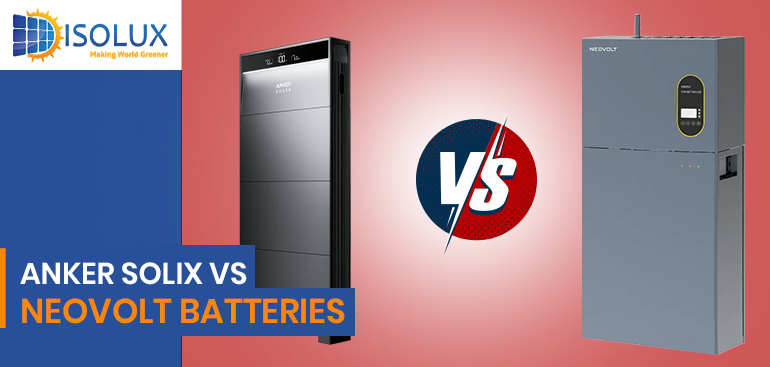

As households across Australia move toward solar plus storage, choosing the right battery system is one of the most critical decisions. Among the newer contenders, Anker Solix (especially the X1 series) and Neovolt / NeoVolta are gaining attention. But which one suits your home better? In this article, we compare their technology, performance, pros and cons, and real-world fit in Australian settings.
Anker Solix (X1 Series)
The Anker SOLIX X1 is a modular energy storage system that allows scaling from small home setups up to large capacities. Each module combines power and battery elements via an internal “energy optimizer,” enabling independent charging/discharging of modules. The system supports both AC-coupled and hybrid/three-phase configurations for flexibility in new or retrofit installations.
One module typically offers 5 kWh capacity as a base unit. Systems can scale up (e.g. multiple modules) to reach tens or even hundreds of kWh. Anker claims round-trip efficiency and smart control via app for energy modes (self-consumption, time-of-use, off-grid etc.).
Neovolt / NeoVolta Battery Systems
Neovolt (or sometimes marketed “NeoVolta”) is a battery + inverter combination typically offered as an integrated “all-in-one” unit. For example, a common model is a 10 kWh battery with a 5 kW inverter combined into a single device. Neovolt (via VoltX Energy in Australia) also supports parallel connection—multiple units can be linked for greater capacity.
In terms of battery chemistry, Neovolt uses LiFePO₄ (lithium iron phosphate), known for better thermal stability, safety, and longer cycle life. The system supports dual MPPT inputs and typically delivers continuous output ~5 kW, with peak (surge) capabilities around 7.36 kW or 10 kW depending on the model. Switchover to backup mode during grid outage is fast—about ~20 ms in many cases.
Neovolt also offers modular capacity variants (10 kWh, 20 kWh, 30 kWh etc.) for different home sizes.
Spec & Performance Comparison
Here’s a comparative look at key performance metrics and technical specs in the Australian context:
| Feature | Anker Solix (X1) | Neovolt |
| Base Module / Capacity | 5 kWh per module, scalable upward | 10 kWh (≈9.6 kWh usable) unit, modular stacking possible |
| Inverter / Coupling Design | Hybrid options, AC and hybrid configurations / three-phase support | Integrated inverter (5 kW typical) built into unit |
| Continuous Output / Back-up | Varies by module count and configuration; supports high outputs in multi-module setups | Typically 5 kW continuous (AC) with surge capacity ~7.36–10 kW |
| Efficiency / Round-Trip | Claimed high efficiency (Anker mentions smart modes to reduce losses) | Efficiency over 90% in many configurations (LiFePO₄ chemistry helps) |
| Switchover Time (Backup) | Very fast — claims <10 ms or <20 ms depending on mode | ~20 ms in many models |
| Operating Temp / Environment | Designed for harsh conditions, maintain 100% power in hot/cold extremes in claims | Operating discharge/charge ranges ~–10 °C to +50 °C (depending on model) |
| Warranty | 10 years typical (subject to terms) | 10 years for performance / product in many offerings |
| Scalability / Modularity | Very modular; can grow in small increments (5 kWh modules) | Can parallel multiple Neovolt units (e.g. up to 6) for bigger capacity |
| Key Advantages | Flexibility, modular expansion, smart modes, integration options | Simplicity (all-in-one), solid backup performance, established chemistry |
Strengths, Weaknesses & Best Use Cases
Why You Might Choose Anker Solix (X1)
- Flexible scaling — You can start with a smaller system and grow module by module, reducing initial capital burden.
- Configurable architecture — With hybrid and multi-phase support, it’s suitable for both new installs and retrofits.
- Smart energy control — The Anker app and energy modes help you optimize how and when energy is stored or discharged.
- Resilience in extreme conditions — Built to maintain capacity across heat/cold extremes.
- Strong brand backing — Anker is a globally known electronics brand expanding into home energy systems.
Potential Drawbacks / Watchouts:
- To get a high continuous output, you’ll often need multiple modules, which increases cost.
- As a newer system in Australia, installer familiarity and local support may be less mature (relative to incumbents).
- Efficiency claims depend heavily on system design and matching to solar input, so real-world results might differ.
Why You Might Choose Neovolt
- All-in-one simplicity — The battery and inverter are combined, reducing parts count, wiring, and potential points of failure.
- Proven chemistry — LiFePO₄ is stable, safer, and has good cycle life.
- Parallel expansion — You can link up multiple units for higher capacity while keeping modular flexibility.
- Good backup performance — Reliable switchover times and decent surge output make it effective during blackouts.
- Strong market presence for this product class — Greater awareness in the all-in-one battery niche.
Potential drawbacks / watchouts:
- The fixed inverter size (e.g. 5 kW) may limit how much load you can run during outages unless you scale with more units.
- Efficiency losses can be higher in AC-coupled systems (depending on system design).
- Larger homes or high-demand users may require several units or dealing with more complexity in parallel linking.
Decision Criteria — What Matters Most
Here are key factors you should consider when choosing between Anker Solix and Neovolt (or any battery system):
- Your load profile / backup needs
If you want to run high-power appliances (air conditioners, pumps, EV chargers) during outages, you’ll need higher continuous and surge capacity. - Growth and future scaling
If you anticipate increasing your demand (e.g. buying an EV, adding loads), modular or parallel capacity options become more valuable. - Ease of installation and compatibility
If you already have a solar setup, adding a modular battery like Anker Solix may integrate more flexibly. Neovolt’s all-in-one can simplify new installs. - Efficiency and energy losses
Look into round-trip losses, conversion steps (AC ↔ DC), inverter overheads — over years, these losses add up. - Support, warranty & local service
A strong local solar installer network, responsive support, and robust warranty terms matter a lot in maintaining system reliability. - Cost vs value
Upfront costs are important, but also look at the payback, rebate schemes, and how much energy you’ll realistically shift or save.
Conclusion
Anker Solix (X1) and Neovolt / NeoVolta batteries both offer strong propositions for Aussie homes, but their strengths differ. Anker Solix shines in modular flexibility and scalable architectures, while Neovolt appeals for its compact all-in-one design and straightforward expansion. The best choice depends on your energy goals, loads, and budget.
At Isolux Solar, we help households choose and implement the right solar panel system tailored to your roof, consumption patterns, and local conditions.
Want to know which battery fits you best?
Get a free quote from Isolux Solar today, and let our expert team guide your solar + storage journey.