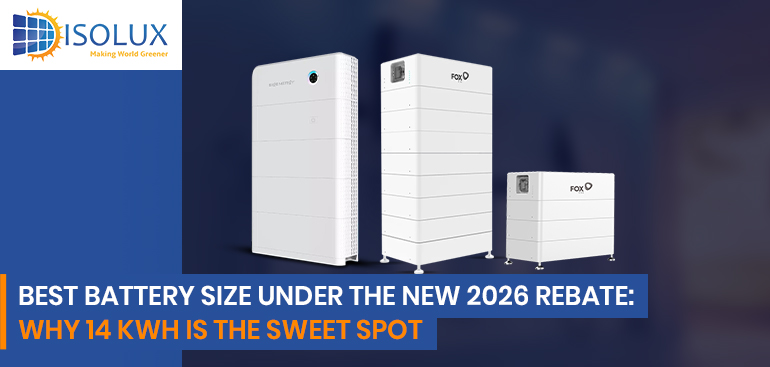

Australia’s solar battery rebates are changing from 1 May 2026, and these updates have created a clear shift in which battery sizes offer the best financial return. Thanks to the Federal Government’s new tiered rebate structure, the most cost-effective batteries for Australian households fall between 10 kWh and 14 kWh of usable capacity. This range not only attracts the highest rebate but also delivers practical daily performance for most homes.
If you’re planning to install a battery in 2026, understanding why the 14 kWh threshold matters will help you avoid overpaying and ensure your investment continues working in your favour.
How the 2026 Rebate Changes Affect Battery Sizing
The Cheaper Home Batteries Program, introduced in 2025, remains active, but its structure becomes more targeted in 2026. Instead of a flat rebate calculation, the updated rules apply different rebate levels depending on the battery’s usable capacity. Because most Australian households share similar energy profiles, these sizing rules directly influence which battery models deliver the best value over time.
The rebate does not disappear, but the amount shifts based on the battery’s size. As a result, selecting the right capacity has become far more important than in previous years.
You might also like this: NSW Battery Rebate Update 2026
Why the Federal Government Introduced These New Rules
The updated rebate structure is designed to prevent oversized systems from absorbing most of the available funding. Government modelling shows that many homeowners install more storage capacity than they genuinely need, either due to future planning or a misunderstanding of daily energy usage. This leads to larger systems receiving disproportionately large rebates compared to their real-world benefit.
By reshaping the incentive into tiers, the government encourages households to choose an energy-efficient battery size while still supporting those who need larger systems.
Also Read: Solar Battery Rebate Changes on 1 May 2026: What Australian Homeowners Must Know
Understanding the New Tiered Rebate System in 2026
The 2026 rebate system divides eligible battery capacities into several bands. Batteries up to 14 kWh receive the strongest incentive because they align with an average household’s overnight energy consumption. Once the battery exceeds 14 kWh, the rebate reduces sharply and continues to fall as capacity increases.
This structure still rewards larger systems, but the support is no longer proportional to size. It encourages right-sized installations and ensures rebate funding remains sustainable for years to come.
You may find this helpful: 2026 Tiered Battery Rebate Guide: New STC Rules Explained
How Battery Capacity Influences Your Rebate Value After 1 May 2026
The new formula prioritises energy efficiency. Smaller and mid-sized batteries retain the majority of the rebate value, while larger systems move into lower rebate categories. This means the installation date directly impacts your total rebate amount because the multiplier applied after May differs from the one used beforehand.
The rebate is locked in when the Certificate of Compliance is issued, not when the contract is signed. This makes timing especially important for households trying to secure a higher rebate before the change.
Why 14 kWh Is the Sweet Spot Under the 2026 Rules
A battery size of up to 14 kWh sits in the optimum tier because it matches the full STC (Small-scale Technology Certificate) factor. This effectively gives homeowners access to the maximum incentive available after the new rules take effect. It also aligns closely with the energy needs of a typical Australian home, which usually consumes most of its electricity in the evening and early morning.
This capacity provides a practical balance. It is large enough to power essential loads and support comfortable evening living while avoiding wasted storage that might never be fully utilised. Because of this, the 14 kWh mark is both financially and functionally efficient.
What a 10–14 kWh Battery Delivers in a Typical Australian Home
For most three- or four-bedroom homes with a solar system between 5 kW and 8 kW, a mid-range battery provides reliable energy storage without needing additional modules. It covers cooking, refrigeration, lighting, entertainment systems and moderate air-conditioning for several hours. It also offers enough backup power to maintain comfort during unexpected outages.
Because the energy stored in a 10–14 kWh system is usually used every night, it tends to cycle efficiently and deliver a quicker return on investment.
Popular Batteries That Fit Within the Sweet Spot
Many leading battery manufacturers already design their most popular models in this range. Examples include the Tesla Powerwall 2 and 3, Alpha ESS Smile5, Sungrow SBR128 and BYD Battery-Box HVS. These models have earned strong reputations for performance, reliability and compatibility with hybrid inverter systems across Australia.
This widespread availability makes it easier for homeowners to compare options and choose a system that suits their installation preferences and budget.
Why Larger Batteries Lose More Rebate After May 2026
Batteries above 14 kWh fall into a lower rebate bracket, and systems between 14.1 kWh and 28 kWh receive a significantly reduced incentive. Once a battery surpasses 28 kWh, the rebate shrinks again, and anything above 50 kWh receives no additional rebate at all.
These reductions are designed to support fair access to the program while reducing the subsidising of oversized systems that most homes will never fully use.
The Cost Difference Before and After 1 May 2026 for Larger Systems
Homeowners opting for systems in the 28 kWh to 50 kWh range may see the rebate drop by several thousand dollars if the installation occurs after the new rules come into effect. This difference can be substantial for large families or households that plan to integrate electric vehicle charging, pool pumps or ducted air-conditioning into their solar ecosystem.
Although the rebate reduction is significant, these households may still benefit from larger storage sizes depending on their daily usage patterns.
Should You Avoid Large Batteries Now? When Bigger Still Makes Sense
Some homes genuinely need more than 14 kWh. This includes properties with multiple air-conditioning units, large entertainment systems, high daily electricity use or off-grid lifestyle requirements. Households planning to install or charge an electric vehicle may also benefit from a larger capacity.
In these situations, the reduced rebate does not undermine the value of a large system. Instead, it highlights the importance of careful planning so that capacity aligns directly with real-world needs.
How Modular Batteries Help You Stay Rebate-Optimised
Several popular battery brands offer modular designs that let homeowners start with a mid-range configuration and expand later as usage increases. These modular options allow households to benefit from lower upfront costs and the full rebate available for initial installation, while still leaving room for future growth.
Because additional modules installed later may also qualify for rebates at the time of expansion, modular systems provide long-term flexibility without forcing homeowners into oversized systems today.
How to Choose the Right Battery Size for Your Home
Selecting the ideal battery capacity depends on your energy usage, household size, daily habits and backup expectations. A detailed load assessment performed by your installer can help identify the best fit. Most Australian households fall comfortably within the 10–14 kWh sweet spot, while homes with greater demands may require a more customised approach.
By aligning your battery size with your usage patterns, you ensure that the storage you pay for is the storage you actually use.
Installation Date and Compliance: Why Timing Determines Your Rebate
The rebate amount is determined by the date your installation receives its Certificate of Compliance. This means installation delays, stock shortages or grid approval processes can affect your rebate outcome. Homeowners who want the maximum incentive for larger systems should move early to avoid missing the deadline.
Installers across Australia have already reported increased demand for pre-May installations, making early scheduling important.
Conclusion
The updated rebate rules make the 10–14 kWh range the most efficient and economical choice for many households. This size hits the financial sweet spot by securing the highest rebate tier, while also aligning naturally with evening consumption patterns and typical energy habits in Australian homes.
Larger systems still have value, but the financial advantage decreases sharply after the 14 kWh threshold. By selecting a battery that fits within this optimal range, homeowners strike the right balance between cost, performance and long-term value.
Get Expert Battery Sizing and Rebate Guidance with Isolux Solar
Isolux Solar is Solar Accreditation Australia certified and a Clean Energy Council Member, offering professional battery installations across Sydney, Wollongong, Wagga Wagga, Blacktown, Schofields and surrounding regions. Our specialists can assess your daily energy usage, explain the new rebate rules and recommend the best battery size for your home.
You can request a personalised quote in under thirty minutes at isolux.com.au