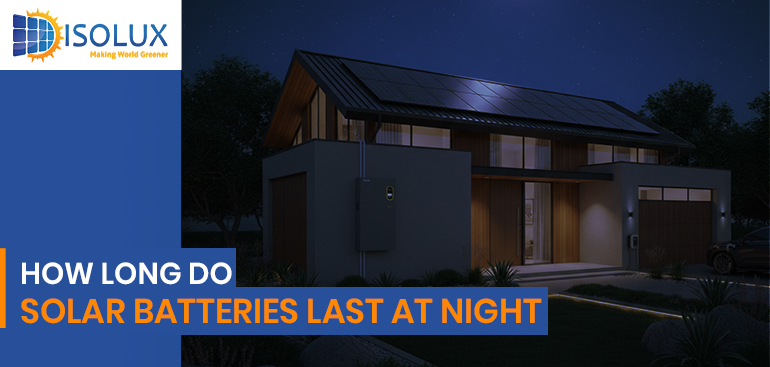

As more Australian households embrace solar energy, understanding how long solar batteries can power your home at night is crucial. Nighttime energy storage determines whether you can fully rely on your solar battery after the sun goes down, especially during peak evening usage or unexpected outages. Let’s explores the factors affecting battery runtime, real-world performance, and tips to get the most out of your system.
Solar batteries typically last 8–12 hours at night for an average Australian home, depending on battery capacity, depth of discharge, efficiency, and household energy consumption. Larger batteries or lower nighttime usage can extend this duration.
Understanding Solar Battery Runtime at Night
The duration a solar battery can supply power overnight depends on battery capacity, household energy consumption, efficiency, and environmental conditions. Unlike daytime, when solar panels produce electricity, at night your home depends entirely on stored energy.
1. Battery Capacity
Battery capacity, measured in kilowatt-hours (kWh), represents the total energy the battery can store. A larger battery capacity naturally provides longer runtime. For example, a 5 kWh battery can power small households for a few hours, while a 13–15 kWh battery can meet the energy needs of a larger home through the night.
2. Depth of Discharge (DoD)
Depth of Discharge indicates how much of the battery’s stored energy can safely be used without harming its lifespan. For example, a battery with 90% DoD allows you to use most of its capacity, while preserving longevity. Using more than the recommended DoD can shorten the battery’s operational life.
3. Efficiency of the Battery
No battery is 100% efficient. Conversion losses occur when storing and drawing energy. Modern lithium-ion batteries typically have round-trip efficiencies of 90–98%, meaning nearly all stored energy is usable. Lower efficiency batteries, such as older lead-acid types, lose more energy and last fewer hours overnight.
4. Household Energy Consumption
Nighttime energy usage varies by household size, number of appliances, and lifestyle. In Australia, the average home consumes about 16 kWh per day, with roughly 8–9 kWh used at night. Homes with high appliance usage, EV chargers, or heating/cooling demands may deplete batteries faster.
Estimating How Long a Solar Battery Lasts at Night
You can estimate battery runtime using this formula:
Battery Runtime (hours) = (Battery Capacity × DoD × Efficiency) ÷ Nighttime Energy Consumption
For example:
- Battery: 10 kWh
- DoD: 90%
- Efficiency: 95%
- Nighttime Consumption: 8 kWh
Calculation: (10 × 0.9 × 0.95) ÷ 8 ≈ 1.07 nights of power
This shows that a 10 kWh battery can almost fully power an average Australian home overnight, but high-energy-use households may require multiple batteries or larger capacities.
Comparing Common Battery Sizes for Australian Homes
| Battery Size (kWh) | Usable Capacity (kWh) | Average Nighttime Consumption (kWh) | Approximate Runtime (hours) | Ideal Household Type |
| 5 | 4.5 | 8 | 5.3 | Small households, couples |
| 10 | 9 | 8 | 10.7 | Average Australian home |
| 13 | 11.7 | 8 | 13.9 | Larger families or high appliance usage |
| 15 | 13.5 | 8 | 16.1 | Homes with EV charging or night-time heavy usage |
Pro tip: Battery runtime is directly affected by usage patterns. Turning off non-essential appliances at night can extend battery life significantly.
Real-World Factors Affecting Battery Performance at Night
1. Temperature and Climate
Australian climates vary widely—from hot Northern Territory summers to cold Tasmanian winters. Extreme temperatures can reduce battery efficiency. Lithium-ion batteries generally perform best between 20–25°C, with efficiency dropping in extreme heat or cold.
2. Age of Battery
Battery performance degrades over time. Most modern lithium-ion solar batteries retain 80% of their capacity after 10 years. An older battery may last fewer hours at night than a new one.
3. Load Management
High-demand appliances like air conditioners, electric heaters, or EV chargers can quickly deplete a battery. Using smart energy management systems or timers can optimize nighttime usage.
Tips to Maximise Your Solar Battery’s Nighttime Performance
- Choose the Right Battery Size: Assess your nighttime energy usage before installation. Oversizing may be unnecessary, while undersizing leads to early depletion.
- Energy-Efficient Appliances: Switch to LED lighting, energy-saving fridges, or smart plugs to reduce consumption.
- Use Smart Load Shifting: Schedule heavy appliance usage during the day when solar panels are producing energy.
- Regular Maintenance: Check connections, ensure proper ventilation, and monitor battery health through the management app.
Can Solar Batteries Power a Home All Night?
With the right battery size and efficient energy management, modern lithium-ion batteries can power an average Australian home throughout the night. For instance:
- 10 kWh battery: Powers a standard 2–4 person home overnight (up to ~10 hours).
- 13–15 kWh battery: Can support larger homes or households with higher nighttime electricity needs, potentially even for homes with EV charging.
Homes in areas with longer nights in winter or higher energy demands may require stacking multiple batteries or combining battery storage with grid support.
Conclusion
Understanding how long a solar battery lasts at night is essential for Australian homeowners aiming to maximize their energy independence and reduce bills. Factors like battery capacity, DoD, efficiency, household consumption, and climate all influence nighttime runtime.
Isolux Solar help Australian homeowners select the right solar battery system, tailored to their home’s energy needs. From sizing to installation and energy management, we provide end-to-end support to ensure your solar investment delivers reliable power throughout the night. Get a free quote from Isolux Solar today and find the battery solution that keeps your home powered from sunset to sunrise.