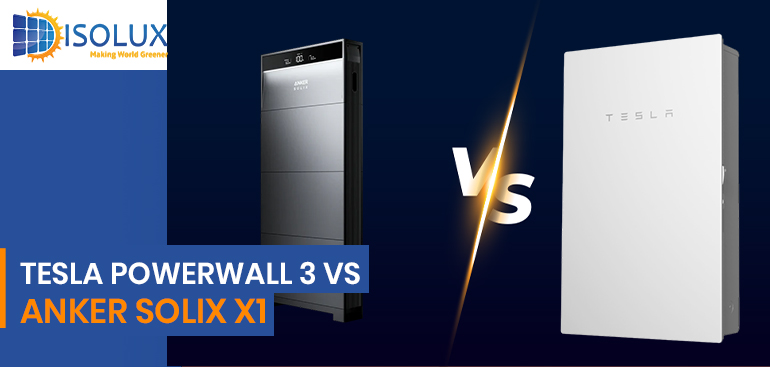

In the rapidly evolving home energy storage market, choosing the right battery system can be confusing. Two strong contenders in 2025 are Tesla Powerwall 3 and Anker’s Solix X1. Both offer modern features, scalability, and support for solar integration—but which one is the better fit for Australian households?
In this comparison, we break down their specs, strengths and trade-offs, costs, use cases, and decision factors to help homeowners make an informed choice.
Overview
Tesla Powerwall 3
Tesla’s latest home battery is an all-in-one unit combining storage and inverter in a single package. It is designed specifically for solar integration and backup with a focus on efficiency and modular scalability.
Anker Solix X1
Anker Solix X1 is a modular, stackable battery system targeted at residential solar users. It uses an AC-coupled architecture (with hybrid/dual coupling options), allowing both retrofits and new installs.
Spec Comparison & Performance
Here’s a side-by-side look at core specs (typical Australian conditions where available):
| Feature | Tesla Powerwall 3 | Anker Solix X1 |
| Usable Storage Capacity | 13.5 kWh per unit | Modular: 5 kWh increments (5 to 30 kWh in typical residential stacks) |
| Continuous AC Output | Up to 11.04 kW (often configured to 10 kW in practice) | Up to 6 kW for single-phase setups; higher with parallel / three-phase stacks |
| Inverter / Coupling Design | Integrated inverter (DC coupling) built in | Primarily AC-coupled; hybrid / DC coupling options via compatible inverters |
| Efficiency / Round-Trip | ~89 % (solar → battery → home/grid) | Up to ~90.2 % (vendor claim) |
| Operating Temperature Range | –20 °C to 50 °C | –20 °C to 55 °C (vendor spec) |
| Ingress / Outdoor Rating | IP55 for wiring compartment; battery & power electronics rated IP67 | IP66 (dust and water resistant) |
| Scalability / Stacking | Up to 4 units (≈ 54 kWh) in many markets | Much higher stacking potential (some sources suggest capacity up to 180 kWh in commercial setups) |
| Backup / Switchover Time | Seamless switching; backup support via Tesla’s Backup Gateway | <10 ms switchover to backup for essential circuits |
| Warranty | 10 years (subject to local terms) | 10 years typically (check local distributor terms) |
Strengths, Weaknesses & Use Cases
Tesla Powerwall 3: Pros & Considerations
Pros
- Integrated inverter and battery: Reduces component count, simplifies installation, and improves efficiency via DC coupling.
- High output: The ability to deliver ~11 kW continuous makes it capable of running heavier loads (e.g. air conditioning, pool pumps) more comfortably.
- Proven brand & support: Tesla has strong brand presence, installer network, and reputation for software updates and system support in Australia.
- Flood resilience: The unit is designed to handle submersion up to ~0.6 m, which is valuable in flood-prone areas.
- Scalable in real systems: The ability to stack multiple units allows expansion over time.
Considerations / Potential Weaknesses
- Cost premium: As a premium product, the upfront cost (hardware + installation) may be higher compared to emerging brands.
- Grid / policy constraints: In Australia, network limits (e.g. local energy distributor rules) may constrain operating power to 10 kW rather than the full 11.04 kW in practice.
- Warranty / performance degradation: Over 10 years, usable capacity may decline — typical warranties often guarantee a remaining percentage (check the fine print).
- Control / interoperability: Tesla Powerwall control over how its battery interacts with third parties or grid services has drawn scrutiny in Australia.
Best Use Cases
- Homes that want a sleek, all-in-one solution with minimal additional components.
- Those planning to run high-draw appliances (e.g., AC, pool pumps) during outages.
- Users who value brand reputation, network integration, and long-term software support.
Anker Solix X1: Pros & Considerations
Pros
- Modular scalability: Start small (5 kWh) and expand in 5 kWh increments. This makes it more budget-friendly for staged expansion.
- Flexible coupling: The primary AC-coupled design makes it easier to retrofit to existing solar installations. Hybrid/DC options offer more design flexibility.
- Good ingress rating: IP66 rating allows installation outdoors with protection from dust and low-pressure water.
- Affordable entry point: Compared to premium brands, Anker often competes more aggressively on price.
- Emerging installer support: As a newer entrant, more installers are likely to offer their product as part of competitive quotes.
Considerations / Challenges
- Lower single-unit power output: The 6 kW AC limit may restrict how many heavy loads can run concurrently during outages.
- Newer to the Aussie market: Being a more recent entrant, long-term performance, support, and local service network are still maturing.
- Efficiency slightly lower: While good, efficiency may lag a fully integrated design under some use patterns.
- Warranty & degradation clarity: Given its novelty, pay attention to the terms — cycle life limits, guaranteed capacity retention, etc.
- Switchover & control: Although backup switching is <10 ms, the implementation depends on your inverter and system design.
Best Use Cases
- Homeowners wanting to start with a modest battery and expand later without over-investment.
- Existing solar systems where AC coupling is more practical or cost-effective.
- Buyers who prefer system flexibility and price competitiveness over premium brand.
Cost & Return on Investment (ROI)
Estimating cost is complex because it depends on system size, local solar panel installer rates, rebates, and grid tariffs. However:
- The Anker Solix X1 (5 kWh base module) is often quoted in the range AUD $5,500 to $6,500 (excluding subsidies or full installation) in Australia.
- For higher capacities (10-15 kWh stacks), pricing scales accordingly, though economies of scale may reduce cost per kWh.
- The Tesla Powerwall 3 (hardware + installation) tends to come at a premium, partly due to its integrated inverter, brand, and market positioning. Some installer quotes in Australia suggest significantly higher total package costs (though precise publicly listed quotes are less common).
The real value lies in how much grid usage and peak-tariff electricity the battery displaces, as well as how often backup power is used. In many Australian households, a well-sized 10–15 kWh battery paired with solar can significantly reduce evening grid draw and thus lower bills.
Note: Always check current Federal Rebate and State battery incentives, rebates, and grant schemes (e.g. battery storage discounts under state solar programs). These can tilt the ROI equation substantially.
Decision Factors: What to Prioritise
When comparing, think through your priorities. Here are questions to guide your decision:
- Load demands during outages
If you need to run heavy loads (air conditioning, electric heating, pool pumps), the higher continuous output of Tesla Powerwall 3 can give more headroom. - Scalability & future expansion
If you prefer to scale over time, the modular nature of Solix X1 gives you flexibility to add in chunks. - Existing solar system compatibility
If you already have a solar setup, an AC-coupled system like Solix may be simpler to retrofit. The Powerwall 3’s integrated inverter is ideal for new systems. - Budget constraints
If your budget is tight, starting with a smaller Solix module and upgrading later might be more feasible than the upfront cost of a full Tesla Powerwall 3 setup. - Warranty & support confidence
Tesla has a long track record and a strong installer network in Australia, which can mean better peace of mind. Anker is newer locally, so verify warranty coverage, service support, and installer guarantees in your region. - Grid policy & rebates
Local energy network constraints, export limits, and rebate eligibility can affect how much you benefit from battery storage. Tesla’s control over grid interaction has raised regulatory discussion in Australia.
Conclusion
Both Tesla Powerwall 3 and Anker Solix X1 are excellent choices for Australian homeowners, but the right option depends on your needs. If you want a powerful, all-in-one solution with higher output and long-term brand reliability, the Tesla Powerwall 3 stands out. On the other hand, if you’re looking for flexibility, scalability, and a more budget-friendly entry point, the Anker Solix X1 is a strong contender.
At Isolux Solar, we specialise in helping Australians find the perfect solar and battery solution tailored to their home, energy usage, and budget. Whether you’re considering Tesla or Anker, our expert team can guide you through the process, ensure proper installation, and maximise your return on investment.
Ready to make the switch?
Get your free quote from Isolux Solar today and take the first step towards smarter, more reliable energy storage.